As the Iran conflict approaches the two-week mark following the US-Israeli strikes on 28 February, Oil markets are bracing for what analysts are increasingly describing as a potential “super shock.”
The Islamic Revolutionary Guard Corps has repeatedly warned that Oil prices could surge toward $200 a barrel if tensions escalate around the Strait of Hormuz – the world’s most important Oil transit chokepoint.
For many traders, the number still sounds extreme. Yet the speed of the current move is already rewriting the rulebook.
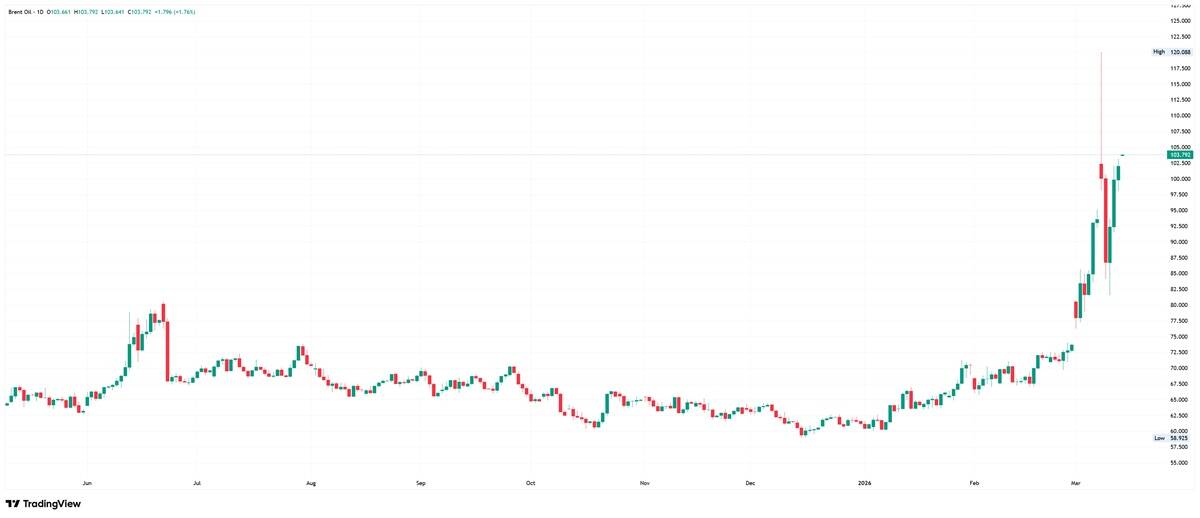
This week alone Oil prices staged their most aggressive rally yet, with Brent Crude soaring toward $120 a barrel while WTI crude surged above $118. Prices are now up an extraordinary 79% this month – on track for the largest monthly gain in the history of the Oil market. The move follows a 35% surge last week, the largest weekly gain on record going back to 1982.
Suddenly, the question facing traders is no longer whether the market is tightening. It is how large the shock could become.

The Largest Supply Shock in Modern Energy History
At the heart of the surge lies a disruption of unprecedented scale.
With tanker traffic through the Strait of Hormuz effectively at a standstill, global markets are facing the potential loss of nearly 20 million barrels per day of Oil supply. That represents roughly one-fifth of the world’s total petroleum consumption flowing through a waterway just 21 miles wide.
To put the magnitude into perspective, the Iranian Revolution in 1978 removed around 5.5 million barrels per day from global supply. The 1973 Yom Kippur War triggered a disruption of roughly 4.5 million barrels per day, while the Gulf War in 1990 removed approximately 4.3 million barrels.
Today’s disruption is roughly the size of the five largest historic Oil shocks combined.
“This is not a routine geopolitical headline,” explains Lars Hansen, Head of Research at The Gold & Silver Club. “When you remove this amount of supply from global markets, the system simply cannot absorb it without a dramatic repricing. The scale of the shock now hitting the energy market is something traders have not experienced for decades.”
Only around 2.6 million barrels per day can realistically bypass the Strait through alternative pipeline routes. In other words, the global system currently has no meaningful replacement for the missing supply.
Major Wall Street banks are now beginning to model extreme scenarios. Analysts at Deutsche Bank suggest a full blockade could push crude toward $200 a barrel, while JPMorgan estimates that if disruptions persist for more than three weeks Brent could surge into the $130-$150 range as Gulf storage fills and production is forced to shut down.
Brent Oil Price Forecast
Every new Brent Oil analysis as it publishes, today's technical signal and key levels, live price — on one page.
See all Brent Oil forecastsWhen Oil, Gold and Silver Rise Together
What makes the current moment particularly dangerous is that the global financial system was already fragile before the energy shock arrived.
Debt levels across major economies remain historically high. Inflation has proven far more persistent than central banks expected. Bond yields remain elevated while liquidity conditions are tightening across financial markets.
Now the energy shock is beginning to ripple through the entire system.
Oil typically moves first. Inflation expectations follow. Borrowing costs rise. And the pressure then spreads into equities, bonds, real-estate and cryptocurrencies simultaneously.
“When Oil, Gold and Silver start rising together like this, the market is not saying everything is fine,” Hansen explains. “It’s signalling that the system is beginning to price something much bigger than geopolitics. It’s pricing an inflation shock and a potential loss of confidence across the financial system.”
Europe is already feeling the first wave of pressure. Gas prices have surged nearly 90% in less than a week following disruptions to regional energy flows, raising fears of another industrial energy crunch only four years after the Russia-Ukraine crisis.
Inflation, Interest Rates, and The Next Phase of the Shock
If Oil prices remain elevated, the consequences for inflation could be severe.
Energy costs feed into almost every part of the global economy – from transport and manufacturing to food and electricity prices. Some economists now estimate that a sustained surge in Oil could push U.S CPI inflation back toward 5%, levels last seen in 2023 when the Federal Reserve was aggressively raising interest rates.
That shift is already appearing in bond markets. For the first time this year, a rate cut in 2026 is no longer fully priced. Instead, traders are beginning to question whether global central banks will be forced to hike interest rates in response to the Iran war as Oil prices reignite inflationary pressures.
“The market entered this crisis underestimating the scale of the shock,” says Hansen. “That is precisely how major Commodity Supercycles begin – under-owned, underestimated and dismissed until price forces recognition.”
The Early Stages of a New Energy Supercycle?
History offers a useful guide.
Following major geopolitical shocks over the past 90 years, Oil has consistently emerged as the best performing asset in the months that follow, often accompanied by powerful rallies in Gold and Industrial metals.
This time the structural forces may be even larger.
Artificial intelligence infrastructure, electrification, reindustrialisation and energy security are all driving enormous demand for energy and critical resources. Yet capital investment in the sector has lagged for years.
“That imbalance is starting to matter,” Hansen argues. “Oil today resembles where Gold was eighteen months before its historic breakout – quietly building pressure beneath the surface before the move everyone eventually sees.”
The opportunity, he argues, is increasingly visible in tanker routes, storage capacity and global demand data.
Measured in barrels rather than headlines.
And if the current disruption evolves into a prolonged energy shock, $200 Oil may not be the ceiling – it may simply be the next milestone.
History shows the biggest moves in Commodities reward those positioned early. The only question now is: will you be one of them?