
The Australian Dollar is edging higher against its U.S. counterpart early Tuesday after sinking the previous session on concerns about unrest over COVID-19 restrictions in China and hawkish comments from a prominent Federal Reserve official.
At 01:48 GMT, the AUDUSD is trading .6666, up 0.0013 or 0.20%. On Monday, the Invesco CurrencyShares Australian Dollar Trust ETF (FXA) settled at $65.80, down $0.96 or -1.44%.
The Aussie’s gains are being capped amid rising risk aversion, as stringent virus curbs in China triggered clashes in many cities, including Beijing.
The Australian currency was also pressured by a stronger US Dollar, which rebounded on Monday after St. Louis Fed President James Bullard said the Federal Reserve needs to raise interest rates quite a bit further and then hold them there throughout next year and into 2024 to gain control of inflation and bring it back down toward the U.S. central bank’s 2% goal.

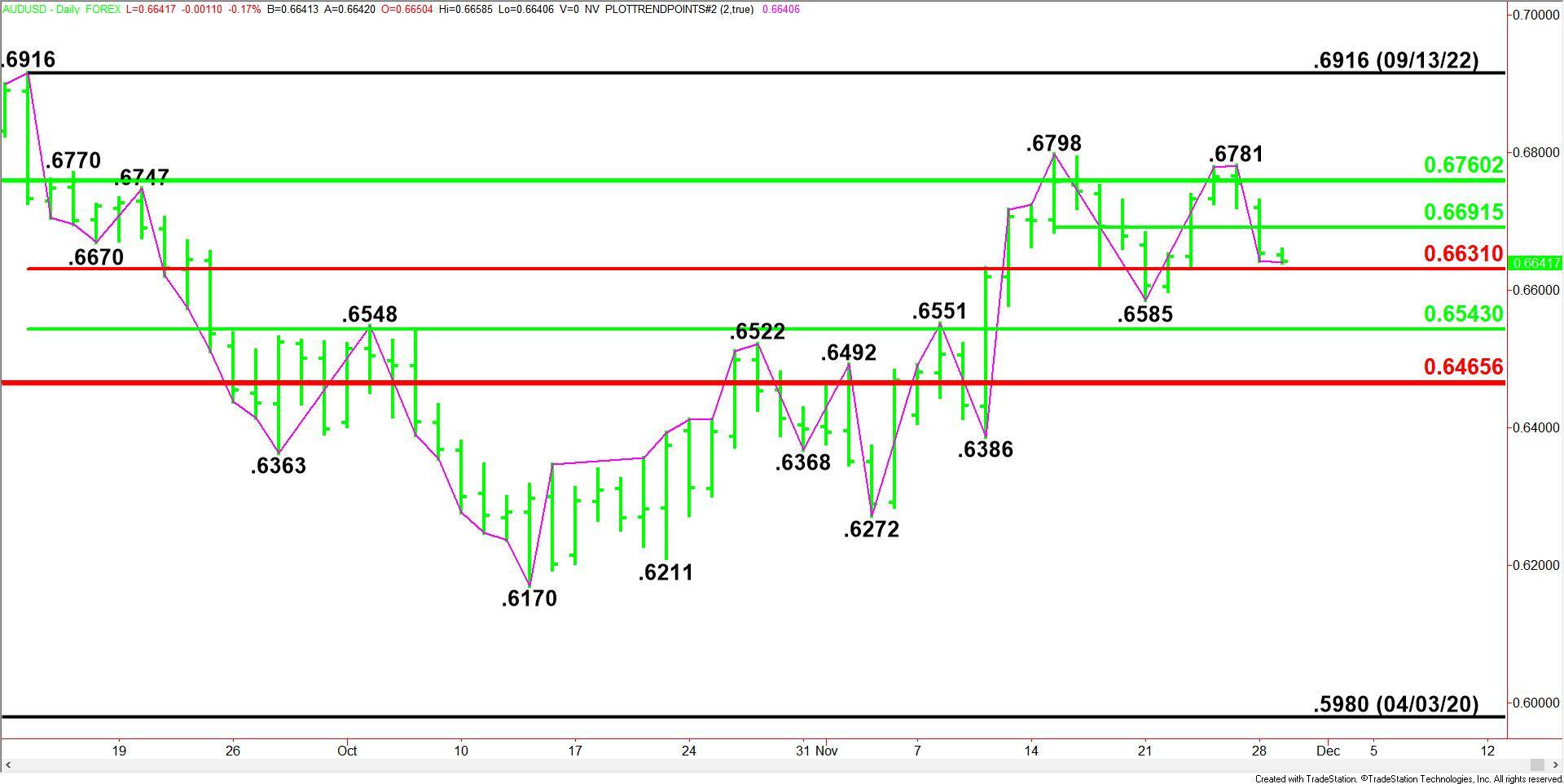
Daily Swing Chart Technical Analysis
The main trend is up according to the daily swing chart. However, momentum is trending lower. A trade through .6585 will change the main trend to down. A move through .6798 will reaffirm the uptrend.
The nearest support is a short-term Fibonacci level at .6631. Following this level is a short-term 50% level at .6543 and a longer-term Fibonacci level at .6466.
On the upside, the nearest resistance is a pivot at .6692, followed by a long-term 50% level at .6760.
Daily Swing Chart Technical Forecast
Trader reaction to .6631 is likely to determine the direction of the AUD/USD on Tuesday.
Bullish Scenario
A sustained move over .6631 will indicate the presence of buyers. This could trigger a surge into the pivot at .6692. Overtaking this level will indicate the buying is getting stronger with the nearest resistance clustering around .6760 to .6798.
Bearish Scenario
A sustained move under .6631 will signal the presence of sellers. If this creates enough downside momentum then look for the selling to extend into the main bottom at .6585.
A trade through .6585 will change the main trend to down. This could trigger an acceleration into the retracement zone at .6543 to .6466.