Investors attempted to drive the AUD/USD higher on Tuesday and take back some of the previous days loses, but the rally failed into the close after the
Investors attempted to drive the AUD/USD higher on Tuesday and take back some of the previous days loses, but the rally failed into the close after the U.S. stock indices reversed course and closed lower.
We’re still in an environment of uncertainty as to the direction of the global stock markets and investor appetite for risk so traders should continue to look for extreme volatility. On Tuesday, the People’s Bank of China temporarily put a halt to the selling pressure when it cut its key lending rate. This told investors that the PBOC is aware of the situation in Chinese equity markets, however, the price action suggests that investors want to see more aggressive action.
Also putting a lid on any rallies is growing speculation that the Reserve Bank of Australia will trim another 25 basis points off its benchmark interest rate in November.
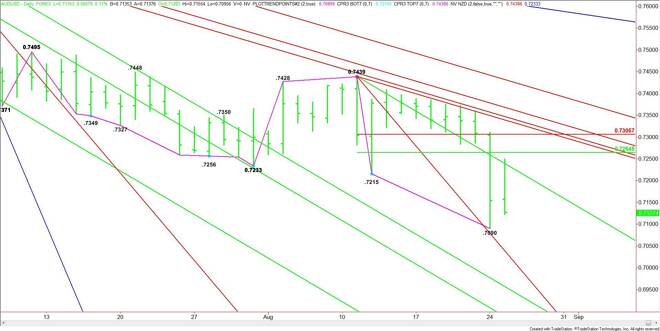
Technically, the main trend is down according to the daily swing chart. The new short-term range is .7439 to .7090. On Tuesday, the Forex pair found resistance on a downtrending angle from the .7439 main top. This angle drops in at .7219 today.
Overtaking .7219 will signal the presence of buyers. This could drive the market into the short-term retracement zone at .7264 to .7306. This is followed by another downtrending angle at .7329.
Based on the weak close on Tuesday, momentum may be to the downside early today. If there is a follow-through move then look for sellers to challenge Monday’s low at .7090. Taking out this level could create enough downside momentum to challenge a steep downtrending angle at .6999. Crossing to the weak side of this angle will put the AUD/USD in an extremely bearish position.
Based on the close at .7127, the direction of the market today is likely to be controlled by trader reaction to .7090. Sellers may dominate and drive the market through this level. Or value-seeking buyers are going to come in an attempt to catch a bottom. It all depends upon whether the equity markets find support or collapse further.
James Hyerczyk is a U.S. based seasoned technical analyst and educator with over 40 years of experience in market analysis and trading, specializing in chart patterns and price movement. He is the author of two books on technical analysis and has a background in both futures and stock markets.