


The AUD/USD pair is currently at a critical technical and fundamental juncture trading near 0.7000–0.7015 as of March 16 2026. While the “Aussie” hit a multi-year high of 0.7185 just days ago a resurgent US Dollar, driven by a mix of geopolitical safe-haven bids and a reset in global inflation expectations, has forced a significant 1.5% correction.
Despite this pullback the underlying bias remains constructive as markets brace for tomorrow’s March 17 RBA meeting where the probability of a “back-to-back” rate hike to 4.10% has surged as high as 66% to 78% across various interbank trackers.
RBA Hawkishness: Is the 4.10% Cash Rate a Done Deal?
The Reserve Bank of Australia has emerged as one of the most hawkish central banks in the G10 space with Governor Michele Bullock recently describing the March meeting as “live” for a rate hike.
Australia’s headline inflation is currently hovering near 3.8% and experts warn it could surpass 4.2% by mid-year as surging oil prices and domestic cost-of-living pressures intensify. As of March 16 the ASX 30-day Interbank Cash Rate Futures reflect a 66% expectation of a 25bps increase to 4.10% which is a massive shift from just weeks ago when the odds were significantly lower.
The local labor market remains exceptionally tight with the unemployment rate holding steady at a seven-month low of 4.1% providing the RBA with the necessary confidence to tighten further.
Geopolitical Friction and the “Hormuz Risk Premium”
The Australian Dollar is currently benefiting from its unique status as a net energy exporter which has partially decoupled it from typical risk-off correlations during the Middle East conflict. With Brent and WTI crude oil prices fluctuating near $100 per barrel due to ongoing Strait of Hormuz disruptions Australia’s LNG and coal export revenues are surging and acting as a fundamental “haven” for the currency.
AUD/USD Price Forecast
Every new AUD/USD analysis as it publishes, today's technical signal and key levels, live price — on one page.
See all AUD/USD forecastsAdditionally stronger-than-expected Chinese economic data and an improving trade surplus have provided a “China proxy” boost to the AUD as demand for Australian iron ore remains stable. However the US Dollar Index (DXY) remains firm near the 99.38 level supported by its role as the world’s preferred wartime safe-haven which continues to cap the Aussie’s upside potential.
RBA Hawkishness: Is That 4.10% Cash Rate a Done Deal?
The RBA has been one of the most hawkish central banks in the G10, with Governor Michele Bullock saying recently that the March meeting is “live” for a rate hike – in other words it’s not a done deal, but it’s definitely on the table.
The big worry for Australia at the moment is inflation – at 3.8% it’s hovering near its long-term average and experts are warning it could easily break 4.2% by mid-year as petrol prices and other living costs continue to rise. On March 16, the ASX 30-day interbank futures had already bumped up the prospect of a 25bps rate hike to 66%, a huge shift from just a few weeks ago when the chances of a hike were much lower.
The Aussie labour market meanwhile is incredibly tight with the unemployment rate steady at a seven-month low of 4.1% and all this is giving the RBA the confidence to keep tightening even more.
Geopolitical Friction and the So-called “Hormuz Risk Premium”
Now one might expect the Australian Dollar to be falling in line with other currencies in times of global uncertainty, but actually it’s been doing the opposite because of its unique status as a net energy exporter. Because of all the Middle East tensions and Strait of Hormuz disruptions, Australia’s LNG and coal export revenues are surging, and this is acting as a fundamental safe-haven for the currency.
All of this comes on top of strong Chinese economic data and a trade surplus that’s been helping out the Aussie – and while the US Dollar is looking rock solid at 99.38 supported by its wartime safe-haven role, it’s still holding back the Aussie’s potential to make a bigger move.
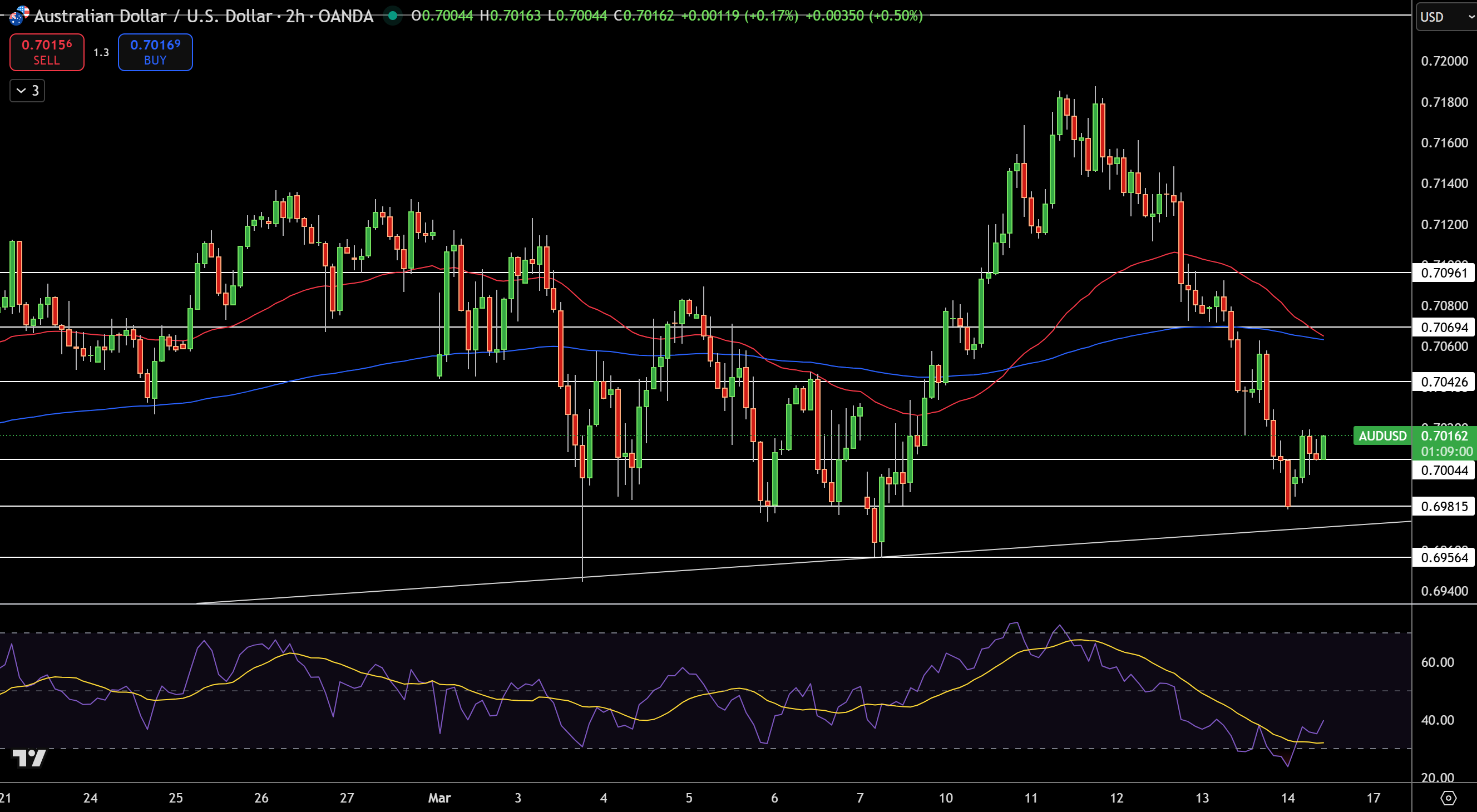
AUD/USD Price Prediction: Rebound from $0.6980 or a Deeper Correction?
On the charts, the AUD/USD is in the middle of a momentum reset after that recent run towards 0.7200 stalled out. Overnight, it managed to hold up at the 0.6981 support zone where buyers did a great job of preventing a fall all the way to 0.6940.
Right now, the price remains below the 50-ema at 0.7096 and the 200-ema at 0.7069 – and that’s a pretty formidable overhead resistance zone that the bulls will need to reclaim if they’re going to get this uptrend going again. The RSI meanwhile is hovering just above 40 after turning up from overbought territory – and all this suggests a possible bounce back to 0.7069 if tomorrow’s RBA rhetoric remains hawkish.
- Support Level: This 0.6981 line in the sand is the critical one for the bulls – they’ve got to hold it otherwise the whole ascending channel structure falls apart.
- Inflation Watch: Aussie inflation expectations have just hit 5.2% – the highest level since mid-2023 – and that’s just one more reason for the RBA to keep pushing up rates.
- Resistance Targets: If the price does manage to break through to 0.7080, the yearly high of 0.7185 is definitely back on the table.
Trade Idea: Keep an eye out for long trades on a successful defence of the 0.6981 support zone – and target a return to 0.7069 and 0.7120. Set your stop-loss below 0.6940 just in case.