
Bitcoin (BTC) has lost nearly 18% of its value in just 7 days, as the crypto market experienced a huge risk-off move this week.
A shift in analysts’ expectations regarding monetary policy in the United States, alongside some other headwinds like persistent geopolitical tensions, pushed down the price of all crypto assets.
The Fear and Greed Index reflects the state of investors’ sentiment at the time of writing. This gauge just dropped to 13, indicating that market participants are in “Extreme Fear” mode.

Analysts Now Expect an Interest Rate Hike in September
Data from FedWatch reveals that analysts do not just expect delayed cuts, which was the baseline scenario a few weeks ago. Now, they anticipate an interest rate hike as soon as September this year.
The reason: the price of oil has managed to stay above $90, and the war in Iran has no end in sight.
This has major implications for the valuation of risky assets, as it implies that market conditions are actually deteriorating.
The move was prompted by the most recent release of the PCE Price Index – the Federal Reserve’s preferred gauge for inflation in the United States.

On May 28, analysts’ consensus estimate of 3.8% for April was confirmed. This means that the Fed is 180 basis points away from its target, which calls for a policy adjustment.
Just four days later, Bitcoin had broken below a key trend line support, and it is now retesting its cycle low at $60,000.
Meanwhile, we can also see in the daily chart that the latest decline started right after the 200-day exponential moving average (EMA) was hit.
We emphasized in previous BTC price prediction articles that this was going to be a key area of resistance for the top crypto, and a strong rejection was expected. However, not necessarily to the extent of what we have seen thus far.
Bitcoin Price Forecast
Every new Bitcoin analysis as it publishes, today's technical signal and key levels, live price — on one page.
See all Bitcoin forecasts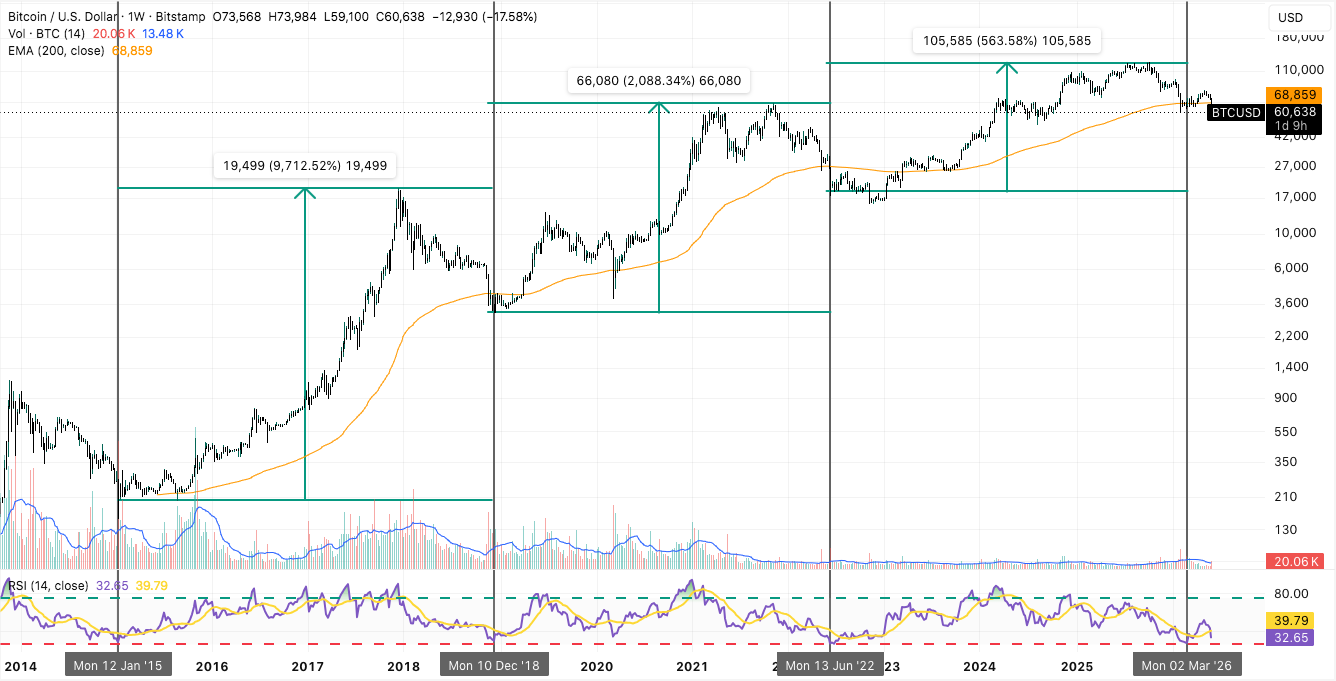
This signal has a 100% win ratio the last three times it popped up. It triggers when the weekly Relative Strength Index (RSI) drops below 30.
Only in one of three instances has the price broken below its previous low. On the other two occasions, BTC made its cycle bottom exactly when the RSI dipped below this threshold.
This is a high-probability signal in a higher time frame (HFT) that we have been tracking for months. We expect that BTC will respect this historical pattern. The latest decline is still in line with what has happened in previous cases.
The price retests the previous cycle low and starts rallying right after. That said, there is also a chance that BTC could drop to lower levels before the true recovery begins.
Based on this historical pattern, we believe that we are either at or near Bitcoin’s cycle bottom.

Heading to the daily chart, buying pressure has picked up right after BTC hit $60,000. We need a strong rally after this support bounce to confirm that this weekly pattern is unfolding as expected.
The RSI in this lower time frame just hit extreme oversold levels, increasing the odds of a technical bounce. If Bitcoin’s bearish cycle is truly over, as historical patterns may be indicating, we could envision BTC rising to $100,000 over the next 3 months and possibly to $200,000 12 to 18 months from now.