As Netflix heads into its upcoming earnings report, market participants are increasingly focused on quality of growth rather than headline expansion alone. Revenue growth remains solid, but for traders, the more important question is whether Netflix can continue translating its global scale into durable profitability and predictable cash generation.
In the third quarter, Netflix delivered revenue of $11.51 billion, up 17% year over year and fully in line with its own guidance. While this result did not surprise the market, it reinforced a critical point: even as Netflix matures, its top line remains resilient, supported by pricing actions, member growth, and early traction from advertising. For traders, consistency matters.
Netflix reported an operating margin of 28%, below its guided 31.5%, immediately drawing investor attention. In isolation, a margin miss would normally raise concerns about cost inflation or waning operating leverage. In this case, management was quick to draw a clear line between underlying performance and a non-recurring legal adjustment tied to Brazil.

A One-Off Tax Charge, Not a Structural Margin Problem
The margin shortfall was driven by an expense related to a Brazilian tax dispute, not by weaker fundamentals. Management stressed that without this charge, operating income and margins would have exceeded guidance. For traders, this distinction is critical. Markets tend to penalise structural margin compression far more aggressively than temporary distortions caused by legal or accounting reassessments.
The tax itself, known as the Contribution for Intervention in the Economic Domain (CIDE), is a gross tax applied to certain outbound payments made by Brazilian entities to foreign companies. Netflix Brazil pays Netflix U.S. for services that allow the platform to operate locally, and until recently, the company believed these payments fell outside the scope of the tax. That interpretation was supported by a favourable lower-court ruling in 2022, which explains why Netflix had not accrued for this liability in prior periods.
The situation changed following an August ruling by Brazil’s Supreme Court in an unrelated case, which broadened the interpretation of transactions subject to the tax. As a result, Netflix reassessed its legal exposure and recorded an expense covering the period from 2022 through the third quarter of 2025.
What Does This Mean for Traders?
From a trading perspective, the key takeaway is forward-looking impact. Roughly 80% of the charge relates to prior years, sharply limiting its effect on future margins. Management has also stated that it does not expect the issue to materially affect results going forward. As a result, most traders are likely to classify the Q3 margin miss as non-recurring rather than a signal of deteriorating cost discipline.
This framing shifts attention back to Netflix’s underlying operating leverage as the company moves into 2026. If margins rebound toward prior targets in coming quarters, it would reinforce confidence that Netflix’s long-term margin trajectory remains intact. Conversely, any hesitation or additional “one-off” adjustments would likely be scrutinised much more closely by the market.
Engagement at Record Levels in Core Markets
Beyond margins, engagement trends continue to strengthen Netflix’s good performance. During the quarter, the company achieved its highest-ever viewing share in both the United States and the United Kingdom, two of its most strategically important markets. According to Nielsen and BARB, Netflix captured 8.6% of total viewing in the U.S. and 9.4% in the U.K.
These figures are not isolated spikes. Since the end of 2022, viewing share has increased by 15% in the U.S. and 22% in the U.K., pointing to sustained competitive gains rather than temporary content-driven surges. Total viewing hours also accelerated in the third quarter compared with the first half of the year, suggesting that engagement is still building, not flattening.
Why Does Engagement Matter for Traders?
For traders, engagement metrics are not just vanity statistics. They sit at the core of Netflix’s monetisation engine. Higher share of viewing strengthens pricing power, reduces churn risk, and increases the effectiveness of advertising inventory. In practical terms, it means Netflix has more flexibility to raise prices selectively without triggering disproportionate subscriber losses.
This is particularly relevant as the company expands its advertising-supported tier. Advertisers value not only raw subscriber numbers, but attention and time spent. Rising engagement improves the quality of Netflix’s ad inventory, which feeds directly into revenue per user and long-term margin potential.
Advertising Growth Continues
Netflix’s advertising business delivered its strongest quarter to date in Q3 2025, with record ad sales and a doubling of U.S. upfront commitments. While advertising remains modest relative to subscription revenue, its growth rate and improving visibility are becoming increasingly important for valuation.
Upfront commitments secured during the quarter will start contributing meaningfully to revenue in late 2025 and continue into 2026, improving forecast reliability. More importantly, management highlighted accelerating growth in programmatic advertising, which is typically more scalable and margin-accretive over time.
The drivers are structural. Netflix now offers advertisers a rare combination of global scale, highly engaged audiences, and increasingly sophisticated buying tools. The rollout of its proprietary ad tech stack has expanded available formats, improved measurement capabilities, and increased flexibility in how inventory is purchased. Management characterises the business as having moved from an experimental phase into a more established execution phase, with rapid iteration based on advertiser feedback.
What Does This Mean for Traders Looking Into 2026?
For traders, the advertising roadmap is a key medium-term catalyst. Netflix plans to integrate additional demand-side platforms, enhance targeting and media planning tools globally, and roll out more interactive ad formats, including new features later this year. Over time, management expects to layer in machine-learning-driven optimisation, advanced measurement, and more sophisticated targeting capabilities.
The implication is that advertising margins may lag subscription margins in the near term as investments continue, but could expand meaningfully as the stack matures. Traders will be watching closely for signs that advertising revenue is scaling without disproportionate cost increases, a combination that could materially change Netflix’s long-term margin profile.
Netflix Guidance
Looking ahead, Netflix expects fourth-quarter 2025 revenue growth of 17% and an operating margin of 23.9%, representing a year-over-year improvement despite the Brazilian tax headwind. For the full year, revenue is projected at $45.1 billion with a 29% operating margin. While slightly below prior expectations, the revision is directly linked to the tax issue rather than operational softness.
Taken together, Netflix’s recent performance paints the picture of a business that remains fundamentally robust. Engagement is rising, monetisation channels are diversifying, and margin pressure appears temporary rather than structural.
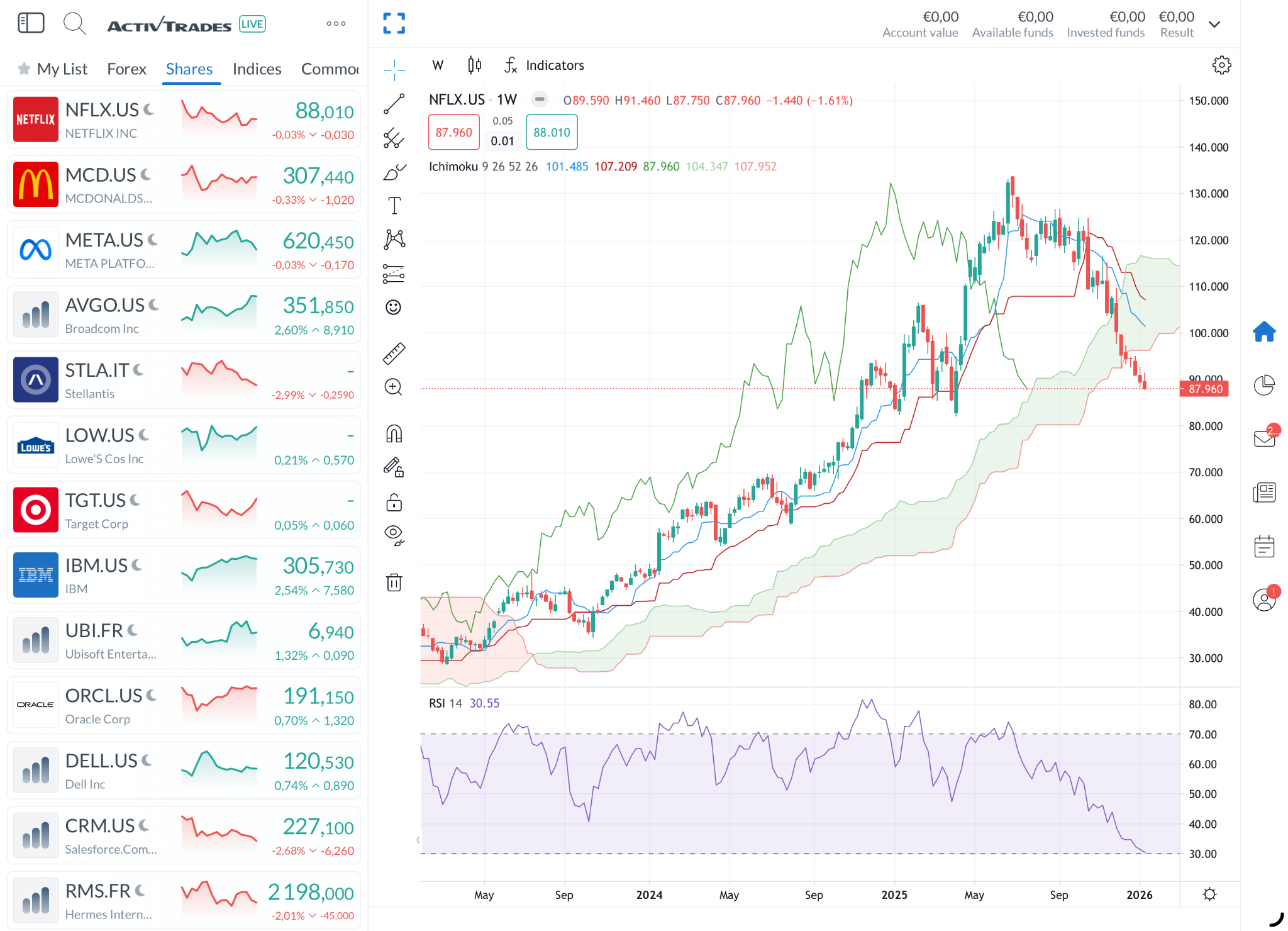
For traders, the upcoming earnings report will be less about headline beats or misses and more about confirmation: confirmation that margins normalise after Brazil, advertising momentum continues into 2026, and engagement gains remain durable.
But beyong monetisation and cash generation, traders will also focus on Netflix’s comments on the Warner Bros. Discovery deal, as well as its gaming and content strategy, which is what we will focus on in the next article.
Sources: Netflix, Reuters, The Wall Street Journal, CNN, CNBC, PwC, Nielsen, MorningStar, Yahoo Finance