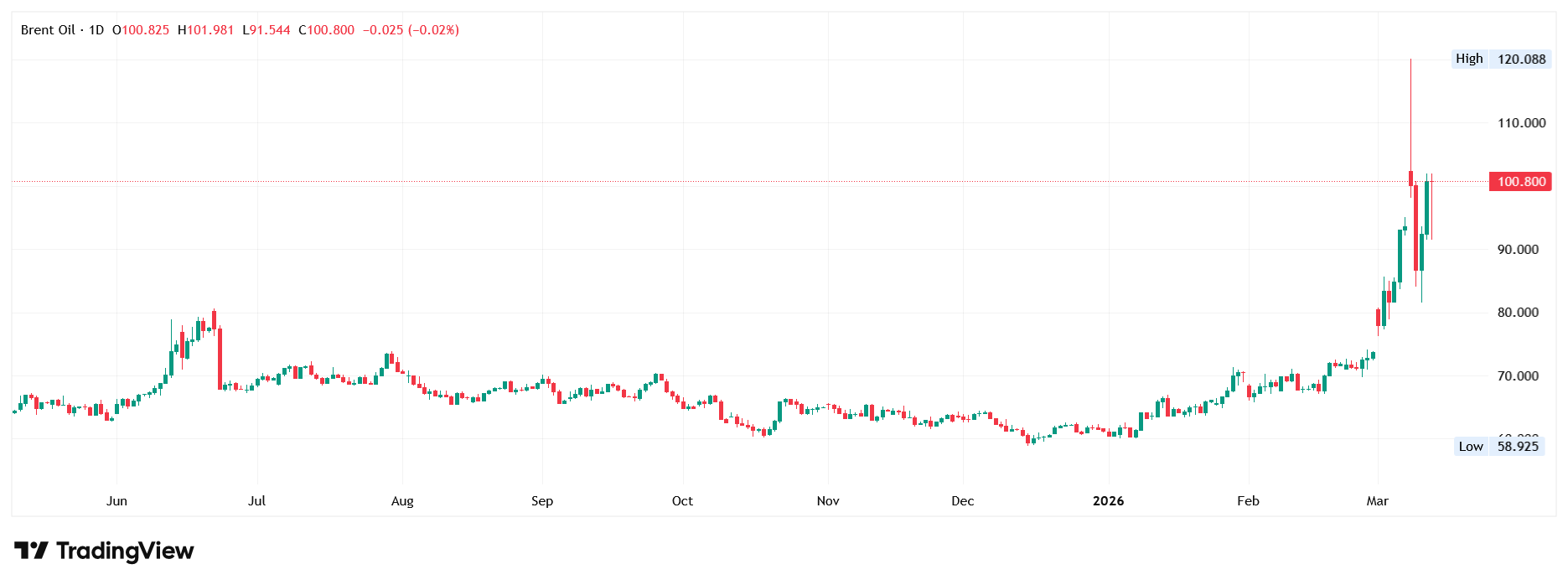
Under normal circumstances, each of these policy gatherings would attract significant market attention. In the current environment, they may collectively become some of the most closely watched events of the year. The backdrop confronting policymakers is far from comfortable. Energy prices have surged sharply in recent months, with Brent crude climbing above $120 a barrel in recent sessions and remaining more than 60% higher since the beginning of the year. At the same time, the outlook for global oil supply has deteriorated dramatically.
The International Energy Agency recently lowered its forecast for oil supply growth in 2026 to 1.1 million barrels per day, down from a previous estimate of 2.4 million barrels per day. Importantly, all of that expected growth is projected to come from producers outside the OPEC+ alliance, highlighting the limited spare capacity available within the global system.
The short-term supply shock is even more striking. Global oil supply in March is expected to fall by around 8 million barrels per day to 98.8 million barrels per day, the lowest level since early 2022. According to the IEA, the conflict in the Middle East is now causing the largest disruption in the history of the global oil market.
Oil flows through the Strait of Hormuz, which normally handle roughly 20 million barrels per day, have almost stopped. At the same time, Gulf producers have reduced combined output by at least 10 million barrels per day. With storage facilities filling up and few viable alternative shipping routes available at scale, the agency warns that supply losses could increase further unless maritime traffic through the region resumes quickly.
For central banks, the implications are significant. Oil shocks of this magnitude almost inevitably translate into higher inflation. As a general rule, a 5% increase in oil prices adds roughly 0.1 percentage point to inflation. With crude prices up around 50% since the start of the year, that alone could add close to one percentage point to headline inflation.
The impact does not stop at energy costs. Higher diesel prices raise transportation expenses across the economy, pushing up the cost of moving goods and raw materials. Agriculture is also affected, particularly as farmers enter the planting season. Rising fuel costs are expected to add billions of dollars to farming expenses, potentially reducing planting activity and increasing food prices later in the year.
Airlines are facing sharply higher fuel bills as well, which could translate into more expensive travel at a time when consumer confidence remains fragile. The broader effects of an oil shock — through supply chains, corporate investment decisions and household budgets — tend to amplify the initial inflationary impact.
This is the difficult environment central banks must navigate next week. Policymakers are being asked to respond to a shock that is still unfolding and whose duration remains uncertain. Most are therefore expected to proceed cautiously, keeping interest rates unchanged while assessing how persistent the disruption will prove.
Moving too quickly carries risks in both directions. Tightening policy aggressively could further weaken a global economy already showing signs of slowing. Easing prematurely, however, risks allowing inflation expectations to drift higher at a moment when price pressures are clearly rising again.
As a result, market participants will focus not only on policy decisions but also on the tone of central bank communications. The risks policymakers highlight and the conditions they outline for future moves may ultimately prove more important than the decisions themselves.

Tuesday March 17 – Reserve Bank of Australia
The Reserve Bank of Australia could be one of the few central banks considering tightening policy next week. A growing number of economists, including analysts at Westpac, National Australia Bank and Commonwealth Bank of Australia, now expect the RBA to raise its policy rate by 25 basis points at its March meeting.
The shift in expectations follows recent warnings from central bank officials that inflation risks could intensify again. The surge in global oil prices has raised concerns that fuel and transportation costs may push inflation higher just as it had begun to moderate.
Australia’s economy remains highly sensitive to global commodity prices, and policymakers appear increasingly cautious about the possibility that the energy shock could slow progress toward their inflation target. For that reason, some analysts believe the RBA may choose to act pre-emptively to prevent inflation expectations from rising again.
AUD/USD Price Forecast
Every new AUD/USD analysis as it publishes, today's technical signal and key levels, live price — on one page.
See all AUD/USD forecastsWednesday March 18 – Bank of Canada and Federal Reserve
In Canada, most economists expect the Bank of Canada to keep interest rates unchanged. The central bank cut rates four times in 2025, reducing its policy rate by a total of 100 basis points to 2.25%.
That level is close to the lower end of the bank’s estimated neutral range, meaning monetary policy is now considered broadly balanced between supporting growth and controlling inflation. Policymakers are therefore likely to adopt a wait-and-see approach as they evaluate the economic impact of higher energy prices and ongoing geopolitical tensions.
In the United States, the Federal Reserve is also widely expected to leave its benchmark interest rate unchanged. However, expectations for when the Fed might begin cutting rates have shifted significantly in recent weeks.
Goldman Sachs now expects the Fed to begin easing later than previously anticipated, forecasting two 25-basis-point cuts in September and December. Earlier forecasts had suggested the easing cycle might begin as early as June, but the recent surge in oil prices has complicated the inflation outlook.
At the same time, the outlook remains uncertain. A weaker-than-expected February employment report has raised concerns that the US labour market could be cooling faster than anticipated. If economic growth slows more sharply or unemployment rises significantly, the Fed could still move earlier than expected.
Thursday March 19 – Bank of Japan, Swiss National Bank, Bank of England and European Central Bank
Several major central banks will announce policy decisions on Thursday, though most are expected to keep rates unchanged while monitoring the evolving economic environment.
In Japan, economists broadly expect the Bank of Japan to leave its policy rate at 0.75%. However, many analysts believe the central bank may still raise borrowing costs later this year, with surveys suggesting the policy rate could reach around 1.00% by mid-2026 if inflation remains stable.
The Swiss National Bank is also expected to hold rates steady at 0%. According to UBS economists, two opposing forces are currently balancing each other out: higher global energy prices are pushing inflation upward, while the appreciation of the Swiss franc is helping to reduce imported inflation.
In the United Kingdom, expectations for an immediate rate cut have faded. Economists now believe the Bank of England is more likely to lower its policy rate later in the spring, possibly in April or June. The surge in energy prices since the start of the Middle East conflict has complicated the inflation outlook, encouraging policymakers to remain cautious for now.
In the eurozone, market expectations have shifted noticeably in recent weeks. German government bond yields have climbed toward multi-year highs as investors begin to consider the possibility that the European Central Bank could tighten policy again later this year.
Before the recent geopolitical tensions, markets had been expecting modest rate cuts from the ECB. However, policymakers have signalled that they are closely monitoring the inflationary impact of rising energy prices and are prepared to act if higher costs begin to feed more persistently into the broader economy.
Sources: Reuters, MorningStar, TradingEconomics, Forbes, EIA, The Wall Street Journal