



Regime Change in Venezuela Unlikely to Shake Oil Markets Next Week
As crude holds in the mid-$50s to start the year, traders are weighing whether President Trump’s overthrow of Nicolás Maduro will move the needle when futures reopen Sunday night.
The early read? Probably not.
Why Markets Are Shrugging Off a Major Geopolitical Shock
Analysts expect Brent to add only $1 to $2 when trading resumes—if that—and some think prices may even drift lower through the week. The muted response comes down to timing and scale. Venezuela produces less than a million barrels a day and exports roughly half of it, barely enough to register in a global market already swimming in excess supply. Forecasts call for a surplus of 2–4 million barrels per day heading into early 2026, keeping WTI stuck in the low-to-mid $50s despite noise elsewhere.
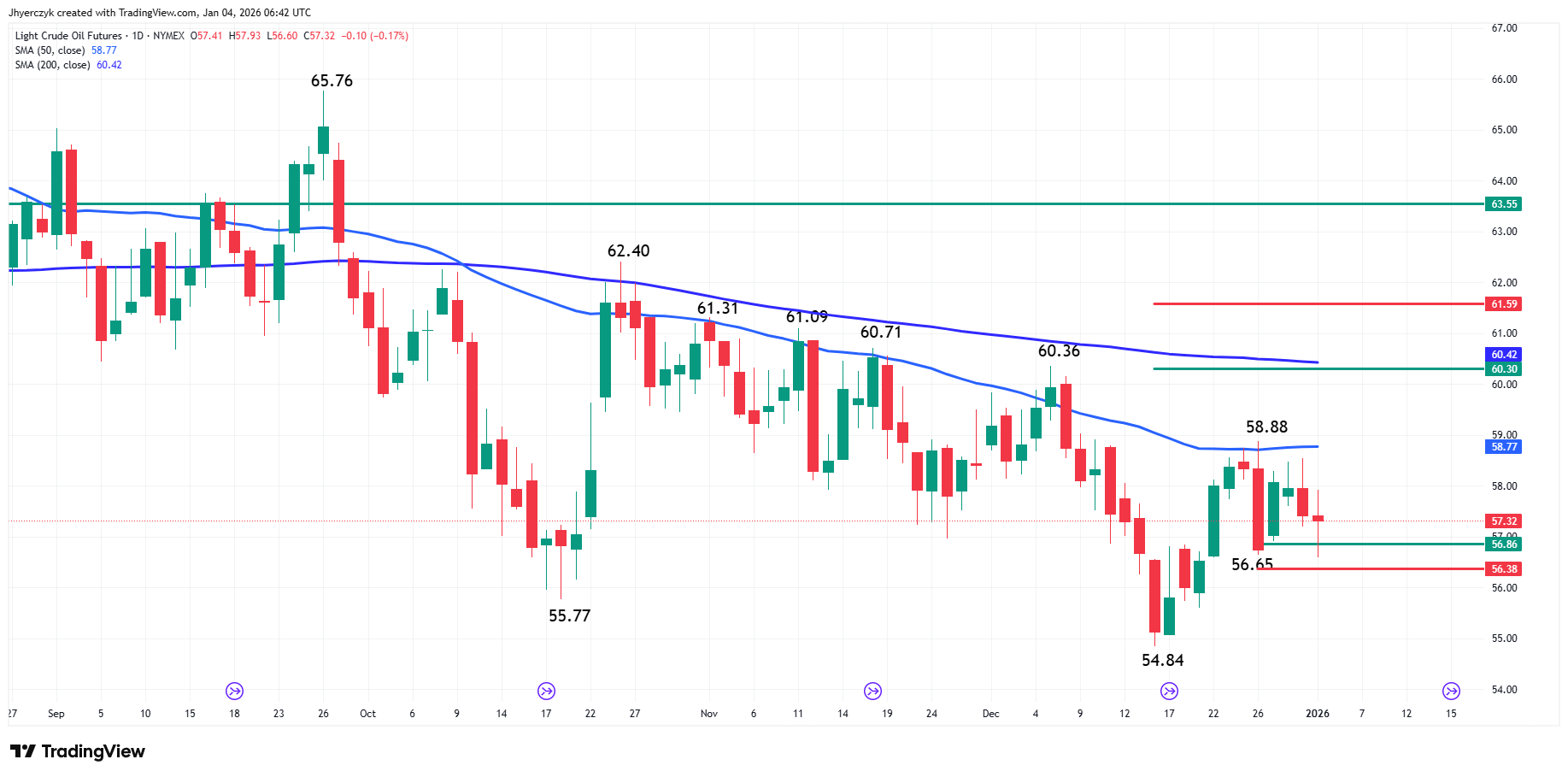
Technically, the light crude oil market was setting up for a volatile move for days with the mostly sideways trade during the last four days of 2025.
Our work sees the 50-day moving average at $58.77 as the potential trigger point for an acceleration to the upside. The short-term Fibonacci level at $56.38 is the potential trigger point for a steep plunge toward $54.84. A surge through the 50-day MA could create the momentum needed to challenge the longer-term retracement zone at $60.30 to $61.59. The 200-day MA at $60.42 will also provide resistance.
“Despite this being a huge geopolitical event that you would normally expect to push up oil prices,” said Arne Lohmann Rasmussen of Global Risk Management, “the bottom line is there’s still too much oil in the market.”
Gulf Coast Refiners Face a Different Reality
Refiners, however, are staring at a different set of problems. U.S. Gulf Coast plants spent decades and more than $100 billion engineering systems designed for Venezuelan heavy, sour crude. Valero, Phillips 66, Chevron and others structured their operations around blending roughly one-third heavy crude with lighter domestic shale. Venezuelan flows to the U.S. have bounced between 200,000 and 300,000 barrels a day depending on sanctions enforcement, and any near-term disruption tightens that niche market even if the broader complex stays oversupplied.
Brent Oil Price Forecast
Every new Brent Oil analysis as it publishes, today's technical signal and key levels, live price — on one page.
See all Brent Oil forecasts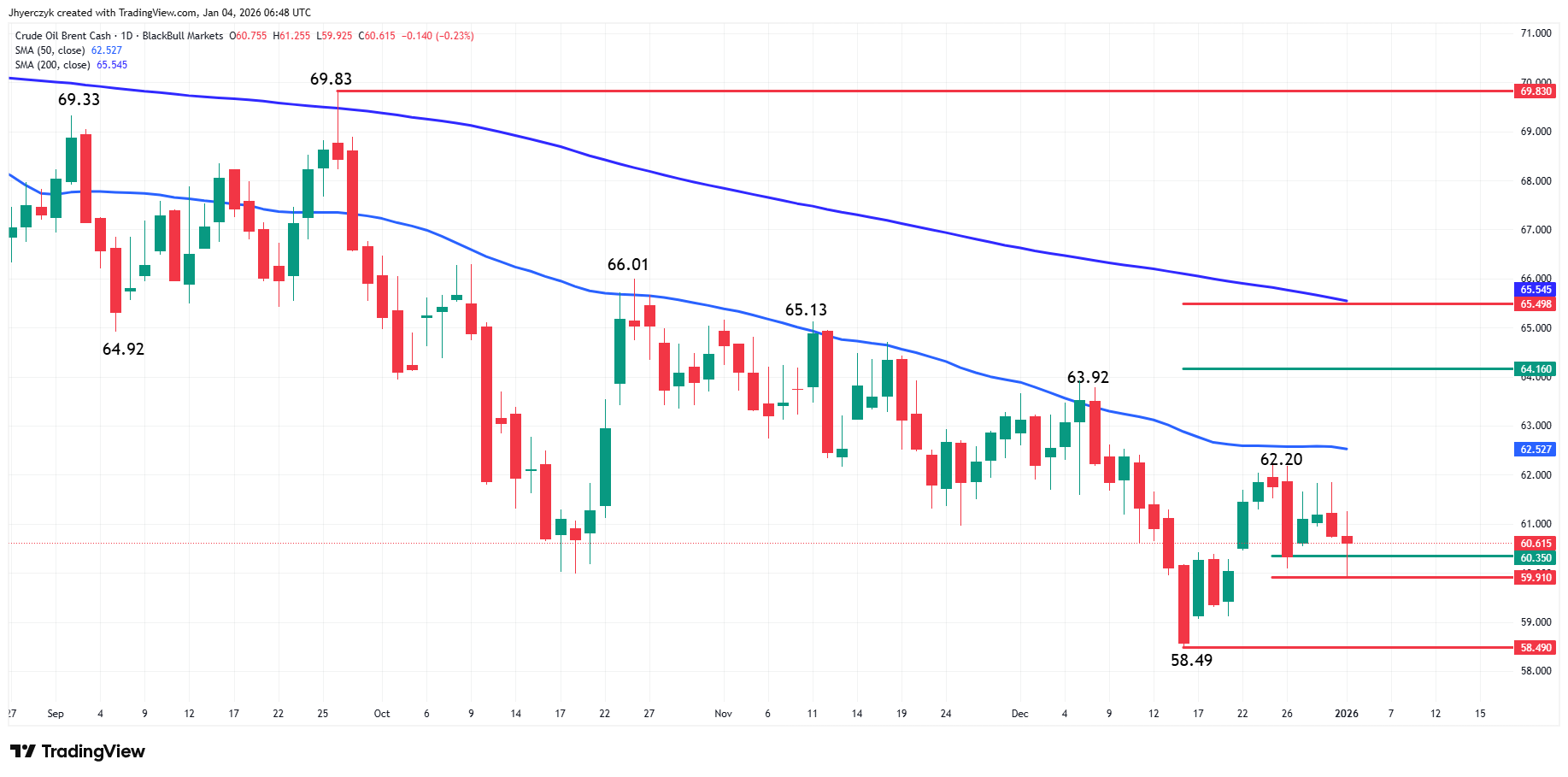
Cash Brent Crude Oil has a similar set up with its 50-day moving average at $62.53 the key resistance and upside breakout point. The Fibonacci level at $59.91 is the trigger for a decline toward $58.49. A surge into the retracement zone at $64.16 to $65.50, combined with the 200-day moving average at $65.55, is the primary upside target if there is a short-covering rally.
The Billion-Dollar Question: Will Big Oil Return to Caracas?
The longer-term issue is whether major oil companies would actually return to Venezuela. Trump says U.S. firms will invest billions to rebuild the sector, but gave no details on which companies or under what terms. Analysts argue Venezuela could eventually push exports toward 3 million barrels per day if sanctions lift and capital flows back in—a notably bearish scenario for crude.
“If anything, the future of Venezuela will have a bearish impact on the market, because there’s really nowhere to go but up,” said David Goldwyn, a former State Department energy official.
But that’s still hypothetical. Companies remember being pushed out and expropriated in the early 2000s; Exxon and others are still pursuing compensation from PDVSA. No one is investing until leadership and contract terms are clear.
What Really Matters for Next Week’s Trade
For next week, Venezuela is more sideshow than market driver. Traders will keep their eyes on the January 4 OPEC+ meeting and whether the group holds production cuts. Oversupply continues to set the tone, even with geopolitical risk simmering.
Technically, the 50-day moving average for both WTI futures and Brent cash is the level to watch since it has capped gains since October. We’re likely to see the same response by traders as we saw when Russia invaded Ukraine in February 2022; buyers betting on a supply disruption are likely to drive the market through the 50-day moving averages with the help of aggressive short-covering. After that initial surge, sellers should re-emerge and the downtrend is likely to resume. That’s the reality of having an oversupply situation.
More Information in our Economic Calendar.