
Geopolitical tensions subsided on Tuesday, January 6, coinciding with expectations of a Fed rate cut, lifting sentiment.
US stock futures advanced in early trading on January 6, as investors downplayed the events in Venezuela and their impact on the global economy. The absence of an escalation in geopolitical tensions was key to risk sentiment this week following Venezuelan President Maduro’s capture.
Upbeat Chinese economic data added to the positive sentiment as overnight US economic data bolstered bets on a Q1 Fed rate cut.
Expectations of a Fed rate cut and optimism toward the upcoming earnings season affirmed a bullish medium-term price outlook ahead of key US economic data.
Below, I’ll outline the key market drivers, the medium-term outlook, and the key technical levels traders should watch.

China Maneuvers Around US Tariffs
External demand for Chinese goods remained strong at the end of 2025, despite the punitive US tariffs on Chinese shipments. Goods producers have found alternative markets and shipping routes, bypassing US tariffs.
The Kobeissi Letter reported on US imports from Southeast Asia, stating:
“US imports from Southeast Asia rose +25% YoY in Q3 2025, to a record ~$40 billion on a 3-month rolling average basis, according to US Census Bureau. Vietnam led the surge, with imports rising to ~$18 billion, an all-time high. This is despite US tariffs, which were initially set at 49%, but later negotiated down to ~20%. At the same time, Chinese exports to the US plunged -40% YoY in Q3 2025.”
The Kobeissi Letter also commented on Southeast Asia’s cost advantage and China’s rerouting efforts, stating:
“This comes as the region has a massive cost advantage over US and European manufacturing, which ranges from 20% to 100%, even after tariffs. Companies use Southeast Asian economies as alternative export bases to avoid China’s 37% reciprocal tariff. As a result, the amount of trade rerouting from China hit a record $23.7 billion in September.”
For context, Chinese exports surged 5.9% year-on-year in November, recovering from a 1.1% fall in October. Mainland China’s equity markets have started the year strongly, bolstering demand for risk assets such as US equity futures. The CSI 300 rallied 1.16% in morning trading, climbing to its highest level since 2021.
Dow Jones Price Forecast
Every new Dow Jones analysis as it publishes, today's technical signal and key levels, live price — on one page.
See all Dow Jones forecastsUS Services and the Fed in Focus
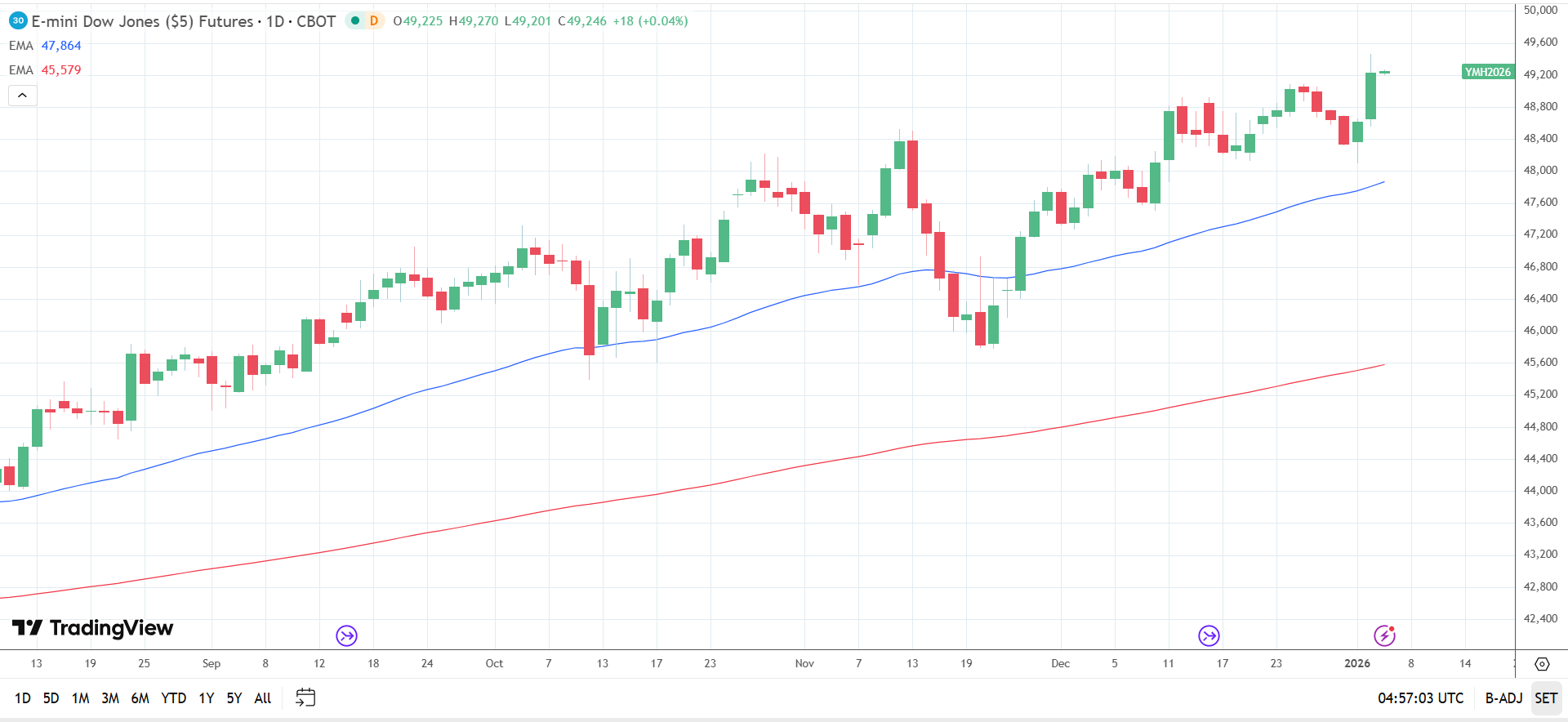
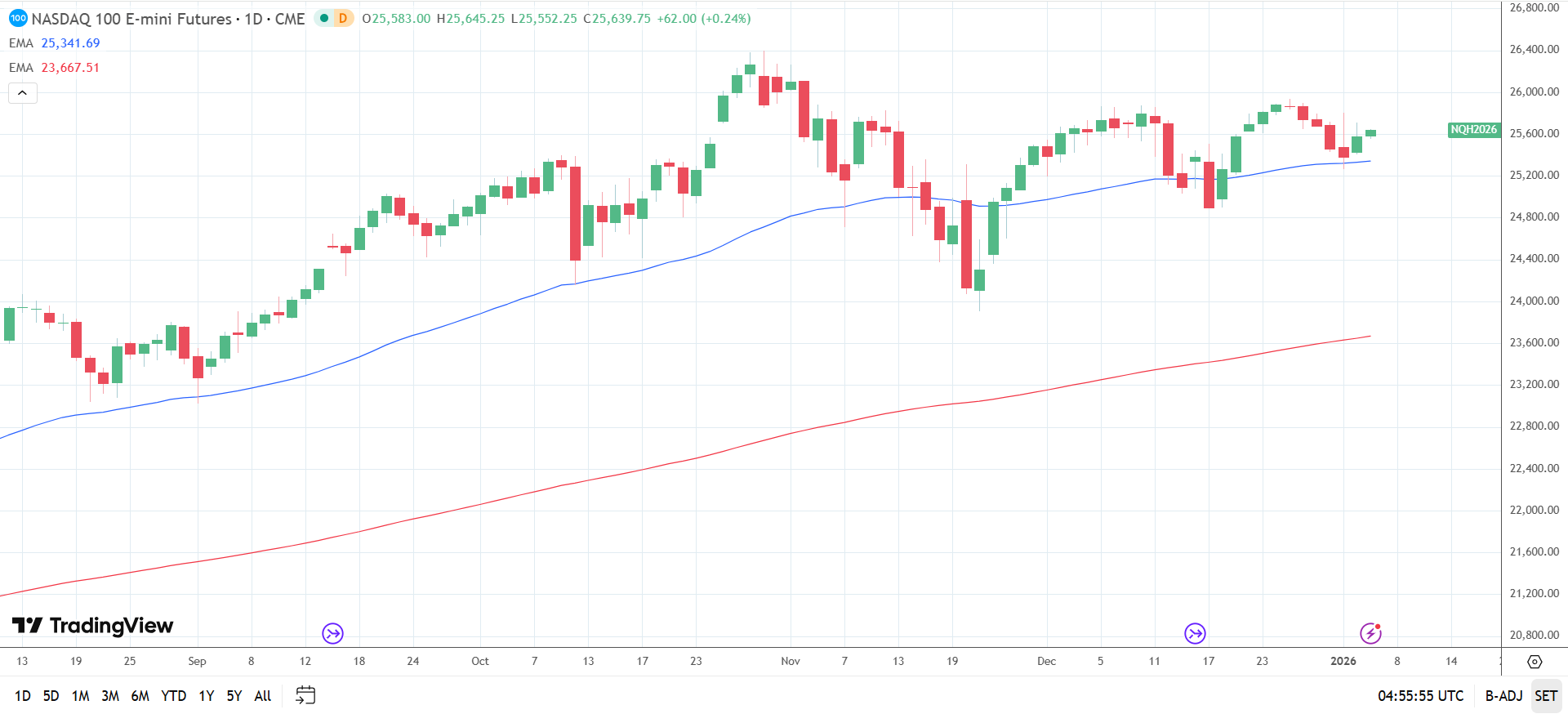
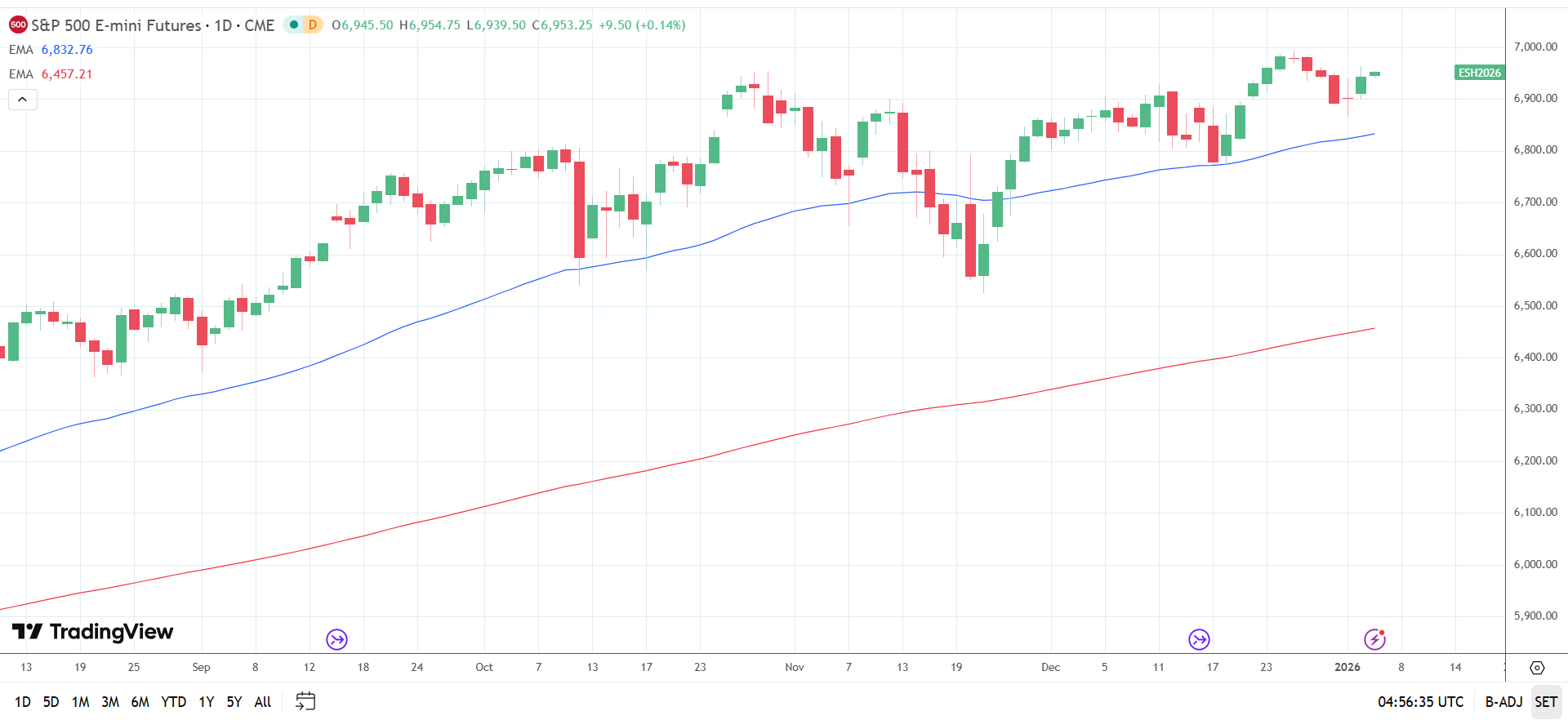
US futures posted gains during the Asian morning session on Tuesday, January 6. The Nasdaq 100 E-mini and the S&P 500 E-mini advanced 62 points and 10 points, respectively, while the Dow Jones E-mini gained 18 points.
Later on Tuesday, US economic indicators will influence risk appetite, with services sector PMI data in focus. According to December’s flash PMI, the S&P Global US Services PMI fell from 54.1 in November to 52.9 in December.
A lower PMI reading would likely fuel bets on a March Fed rate cut, given that services account for approximately 80% of the US GDP. Beyond the headline PMI, sub-components, including employment and prices, also need consideration ahead of the all-important US jobs report.
Slower sector activity, softer services inflation, and rising job cuts would support a more dovish Fed rate path. Lower borrowing costs may boost margins and equity valuations, signaling a stronger appetite for shares.
Market sensitivity to US economic indicators has intensified since the US government reopened. The US ISM Manufacturing PMI fell from 48.2 in November to 47.9 in December, supporting a dovish Fed policy stance.
According to the CME FedWatch Tool, the probability of a March Fed rate cut rose from 46.5% on December 5 to 48.5% on January 5.
Key Technical Levels for Dow Jones, Nasdaq 100, and S&P 500
This week’s gains left the Dow Jones E-mini, the Nasdaq 100 E-mini, and the S&P 500 E-mini trading above their 50-day and 200-day EMAs. The EMAs indicated a bullish short- to medium-term outlook, aligning with upbeat fundamentals.
Near-term trends remain hinged on geopolitical risks, US data, and Fed chatter. Key levels to monitor include:
Dow Jones
- Resistance: the January 5 record high of 49,463, and then 50,000.
- Support: 49,000 followed by the 50-day EMA (47,864).
Nasdaq 100
- Resistance: 26,000 followed by the October 30 record high of 26,399.
- Support: the 50-day EMA (25,342) and then 24,500.
S&P 500
- Resistance: the December 26 record high of 6,988, and then 7,000.
- Support: the 50-day EMA (6,833) and then 6,500.
Bullish Medium-Term Outlook: US PMI Data and Fed Chatter Key
In my opinion, the short-term price outlook remains bullish on expectations of a Fed rate cut and strong corporate earnings, aligned with technicals. Furthermore, increased speculation about an incoming Fed Chair tolerating elevated inflation and lower interest rates reinforces the constructive medium-term bias.
However, several events would likely challenge the bullish medium-term outlook, including:
- The Bank of Japan declares a neutral interest rate in the range of 1.5 and 2.5%, suggesting a narrower-than-expected US-Japan rate differential.
- Strong US data and hawkish Fed chatter reduce bets on a Fed rate cut.
- Geopolitical tensions escalate after the Venezuelan President’s capture.
Conclusion: Bullish Outlook Intact
In summary, a resilient US economy, a more dovish Fed rate path, AI-related developments, and a less hawkish BoJ policy stance support a positive short-term and bullish medium-term outlook for US stock futures.
However, traders should closely monitor 10-year JGB yields, USD/JPY trends, and the Nikkei 225 in the near term. Yen intervention threats and hawkish BoJ policy signals may trigger a yen carry trade unwind.
Key levels to watch include a USD/JPY drop below 150 and 10-year JGB yields climbing to new highs. These levels would likely drag the Nikkei 225 lower, weighing on demand for US risk assets.
Despite the expectations of further BoJ hikes, US stock futures are likely to target new highs, with upcoming earnings and the Fed being the key drivers.
Follow our live coverage and consult the economic calendar for real-time market updates.