Federal Reserve: The Decision Matters Less Than the Message
The Federal Reserve is widely expected to leave interest rates unchanged at the meeting concluding today on 17 June – the first meeting chaired by Kevin Warsh. Yet for markets, the most consequential development may not be what policymakers do, but what they may hypothetically opt to stop saying.
For months, the Federal Open Market Committee has retained language that implicitly suggested the next move in rates would be lower. As I commented for Bloomberg, that easing bias today appears increasingly difficult to justify. Inflation has accelerated, labour market conditions remain resilient and investors have steadily repriced the outlook. Removing that bias would simply formalise what markets have already accepted: the next move, under the current analysis, is no longer obviously a rate cut.
The updated Summary of Economic Projections is likely to reinforce that shift. Policymakers may push projected rate cuts further into the future, potentially into 2027, reflecting a growing consensus that inflation risks remain uncomfortably elevated. Some officials are expected to signal the possibility of rate rises.
Yet investors expecting an overtly hawkish pivot may nevertheless be disappointed. Markets have swung dramatically from pricing aggressive easing to previously pricing a rate increase as early as September or October. Federal funds futures and options markets suggest investors still see a meaningful probability of higher rates before year-end. However, with energy prices falling and midterm elections approaching, the bar for a pre-election rate increase remains exceptionally high.
The Federal Reserve’s challenge is that inflation and politics are pulling in opposite directions. Consumer prices have accelerated sharply, creating pressure for a firmer policy stance. At the same time, policymakers remain acutely aware of the scrutiny that any rate rise would attract from the White House. For the moment, holding rates steady buys Warsh time.
The Warsh Era Begins
Looking beyond this meeting, a defining feature of the Warsh Fed may be its communication policy.
Warsh has repeatedly signalled his desire to reform how the central bank conveys its message, including trimming reliance on explicit forward guidance and revisiting the format of the Summary of Economic Projections. Investors may need to prepare for a Federal Reserve that becomes less predictable in its messaging while increasing flexibility in its policy choices.
That shift could easily prove meaningful. Since January, several policymakers have pushed to remove language implying future rate cuts, and disagreements over communication have become growingly visible. Under Warsh, markets may receive fewer signals around where rates are headed and more emphasis on incoming data and policy discretion.
The bond market will be watching closely. Concerns about Warsh’s commitment to the Federal Reserve’s inflation mandate may have eased since his appointment, but they have certainly not disappeared (Figure 1). Maintaining investor confidence will prove crucial. Any perception that the central bank’s inflation-fighting credibility is weakening could quickly translate into higher risk premia and tighter financial conditions – with an outstanding question of whether the inflation hawk Warsh was during his last Fed term turns up. At the same time, should Warsh underwhelm on dovish rhetoric and deliver a more centrist-to-hawkish tone today, markets may easily respond by pricing in tighter financial conditions.
Figure 1. Do you believe Chairman Kevin Warsh will be committed to achieving the Fed’s 2% inflation target?
% of Bloomberg survey respondents, March and June 2026
GBP/USD Price Forecast
Every new GBP/USD analysis as it publishes, today's technical signal and key levels, live price — on one page.
See all GBP/USD forecasts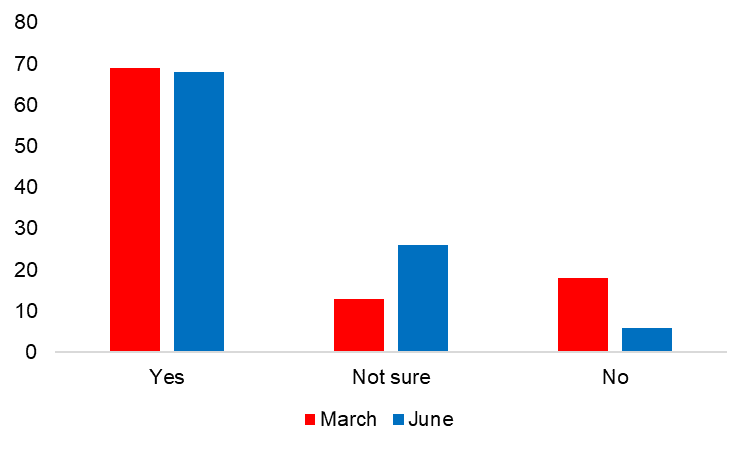
Inflation Today, Easier Policy Tomorrow?
The medium-term outlook remains more nuanced than current inflation data may suggest.
While US inflation has accelerated – hitting 4.2% for headline CPI and 2.9% for core last month, the geopolitical backdrop has become disinflationary. The interim peace agreement between the United States and Iran and gradual reopening of the Strait of Hormuz ought to help to reverse part of the recent energy price shock. Policymakers therefore face a dilemma: present inflation risks outweigh risks for the labour market and argue against rate reductions, but improving global energy conditions argue against overreacting to temporary price pressures.
The result is a Federal Reserve that may be on hold for longer near term.
Ultimately, a key question for investors may not be whether the next move is a hike or a cut. It may be whether a Warsh Fed defines price stability differently from its predecessors. With President Donald Trump continuing to call publicly for lower rates, markets will spend the coming months seeking to determine whether the framework is changing—or merely the rhetoric.
Bank of England: Watching the Vote Split
The Bank of England is also expected to leave rates unchanged on Thursday of this week, but investors may find the voting breakdown more informative than the decision itself.
UK inflation surprisingly held steady in May at 2.8% year on year, although services and producer input inflation have further risen from already high levels. That combination leaves policymakers balancing persistent price pressures against a UK economy that has lost momentum. Labour market conditions remain soft, wage growth has eased and broader activity indicators remain subdued.
A key question remains whether any additional Monetary Policy Committee members join Chief Economist Huw Pill in voting for a rate increase. External member Megan Greene recently suggested there may be a case for tighter policy, making her vote especially insightful. If Pill were to attract support, markets may interpret this as being evidence that the Bank is becoming more concerned about inflation persistence. If he remains isolated, that argues that the Bank remains unconvinced concerning the need for any tightening as a response to the Iran war.
A Higher Bar for Future Tightening
Looking beyond this week, an eventual rate increase cannot be ruled out. Nevertheless, investors may still be overestimating how far the Bank would ultimately be willing to go if it indeed takes any action.
The UK economy remains fragile, and several disinflationary forces are emerging. Lower energy prices, easing wage pressures and softer business pricing intentions all point towards a more favourable inflation outlook than many feared several months ago. Gas prices have avoided the explosive moves seen in previous crises, curtailing the risk of another punishing jump in the energy price cap. Oil prices rest today below the assumptions embedded across the Bank’s three scenarios outlined in April, and inflation is set to peak even below a 3.6% level estimated by the Bank under its most optimistic scenario.
Political considerations may also encourage caution. Any renewed instability within the Labour government may tighten financial conditions through gilt markets without assistance from the Bank itself.
For now, both the Federal Reserve and the Bank of England appear content to keep policy unchanged. The difference is that the Fed is entering a new communications regime, while the Bank remains focused on balancing inflation risks against economic weakness. In both cases, investors should pay less attention to the rates decision itself this week and more attention to the signals embedded around it.
Dennis Y. Shen is a macroeconomist and the former Chair of the Macroeconomic Council of the European credit rating agency. He is a lecturer at the International School of Management (Germany) and serves as a Member of the Supervisory Board of Visioneers gGmbH. He is a regular contributor for the London School of Economics.