


It is one of those mornings when you do not know where to look first.
Risk assets took a hit on Wednesday, along with geopolitical tensions, which have once again flared up in the Middle East, and today’s US inflation print will keep us on our toes.
Tech Rotation: Asia Indices Bearing the Brunt of Losses
One of the dominant market narratives right now is the rotation out of tech stocks, a move that kicked off in the US and has carried over to Asia-Pac regional indices.
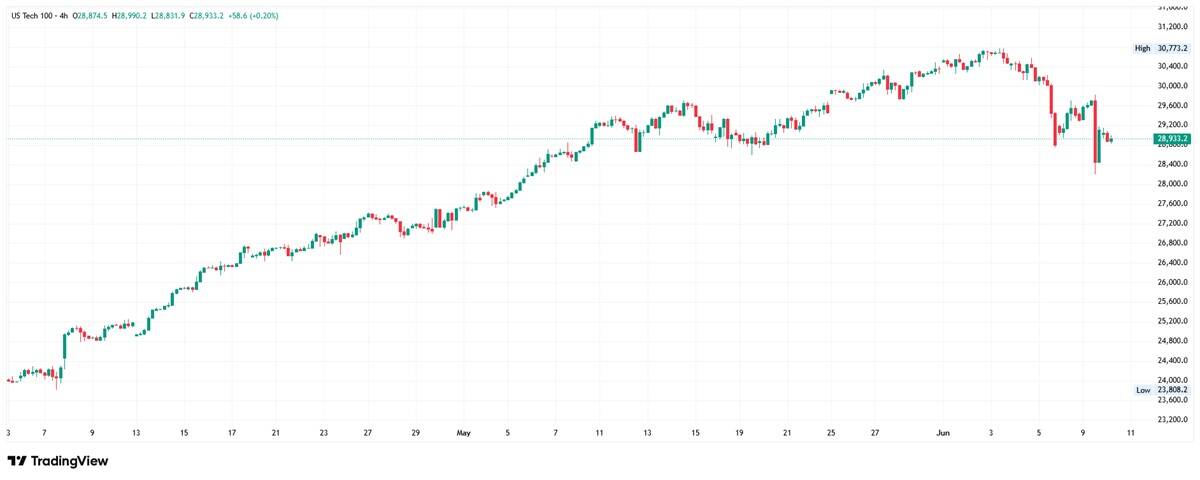
The Nasdaq 100 shed 1.1% at the close of trade yesterday, touching lows of 28,196 – levels not seen since the start of May. Futures are also down around 0.6% for the index – in fact, we are modestly red across the board right now for major US equity benchmarks.
South Korea’s KOSPI once again bore the brunt of losses overnight, losing nearly 7%, as chipmakers retreated sharply from what had been a truly extraordinary run.
Gold Losing Its Footing Under the 200-day SMA
Gold is struggling to find a foothold under the 200-day SMA – triggering additional algorithmic selling and compounding the weakness – as markets are now fully pricing in Fed rate hikes.
Brent Oil Price Forecast
Every new Brent Oil analysis as it publishes, today's technical signal and key levels, live price — on one page.
See all Brent Oil forecastsReal US yields have also been rising since the beginning of March, thereby increasing the opportunity cost of holding gold; additionally, US Treasury yields are higher across the curve this morning.
War, Ceasefire & Lower Oil Prices
This brings me to the Middle East. Just when it appeared ceasefire negotiations might be edging towards some form of resolution, tensions have ratcheted up sharply once more.
The US launched a series of strikes – described by Central Command as self-defence measures in retaliation for a US Army helicopter being downed while patrolling the Strait of Hormuz, and reports of a third round were crossing the wires in early Asian trading. Iran’s foreign ministry wasted little time signaling that no attack would go unanswered.
Unless I am missing something here – and feel free to correct me – it appears as if we are in an environment with simultaneous headlines about imminent war and a ceasefire. That contradiction alone deserves a moment’s pause.
Perhaps more surprising is how oil is responding. Despite the escalation, Brent and WTI are actually lower this morning, down 1.3% and 0.9% respectively – a move that, frankly, I would not have predicted given the headlines crossing the wires.
Today’s Playbook: US Inflation & BoC Update
All of which brings us to the real question for traders today: the US May CPI inflation print at 12:30 pm GMT and the BoC rate decision at 1:45 pm. My view on these two events remains unchanged, which could present an interesting scenario for USD/CAD.
Economists expect US inflation to come in higher for headline and core YY measures. Per the forecast distribution, 4.4% at the headline and 3% at the core would likely create an upside surprise large enough to bring forward rate-hike expectations to October’s meeting, lifting US yields and the buck. Assuming this plays out, given that CAD positioning is moderately overstretched to the downside, a USD/CAD long may unfold.
An hour or so later, the BoC rate decision lands. Ultimately, those long USD/CAD will want to see the central bank pour cold water over rate pricing: 35 bps of BoC tightening implied by year-end. I have noted this a number of times, and I feel this may be exaggerated given the lack of growth, subdued Canadian core inflation measures, and the CESI Canada chart trending lower this year. As a result, language suggesting pushback against this hawkish pricing could weigh on the CAD and ultimately provide USD/CAD with another leg higher.
Written by FP Markets Chief Market Analyst, Aaron Hill