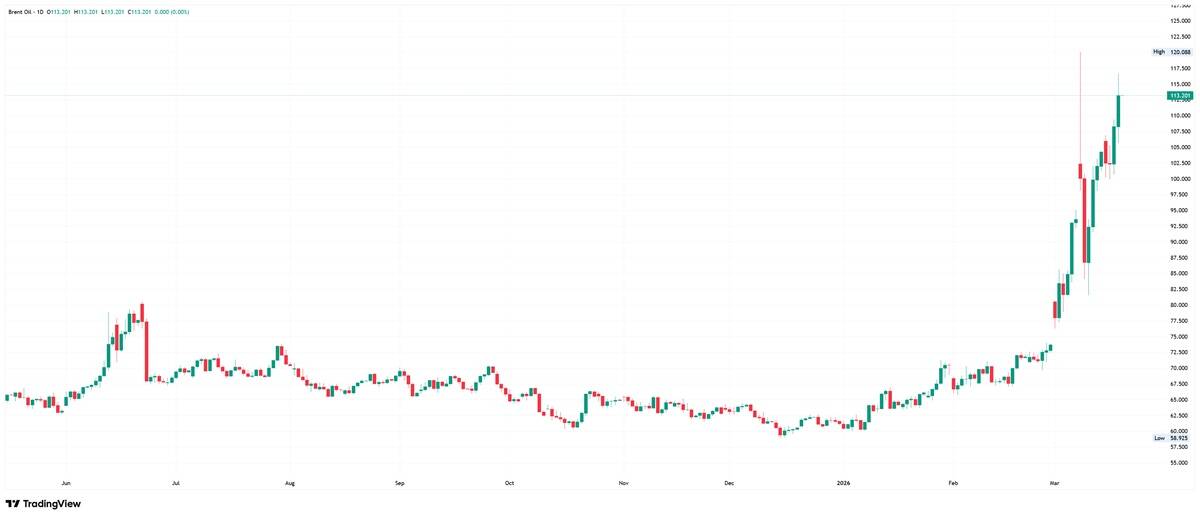
With the Strait of Hormuz remaining all but blockaded, coupled with a series of Iranian attacks on energy infrastructure in the Middle East – specifically Qatar’s Ras Laffan industrial zone, which holds a significant LNG facility – headlines continue to come in thick and fast. Brent Crude clocked a high of US$113/barrel this morning, up nearly 4% on the day, while WTI is down approximately 2% at US$96.50. We are now talking about a US$16 spread between these two markets!
Spot gold and silver took a sizeable hit on Wednesday following the Fed’s rate decision (I touch on that in more detail below). This was partly due to the USD catching a bid, up 0.7% per the USD index.
US Treasury yields bear flattened yesterday, as yields rose across the curve, particularly at the front-end. The benchmark 10-year yield rose to 4.27% and is nearing January highs of 4.31%.
In the equities space, it was red across the board for major US averages, with the Dow falling 768 points (1.6%) to 46,225, the lowest closing level YTD, and also elbowed south of the 200-day SMA at 46,528. The S&P 500 dropped 91 points (1.4%) to 6,624, and the Nasdaq 100 was down 355 points (1.4%) to 24,425. Market breadth showed 422 names in the red in the S&P 500, with 81 stocks ending higher. All 11 sectors also finished on the ropes – consumer staples and consumer discretionary led the way, shedding more than 2%.
Fed in the Rear-view Mirror: Powell Is Not Going Anywhere
The Fed decision landed yesterday evening (for me) and kept the target rate unchanged at 3.50-3.75%. No surprises there, as it was widely priced in by economists and markets.
The March SEP was interesting; real GDP was revised higher across all horizons, surprising many, as a downgrade was expected given the elevated uncertainty. Both the headline and core PCE were revised materially higher for this year to 2.7% (from 2.5%) and to 2.2% (from 2.1%) in 2027, and are expected to hit 2.0% in 2028, respectively. This was a little lower than some desks had forecast, particularly for this year. But it ultimately demonstrated that, while the 2% target landing is preserved, the path is likely to be bumpier than expected. Higher growth and inflation suggest a supply-side shock narrative rather than simply overheating.
In terms of the rate path, there was no change: the median Fed funds rate remained at 3.4% for this year, meaning the central bank still expects to lower rates once, with a follow-up cut in 2027 (3.1%). However, the median long-run rate dot was revised up to 3.1% from 3.0%, indicating that even if they cut this year and the next, we are not going any lower than that for now. Fed officials are essentially signalling that it is on the sidelines, looking through the near-term inflation bump and waiting for more data. According to market pricing, investors are essentially now 50/50 about whether the Fed will lower rates at all this year – 11 bps of easing is implied by year-end.
Fed Chair Jerome Powell signalled that the central bank is on the sidelines and offered no hint of the timing of any rate cut. Powell did, however, leave the door ajar when questioned about his future at the Fed, stating that he is not going anywhere until the legal proceedings against him have concluded, but he remains undecided whether he will stay on as a Governor once his term as Chair ends in May. Powell did note that he would keep serving as Chair until, presumably, Kevin Warsh is confirmed by the Senate.
I also noted three things changed in the accompanying rate statement between January and March:
Brent Oil Price Forecast
Every new Brent Oil analysis as it publishes, today's technical signal and key levels, live price — on one page.
See all Brent Oil forecasts- January’s report described the unemployment rate as showing ‘some signs of stabilisation’. This has been replaced with ‘little changed in recent months’, offering a more neutral tone for the jobless rate.
- Middle East uncertainty was highlighted, adding: ‘The implications of developments in the Middle East for the U.S. economy are uncertain’. This clearly indicates that this is a source of economic uncertainty for the Fed.
- There was just one dissenter who opted for a 25-bp rate cut – Governor Stephen Miran – which was not a surprise. However, it was interesting, given that I would have thought the latest February jobs report should have prompted Governor Christopher Waller to opt for another 25-bp cut. I am curious to understand his rationale.
Day Ahead: ECB and BoE in the Spotlight
Overnight, the BoJ held the policy rate steady at 0.75%. Similar to the Fed, this raised few eyebrows. Updates from the BoE and the ECB are due to make the airwaves today at midday GMT and 1:15 pm, respectively. Both central banks are forecast to stand pat on rates, but the tone and direction from each may vary.
Bank of England
For the BoE, the pendulum has well and truly swung in favour of hikes; markets are now pricing in 35 bps of tightening by year-end. Investors are eyeing either June or July’s meeting as a possibility for a 25-bp hike. Nevertheless, I feel the market may be getting a bit ahead of itself here; does this all not seem ‘too’ hawkish? I suppose that, given this hawkish pricing, any language that runs counter to it could provide a strong tailwind for GBP shorts.
Overall, nothing has materially changed in the UK economy. The jobs market continues to loosen, growth remains paltry, and inflation is still above the BoE’s 2% target. The hawkish tilt is simply about rising GILT yields driven by higher inflation expectations.
On the back of this, I will be watching for whether the MPC removes its easing bias or conditions it on energy prices. This will be a key piece of information.
Per LSEG data, economists expect a 2-7 vote split – presumably Taylor and Dhingra voting to cut – which, again, seems overly hawkish, knowing that the MPC has been deeply divided in the previous three meetings. The market’s expectation of a 2-7 split indicates that Ramsden and Breeden may retreat to the dovish side of the Committee on concerns about the rise in energy prices.
European Central Bank
The ECB is in a bit of a different spot, as rates are already at the mid-point of the central bank’s estimated neutral range (1.75-2.25%).
We will be getting updated forecasts from the ECB today, but how much value they offer remains to be seen given the conflict in the Middle East. I think this meeting boils down to how President Christine Lagarde frames the war in Iran. It will be interesting to see how she explains the central bank’s reaction function to these risks and how high their tolerance for inflation spikes is.
Lagarde could remove the ‘policy in a good place’ language and swing more hawkish, but is unlikely to openly commit to a tightening bias. If she does, expect the EUR to be bid.
Written by FP Markets Chief Market Analyst Aaron Hill