Outperformance was driven by news that the US and Iran had reached a 60-day truce, pending President Trump’s approval. While this is positive news, frankly, we have been here before, and I am not holding my breath; one social media post could swing things entirely in the other direction.
What I will say is that while markets have reacted as expected – stocks higher, oil, the USD, and yields lower – it has thus far been a measured market response, highlighting the market’s scepticism, and rightly so, in my opinion.

Stagflation Vibes: US Inflation and Lower Growth
We had a slew of US data land yesterday, which largely echoed a stagflationary backdrop.
Both the April YY headline and core PCE numbers reported bang in line with consensus, printing at 3.8% (up from 3.5% in March) and 3.3% (up from 3.2%), respectively. Commonly referred to as the Fed’s preferred inflation gauge, this print – albeit lower than feared – is still showing elevated figures that are considerably north of the central bank’s 2% target. Unsurprisingly, higher prices resulted from increasing energy costs.
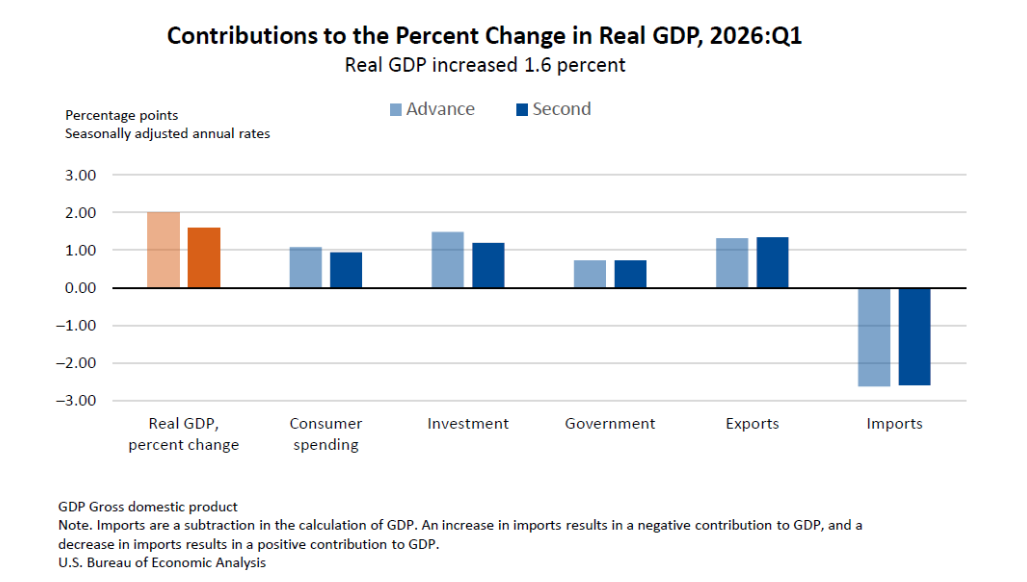
In terms of GDP data, the US Q1 26 second estimate showed economic growth was revised lower to 1.6% from 2%, as shown below. This reflected softer consumer spending and investment. Imports were also little changed between the advance and second estimates, while exports were revised modestly higher — though not enough to offset the drags elsewhere. What did raise a few eyebrows, however, was the April numbers getting off to a bad start for the quarter: real consumer spending grew a meagre 0.1%. This is a sign that elevated energy prices are starting to weigh on activity and inflation.
We have seen a modest dovish repricing on the back of these data, from around 15 bps of tightening to 12, which is not really anything to write home about. I cannot see any of these data materially changing the Fed’s outlook.
While the new Fed Chair, Kevin Warsh, has suggested that the Fed’s target rate could eventually be lowered, the Fed is a 12-member voting committee, and, in light of recent commentary from other Fed officials, he is likely to face some resistance if he attempts to reduce rates in the not-so-distant future. Until the mixed messaging between the US and Iran stops and we have clear information regarding the reopening of the Strait of Hormuz in the Middle East, the Fed will continue to echo a hawkish bias, I believe, which could help underpin the USD.
Brent Oil Price Forecast
Every new Brent Oil analysis as it publishes, today's technical signal and key levels, live price — on one page.
See all Brent Oil forecastsToday’s Tape: What to Watch
Regarding the day ahead, we have regional inflation prints from Europe landing, Canadian GDP numbers, and a slew of Fed speak.
The CESI for Canada has largely been a one-way street lower since the beginning of the year, meaning that data has surprised to the downside. We also have GDP growth that is ok but not great, a loosening jobs market, and rising inflation, though not as much as in other developed nations.
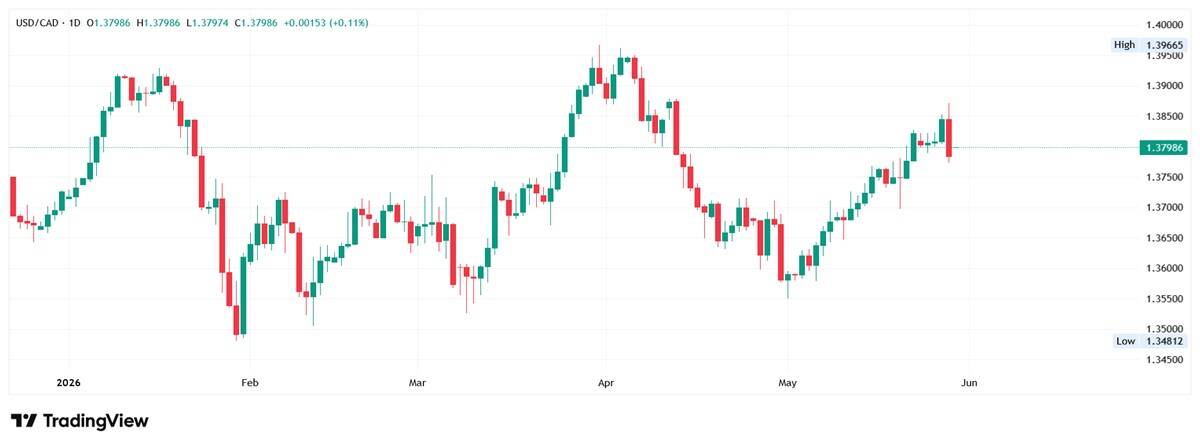
However, markets are pricing in nearly 33 bps of BoC tightening by year-end, which looks a touch optimistic given the data we are seeing at the moment. The CAD is also overstretched to the upside, according to CFTC positioning, so if GDP comes in lower than expected today, investors could unwind some rate-hike expectations and long exposure, which would likely be CAD negative.
Fed speakers on deck today include:
- Kansas City Fed President Jeffrey Schmid and Fed Vice Chair Michelle Bowman are speaking in Reykjavik, Iceland.
- Minneapolis Fed President Neel Kashkari speaking in Seoul, Korea.
- Philadelphia Fed President Anna Paulson speaking in New Jersey.
- San Francisco Fed President Mary Daly speaking in California.
Written by FP Markets Chief Market Analyst Aaron Hill