Market Snapshot: Oil Prices Holding South of US$100
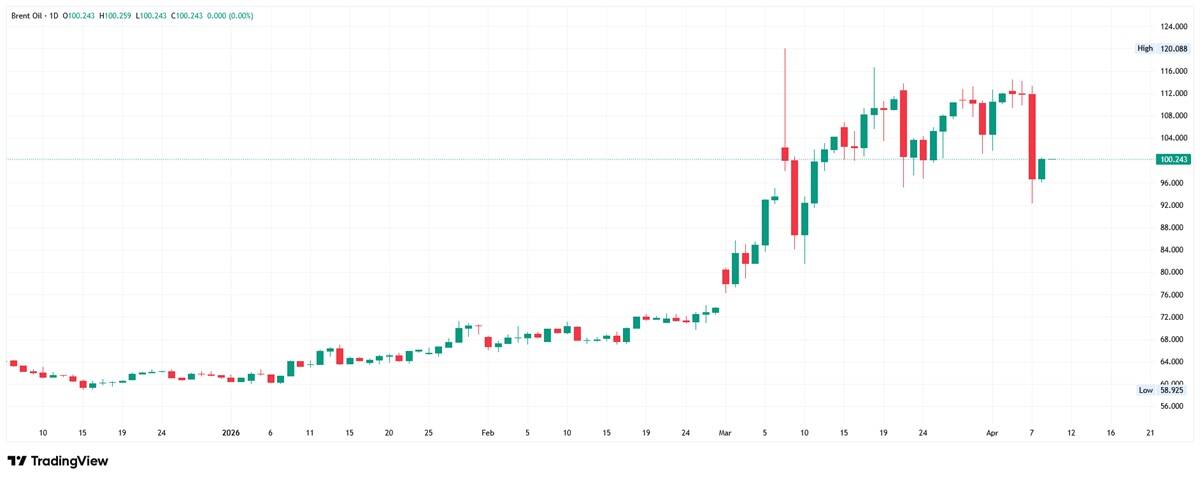
It was very much a risk-on session yesterday as markets were bolstered by the two-week US-Iran ceasefire arrangement, with both Brent and WTI rolling south of US$100 per barrel, and global equity benchmarks catching a strong bid. Spot gold also remained modestly higher into the close, though ended the day considerably off best levels – technical analysts will likely view this as a classic bearish shooting star formation on the daily chart.
Yesterday saw the Dow jump by more than 1,300 points, or 2.9%, to close at 47,913. The S&P 500 added 2.5% to 6,783, and the Nasdaq 100 gained nearly 3.0% to 22,637. The VIX also fell to just north of the widely watched 20.00 barrier.
In FX, the USD squeezed lower, ending the day 0.5% on the ropes as haven longs unwound. YTD, nevertheless, we are still higher by nearly 1.0%, per the USD index. While the move was fuelled by recent developments in the Middle East, it is interesting to note where the index rebounded from: daily support at 98.58, joined by the 50- and 200-day SMAs at around 98.50ish.
However, it was not so cut-and-dried in the fixed-income space, with US Treasury yields dropping across the curve early in the session, only to completely reverse this move by the close and finish largely unchanged.

Tentative Truce: Where Does Israel Fit in?
Conviction in the ceasefire deal remains largely intact, although key risks still exist. While the ceasefire is welcome news, the two sides appear very far apart, with several red lines in place. I simply do not see how both the US and Iran will accept the demands outlined in the 10-point plan, which includes war reparations, Iranian control over the Strait of Hormuz, and no US sanctions. One thing we have confirmed is Iran’s power and influence over the Strait; it was only when the strikes began that we saw it start to exercise that power, and undoubtedly, it will not want to lose this leverage. So, I believe this will be off the table for Iran in the upcoming talks.
We also need to consider that it is not just the US and Iran involved here. What about Israel? Despite the ceasefire, Israel continues to strike Lebanon, which, according to Iran’s deputy foreign minister, is a ‘grave violation’ of the truce.
Brent Oil Price Forecast
Every new Brent Oil analysis as it publishes, today's technical signal and key levels, live price — on one page.
See all Brent Oil forecastsVance to Lead Talks with Iran in Pakistan
US Vice President JD Vance recently hit the wires as he heads to Islamabad, Pakistan, to lead talks with Iran. Before his departure, Vance noted that if talks with Iran fall through due to the Israeli attacks in Lebanon, which he added were never part of the ceasefire agreement, that is ‘their choice’.
Iran’s delegation was scheduled to arrive in Islamabad on Thursday night. Tehran’s parliament speaker called the situation ‘unreasonable’ following Israel’s largest coordinated strike of the war on Wednesday, which resulted in over 250 deaths in Lebanon. Iran states that a ceasefire in Lebanon is a crucial condition for any agreement.
As you can see, there are many cogs turning, making it a difficult trading environment.
The Fed’s Dilemma
The Fed minutes for the March meeting were released yesterday and showed the central bank voted to keep the target rate steady at 3.50-3.75%, with Governor Miran the only dissenter. Fed officials also raised their inflation outlook for this year due to conflict-related energy price shocks, while growth forecasts were slightly upgraded.
There also remains a two-sided debate, suggesting some members believe tightening could be necessary if inflation rises, although there is also pressure to cut rates due to damage to the jobs market and economic growth. Nonetheless, despite this debate, most members still see easing as the baseline scenario. Ultimately, markets were unmoved by the minutes, with geopolitics remaining front and centre.
US PCE Data Eyed
Up ahead today is the US February PCE price index, which is the Fed’s preferred measure of inflation. Headline YY PCE is expected to remain unchanged at 2.8%, while the core measure is forecast to slightly decelerate to 3.0% from 3.1% in January. Importantly, this is the last ‘clean’ read on prices prior to the onset of the Middle East conflict. Either way, despite a reasonably broad estimate range for both measures, price pressures are set to remain north of the Fed’s 2.0% target.
A soft print would be a meaningful relief signal and could extend the ceasefire-driven rally in rate cut expectations. As a result, this would likely add to the USD downside and exacerbate any fall in yields. Conversely, a better-than-expected number could temper rate-cut expectations and give the USD a short-term boost.
In a nutshell, today’s PCE print provides a reading of inflation prior to the Middle East conflict, while the US March CPI numbers deliver the first look at the energy shock’s direct impact on prices on Friday. As a note, the CPI reading is expected to show a considerable jump higher in the headline print, reflecting the impact from the US-Iran war and elevated energy prices.
Written by FP Markets Chief Market Analyst Aaron Hill