For me, the meeting was a blend of hawkish intent and measured restraint, suggesting that while the central bank is serious about controlling inflationary pressures and that it is its primary concern, it did not explicitly commit to aggressive tightening and that future moves would be dependent on incoming data.
This week welcomes the January Australian CPI inflation report on Wednesday at 12:30 am GMT – the first release since the central bank’s rate hike. Market participants will be monitoring this report closely to help determine whether the RBA’s recent hike was a one-and-done move or a sign of things to come.

Jobs Data Holding Steady; Price Pressures Are Key
The upcoming inflation print also follows the Australian January jobs report, which showed that the labour market remains relatively tight. Despite expectations of an increase to 4.2%, unemployment remained at 4.1%, matching May 2025 levels and underscoring resilience. Job vacancies also remain elevated, double the long-run average.
Employment change showed an increase of 17,800, down from December’s 65,200 reading. However, it is worth noting that this reflects those who did any form of paid work based on the reference week. If you look under the hood, you will see that part-time work fell by 32,700, so you could say that the 17,800 gain was driven by a rise in the 50,500 full-time roles.
Given the low jobless rate, wage growth, and price pressures still elevated, the RBA has some work to do.
What to Expect on Wednesday
As shown in the LSEG calendar below, economists are expecting the YY headline inflation to ease by 3.7% from 3.8% in December, which would still be considered too high for the RBA. The trimmed mean YY CPI print is also anticipated to remain unchanged at 3.3%.
AUD/USD Price Forecast
Every new AUD/USD analysis as it publishes, today's technical signal and key levels, live price — on one page.
See all AUD/USD forecasts
Per the latest research note from Westpac Economics, the team there are forecasting the annual headline rate to pullback to 3.6% but align with the median consensus for the trimmed mean.
I do want to add that we are expecting some kickback from electricity prices, as January marks the date when the government’s energy rebates will roll off. This means consumers’ electricity bills will revert to their underlying prices, and this could result in a jump of up to 5.0%, according to Westpac. The main point is that, given this should be a one-off increase, this could be a misleading component.
AUD Overstretched to the Upside
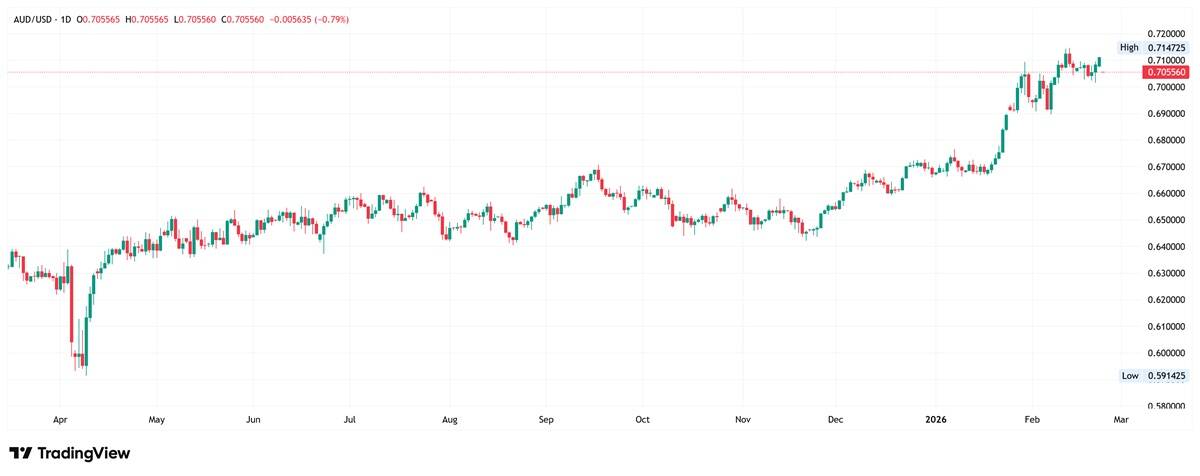
The inflation report also arrives when the AUD is overstretched to the upside; since April last year, the currency has been on a tear versus its G7 peers. Additionally, according to the latest CFTC positioning report, you will note that the AUD remains one of the most overextended currencies to the upside right now.
Per the futures market, investors are pricing in just 5 bps of hikes for the March meeting, with approximately 17 bps for May, and a total of 37 bps implied by year-end.
If inflation comes in hotter than expected, this could fully price in a 25-bp rate hike at May’s meeting, which would naturally bolster the AUD. However, given the currency’s positioning right now, I would be hesitant to jump on Board a beat. With that said, according to the technical picture for AUD/NZD, there is certainly scope for further outperformance after the break of NZ$1.1800, with resistance seen overhead from NZ$1.1960.
Nevertheless, knowing that the AUD is overstretched, I would much rather trade this market on a solid miss, creating a positioning unwind as traders price out some of the tightening this year, with shorts likely to add to positions following a break under NZ$1.1800. One caveat to this trade is that the AUD/NZD cross remains entrenched in an uptrend. So, do bear this in mind if considering shorts on a data miss this week, reducing risk to breakeven when viable and keeping targets tight.
Conclusion
Whatever Wednesday’s figures show, the RBA has been explicit that there is no pre-set path.
Each decision will be made on its merits. But with inflation forecast to remain above the target band of 2-3% until 2028 and with employment risks lessened, according to the latest minutes, the burden of proof lies firmly with the inflation data. It would need to surprise meaningfully to the downside for the RBA to find reason for restraint.
Written by FP Markets Chief Market Analyst Aaron Hill