GBP/USD 2026 Outlook: Dollar Weakness Meets Sterling Constraints
The British Pound enters 2026 with cautious upside against the US Dollar, but conviction remains limited. Following the Federal Reserve’s December 2025 rate cut to 3.50–3.75%, consensus among major investment banks places GBP/USD in a broad 1.35–1.47 range over the year, with most forecasts clustering around 1.36–1.40 by year-end. While dollar weakness is the dominant theme, Sterling’s own economic and fiscal challenges are expected to cap gains and sustain two-way volatility.
The outlook hinges on three variables: the pace and depth of Federal Reserve easing, the Bank of England’s response to domestic weakness, and the evolution of fiscal credibility on both sides of the Atlantic. Together, these forces argue for a constructive first half of 2026 for GBP/USD, followed by a more fragile second half as policy differentials narrow and fiscal risks return to focus.

Federal Reserve Policy: A Divided Pivot
The Fed’s December 2025 decision marked a turning point, but not a clean one. The 25bp rate cut was delivered with a rare 9–3 split, underlining internal disagreement over inflation persistence and labor market softening. Inflation rebounded to 3.6% in November, while job growth slowed steadily through 2025, leaving policymakers navigating increasingly narrow margins.
Chair Jerome Powell’s “wait-and-see” language signaled that further cuts are conditional rather than pre-committed. Complicating matters, a late-2025 government shutdown delayed key data releases, forcing the Fed to act with incomplete information. While markets continue to price additional easing in early 2026, the risk of pauses or slower sequencing remains material if inflation fails to cool.
For FX markets, the significance lies less in the December cut itself and more in what follows. If the Fed continues easing into mid-2026, the dollar’s yield support erodes further. If inflation stalls, the easing cycle could prove shallower than markets expect, limiting GBP/USD upside.
Diverging Bank Views: From Caution to Conviction
Major banks remain divided on how far GBP/USD can rise, largely reflecting differences in their dollar outlooks.
GBP/USD Price Forecast
Every new GBP/USD analysis as it publishes, today's technical signal and key levels, live price — on one page.
See all GBP/USD forecastsGoldman Sachs maintains the most conservative stance, projecting GBP/USD at 1.35 in early 2026 and 1.36 through year-end. Their view reflects skepticism that Sterling can generate independent momentum, given tightening fiscal conditions and slowing UK growth. Goldman expects GBP to track broader EUR/USD trends rather than outperform, with risks skewed toward underperformance if positioning unwinds or global growth disappoints.
JPMorgan strikes a more balanced tone. The bank forecasts GBP/USD recovering toward 1.39 in early 2026 before settling back near 1.36 by year-end. Their thesis is explicitly dollar-driven, rooted in cyclical US slowdown and structural concerns around valuations and fiscal deficits. However, JPMorgan remains wary of Sterling-specific headwinds, favoring tactical long positions rather than a structural bullish stance.
Morgan Stanley presents the most bullish scenario, projecting GBP/USD at 1.47 by end-2026, with upside extensions toward 1.50 if US growth decelerates sharply. Their base case assumes three additional Fed cuts in the first half of 2026, driving the fed funds rate toward 3.00% and compressing US rate differentials. Still, even Morgan Stanley has moderated its earlier conviction, acknowledging that dollar weakness may prove more measured and front-loaded.
MUFG adopts a middle-ground approach, projecting GBP/USD near 1.40 by mid-2026, consistent with a gradual rather than disorderly dollar decline. Importantly, MUFG has revised forecasts higher for the dollar relative to earlier expectations, reflecting its resilience despite easing.
Bank of England: Sterling’s Limiting Factor
If the Fed sets the ceiling for GBP/USD, the Bank of England likely defines the floor. After cutting rates five times in 2025, bringing Bank Rate to 4.00%, markets expect further easing. Consensus forecasts see rates falling to 3.25% by Q3 2026, with several institutions calling for 3.00% or lower by year-end.
The rationale is straightforward. UK growth remains weak, GDP contracted in October 2025, and unemployment has risen to 5.0%. At the same time, inflation remains elevated at 3.6%, leaving the BoE balancing fragile growth against incomplete disinflation. Morgan Stanley expects rates as low as 2.75%, a move that would materially erode Sterling’s carry support.
This aggressive easing bias limits Sterling’s ability to outperform, even in a weakening dollar environment. Unlike earlier cycles, GBP’s upside is unlikely to be driven by yield differentials and instead relies on relative economic resilience and capital flows.
Risk Scenarios: What Moves the Needle
Upside risks for GBP/USD are overwhelmingly dollar-centric. A sharper-than-expected US slowdown could force the Fed into faster or deeper cuts, pushing GBP/USD toward the upper end of forecasts. Similarly, a policy misstep that tightens financial conditions into labor market weakness would likely weigh on the dollar.
Sterling-specific upside is harder to justify but not impossible. A stabilization in UK growth, improved productivity trends, or credible fiscal signaling could help GBP outperform expectations, though these remain secondary drivers.
Downside risks remain meaningful. Sticky US inflation could stall Fed easing and preserve dollar yield support. In the UK, fiscal scrutiny is likely to intensify ahead of future budget cycles, particularly if debt dynamics worsen. A global risk-off episode would also favor the dollar, regardless of valuation arguments.
Technical and Positioning Context
From a technical standpoint, GBP/USD faces heavy resistance in the 1.38–1.42 zone, an area that capped rallies in prior cycles. Support near 1.30–1.32 has held consistently, suggesting a broad trading range rather than a trending market.
Positioning remains elevated following Sterling’s 2025 performance, increasing vulnerability to pullbacks if underlying momentum fades. Sustained breaks above 1.38 would likely require either pronounced US weakness or a material improvement in UK fundamentals, neither of which sits in the consensus base case.
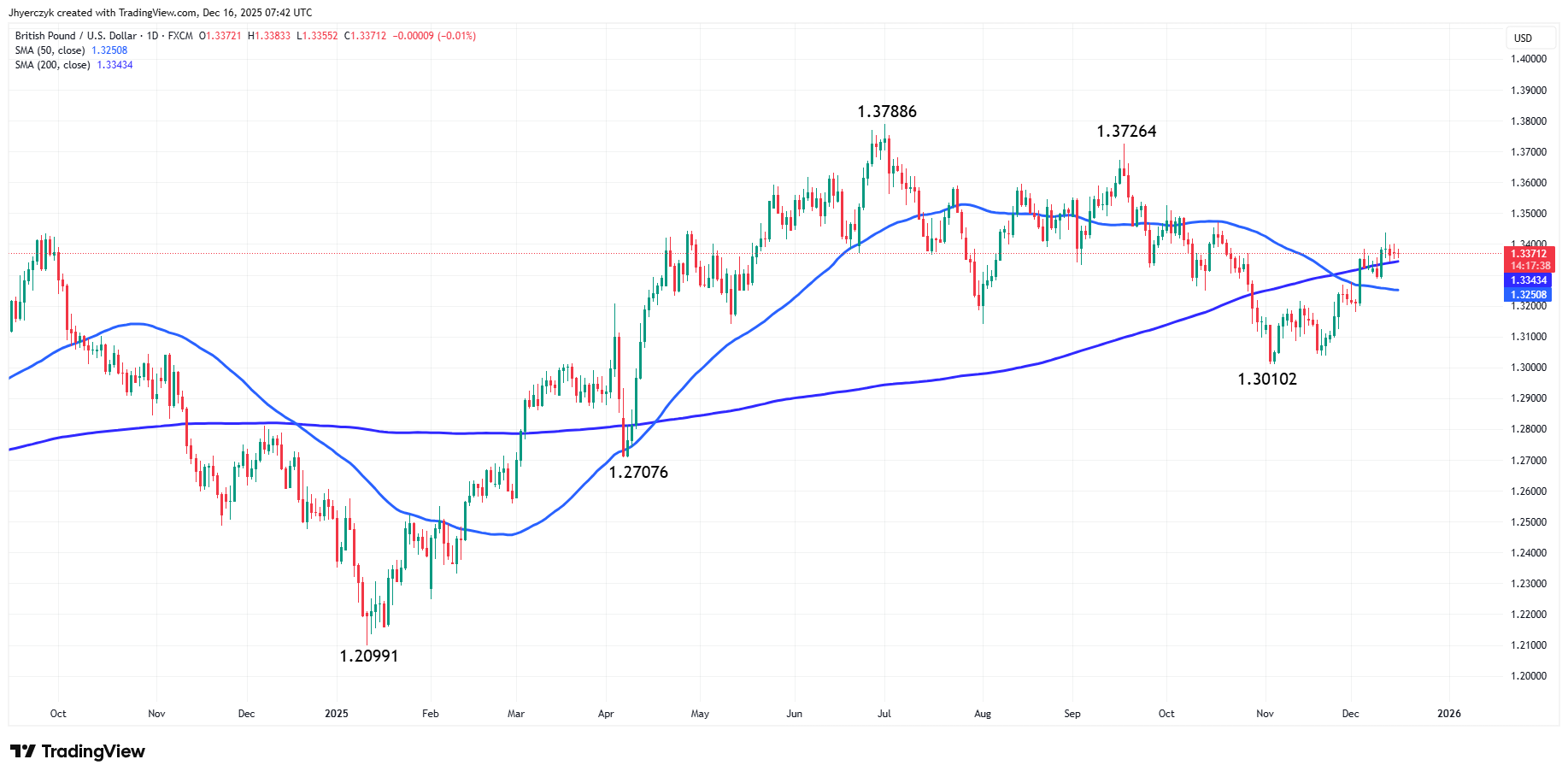
Short-term trend analysis shows GBP/USD is the early stages of a shift in momentum. The Forex pair is trading well-above the 50-day moving average at 1.32508, but only starting to establish support on the strong side of the 200-day moving average at 1.33434. The 50-day MA is also trading on the weakside of the 200-day MA, which isn’t a particularly bullish short-term indicator. It typically indicates investor indecision with traders searching for the short-term catalyst to drive the GBP/USD decisively above both moving averages.
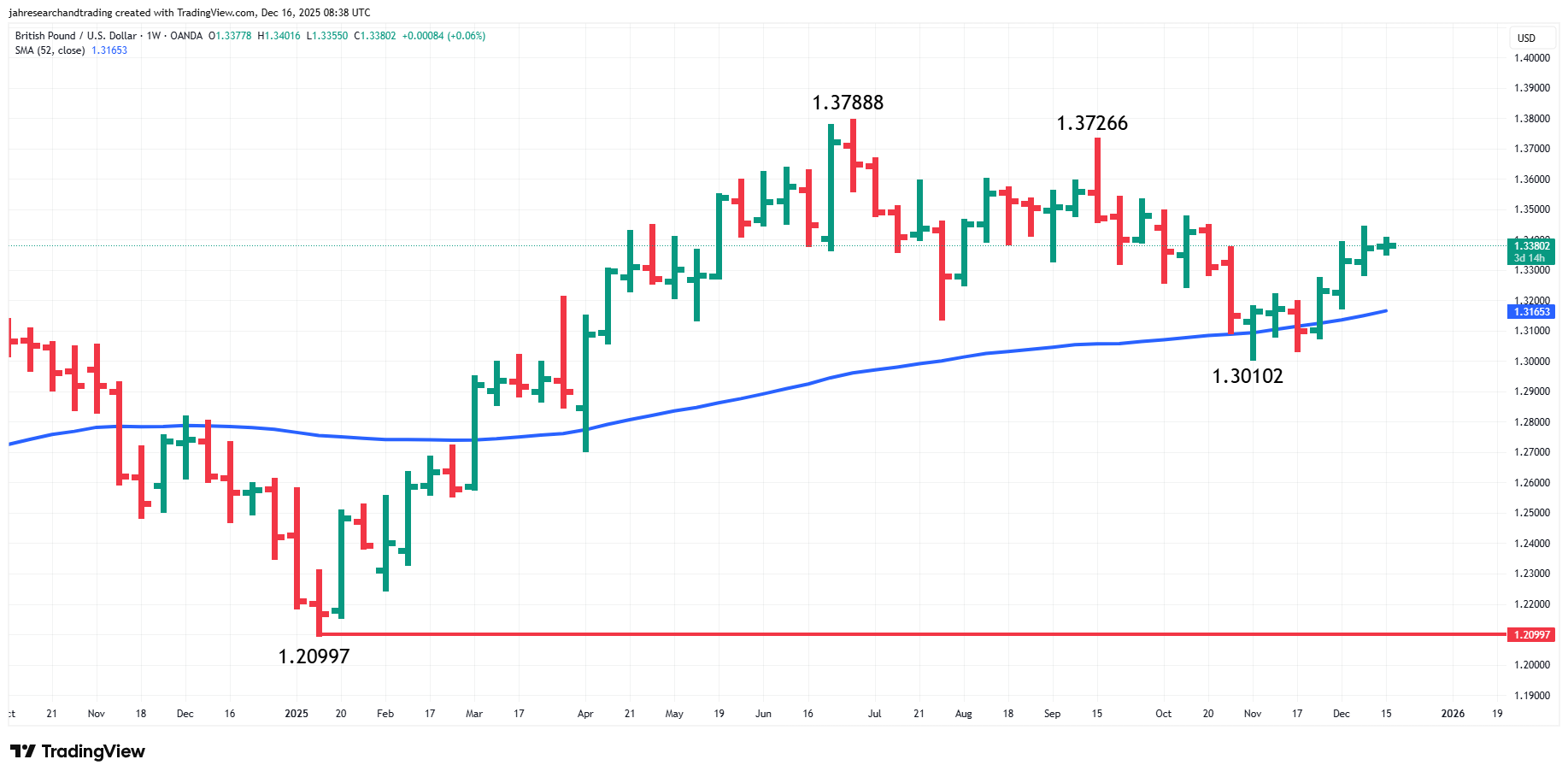
The intermediate trend is decisively bullish with the GBP/USD pulling away from the 52-week moving average at 1.31653 for the fourth straight week as we approach the start of the new year. After crossing to the strong side of this technical trend indicator in early March, the GBP/USD spent most of the year in a bullish position, even surviving a couple of attempts to shift momentum to the downside in April and November.
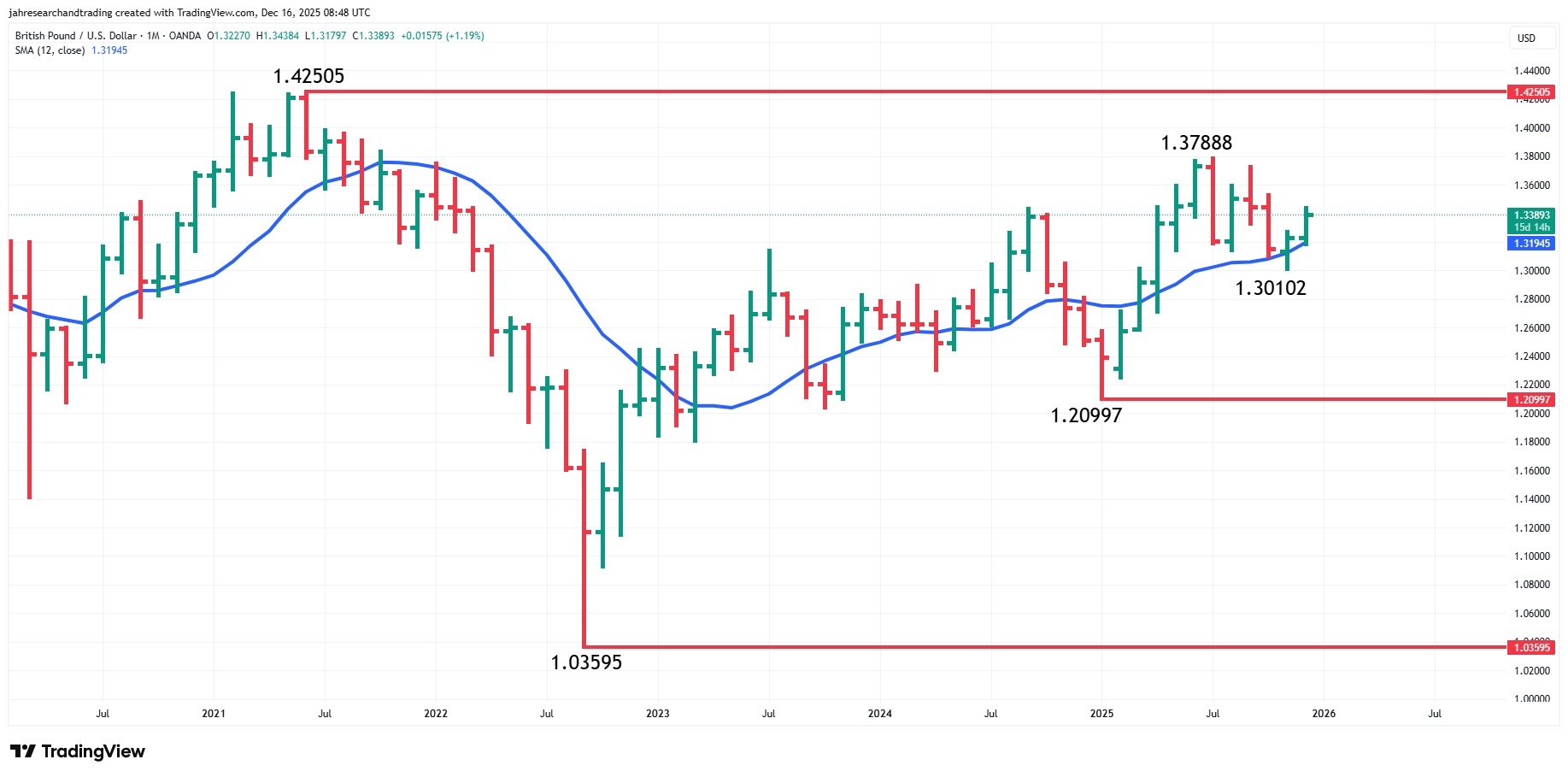
The longer-term monthly chart is in a position to start the new year in a bullish position with the December breakout to the strong side of the 12-month moving average at 1.31945. The GBP/USD will still have to show strength by challenging the major tops at 1.37888 and 1.42505, but this long-term trend indicator should set the tone for the year. A sustained move under this moving average and a break under 1.30102 will put the Forex pair in a weak position with no major support until 1.20997.
Bottom Line
GBP/USD in 2026 is best framed as a dollar story with Sterling constraints. The balance of evidence supports modest upside in the first half of the year as Fed easing progresses, followed by consolidation or retracement as policy differentials compress and fiscal concerns resurface.
A year-end range near 1.30–1.38 remains the most defensible baseline, with wider outcomes reflecting unusually high policy and growth uncertainty. For traders and investors, flexibility matters more than conviction. Monitoring central bank communication, labor data, and fiscal signaling will be critical, as the December 2025 Fed pivot provided direction—but not resolution.
More Information in our Economic Calendar.