
What began as a technically driven bull market — anchored in moving average crossovers, channel breakouts, and RSI momentum — has now collided with a fundamental backdrop of historic severity. The convergence of a Middle East war directly involving the United States and Iran, a credible threat to the world’s most critical oil chokepoint, and a cascading risk to China’s energy security has created conditions that, by any historical precedent, are profoundly bullish for gold. This analysis outlines the technical structure across multiple timeframes and frames the macro thesis that supports a move toward $6,000 in the near term, with $8,250 as the primary cycle target under a sustained crisis scenario.

Technical Structure: Multi-Timeframe Confirmation
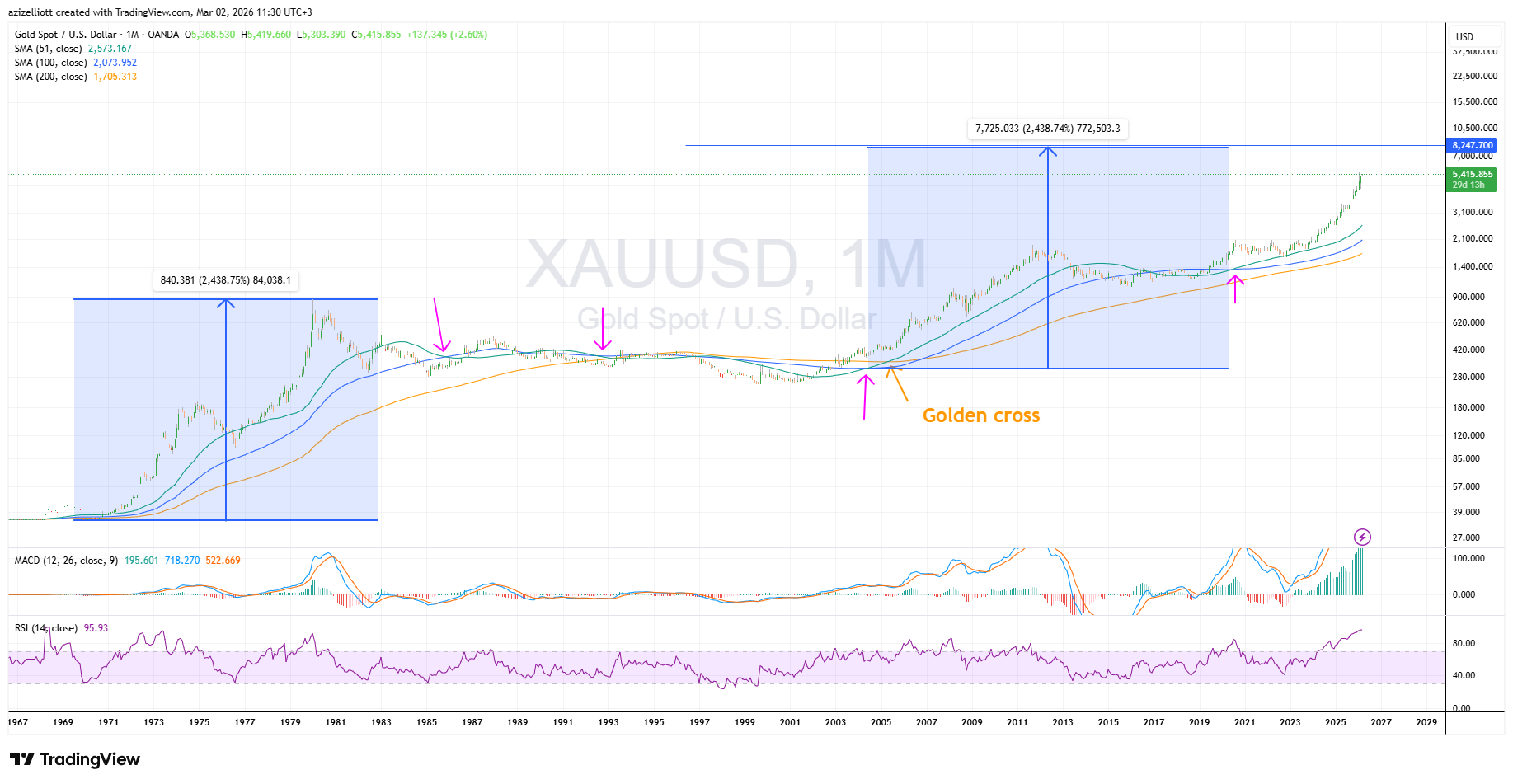
Monthly Chart — SMA Crossovers and Dynamic Resistance
On the monthly timeframe, the SMA100 and SMA51 crossovers have been highlighted as historically reliable signals of trend reversal. Each instance where these two averages have crossed has preceded a sustained directional move, and the current configuration continues to support the ongoing uptrend.
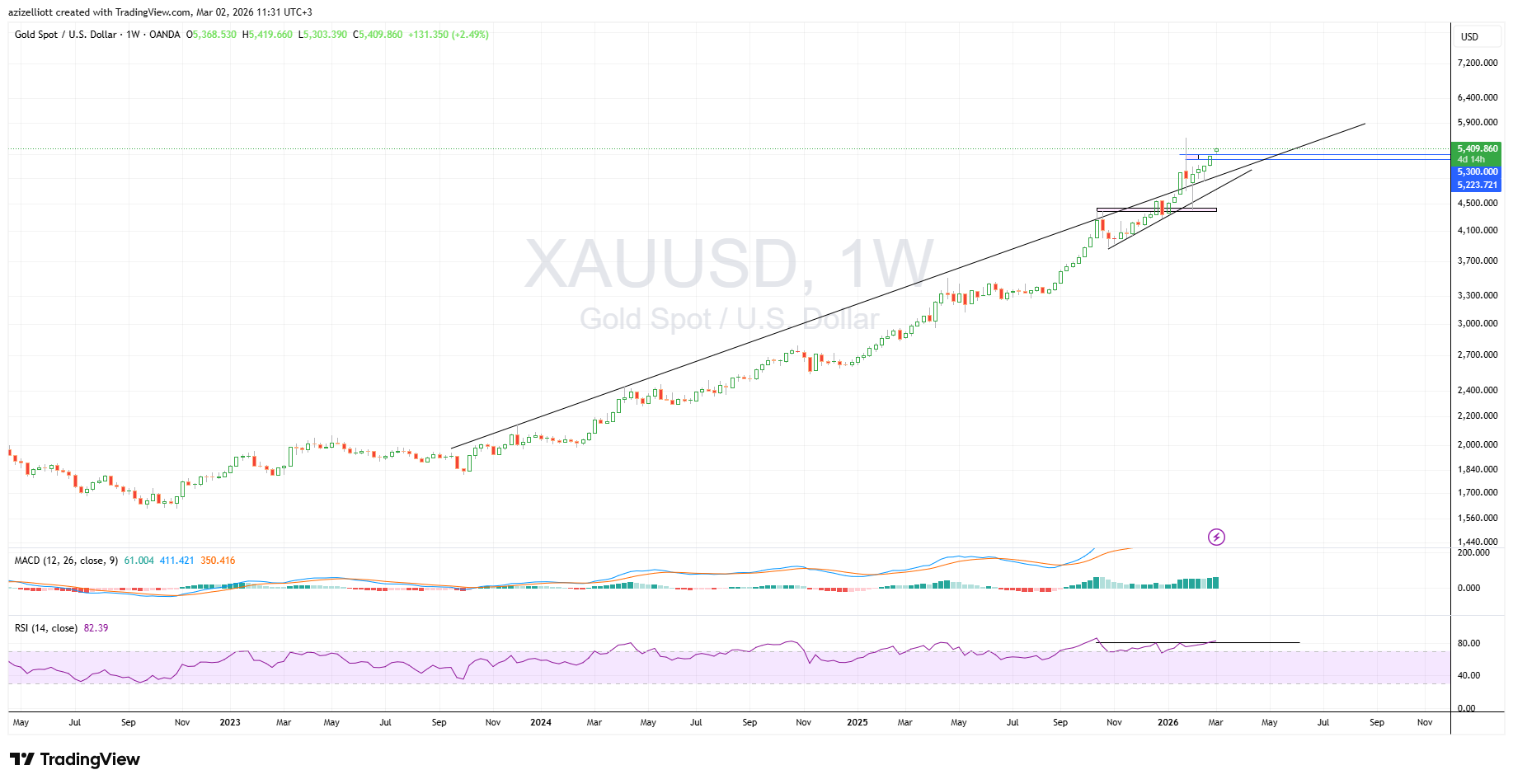
Gold has broken above the dynamic resistance that originated in December 2023 — a level that capped price on multiple attempts before eventually yielding. Following the breakout, price retested this former resistance as support on several occasions and held convincingly on each, confirming the level has transitioned from resistance to a structural demand zone. The weekly RSI has crossed its own long-term barrier and is expected to remain on the verge of overbought territory for an extended period — behavior consistent with parabolic cycle extensions, where momentum remains elevated well beyond what conventional oscillator thresholds would suggest is sustainable.
Daily Chart — Continuation Confirmed
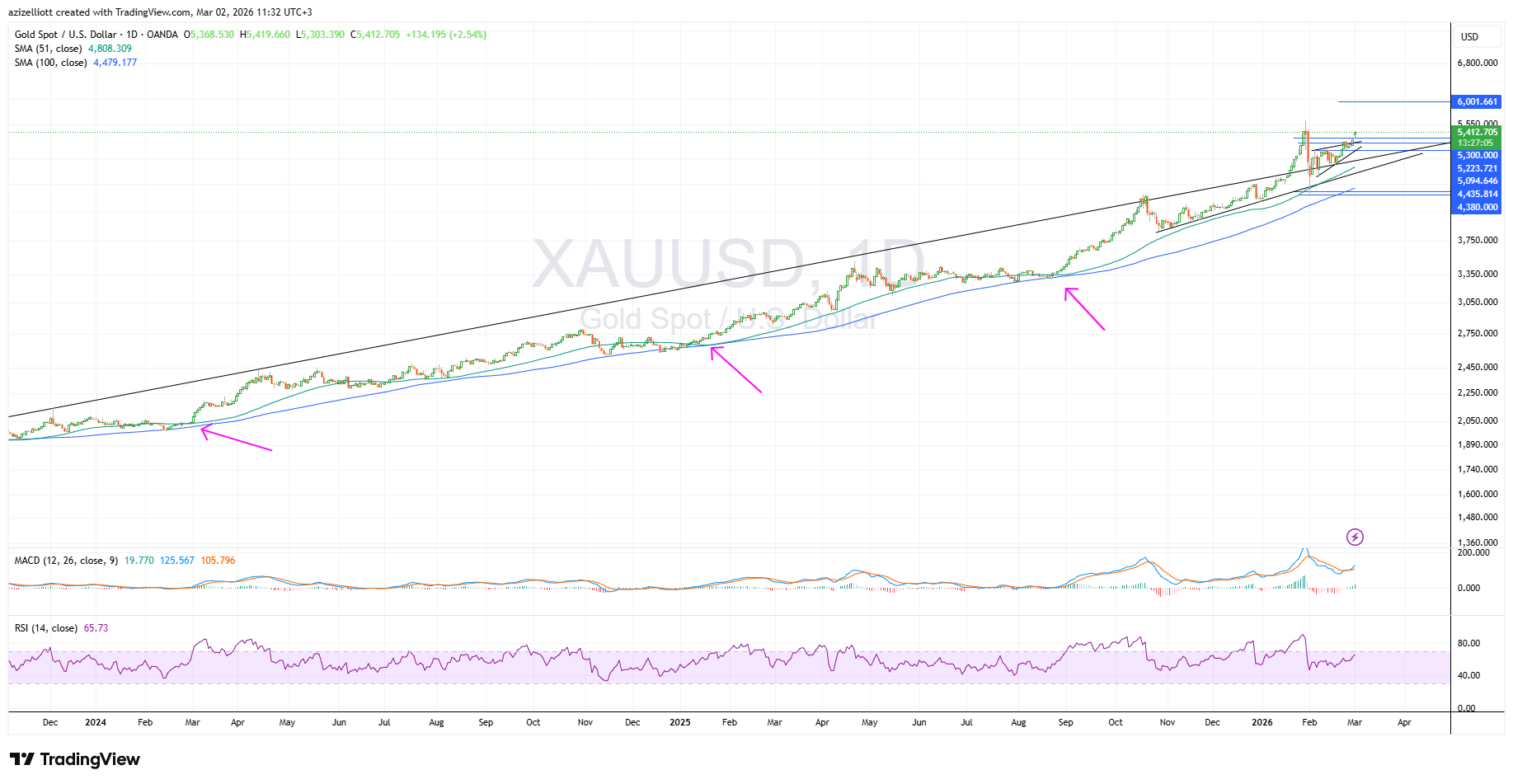
The same SMA crossover dynamic visible on the monthly and weekly charts is now repeating on the daily timeframe, reinforcing the multi-timeframe alignment that characterizes the strongest and most durable trending environments. When the same signal appears across three timeframes simultaneously, the probability of sustained directional continuation increases materially.
4-Hour Chart — Channel Breakout and Near-Term Resistance
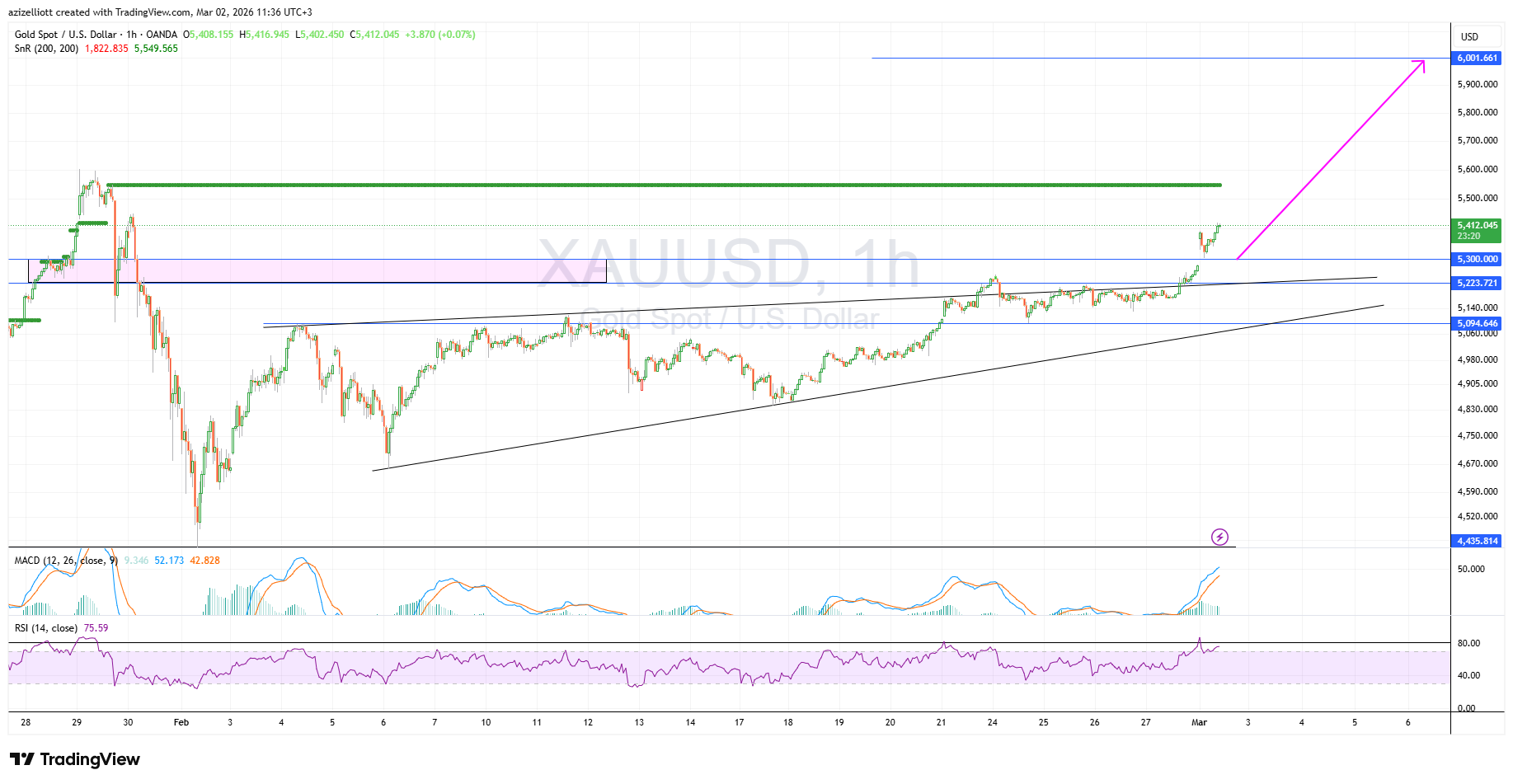
On the 4-hour chart, Gold has broken out above the upper band of a well-defined parallel channel — a technically significant development that shifts the short-term structure from range-bound to directional. However, the $5,300 level represents a meaningful resistance zone that is likely to assert itself in the near term, creating the conditions for a brief consolidation or minor pullback before the next leg higher. This should be interpreted as a technically healthy pause rather than a reversal signal, consistent with the broader structure.
Gold Price Forecast
Every new Gold analysis as it publishes, today's technical signal and key levels, live price — on one page.
See all Gold forecasts
Macro Context: A Convergence of Historic Risk Factors
The Geopolitical Architecture of the Current Crisis
The surge in gold prices is not occurring in a vacuum. The United States has been drawn into a direct military confrontation with Iran — a conflict that, while ostensibly framed around the nuclear deal, carries far deeper strategic dimensions. The broader US strategic objective appears to involve establishing physical presence along a corridor stretching from the Eastern Mediterranean through the Gulf to Central Asia — a posture designed to exert simultaneous pressure on Iran, Russia, and China across multiple theatres.
The reactivation of Bagram Airbase as a strategic objective is particularly telling. Control of Afghanistan positions US forces within striking range of both Iran and western China, while allied control of the Mediterranean corridor would constrain Russian oil flows to Asian markets. Combined with US naval dominance of the Atlantic and Arctic corridors — where Russian tanker traffic remains vulnerable — the strategic logic points toward a coordinated effort to compress China’s energy supply chains from multiple directions simultaneously.
This is not merely a Middle East conflict. It is a multi-front energy war with China as the ultimate strategic target.
China’s Energy Vulnerability — Why the Data Matters
Understanding China’s oil import dependency is essential to grasping the full macro risk embedded in the current situation. In 2025, China’s crude imports grew to 11.6 million barrels per day — of which Rystad Energy estimates 430,000 b/d went directly into strategic stockpiling in anticipation of exactly this kind of disruption.
Of that total, the supply picture is heavily concentrated among sanctioned or geopolitically exposed sources. Saudi Arabia led official imports at 1.72 million b/d (21.1% of total), while Iran ranked second in real terms at 1.61 million b/d (19.6%) — with Iranian volumes surpassing Saudi Arabia’s in September and October 2025. Russia contributed approximately 918,000 b/d by October, its lowest monthly reading of the year, declining under the pressure of new US sanctions on Rosneft and Lukoil.
Malaysia’s headline figure of 1.30 million b/d is largely fictitious as an origin — given that Malaysia’s own production capacity stands at just 535,000 b/d, the gap almost entirely represents Iranian and Venezuelan barrels being rebranded via ship-to-ship transfers. Iraq rounded out the top five at approximately 1.0 million b/d.
In aggregate, sanctioned crudes from Iran, Russia, and Venezuela accounted for over 22% of China’s total imports in 2025 — more than 2.6 million b/d. These are precisely the supply lines most exposed to the current conflict.
The Hormuz Closure: A Supply Shock Without Historical Precedent in Scale
The Strait of Hormuz carries 20 million barrels per day — approximately 20% of total global petroleum liquids consumption. The IRGC’s announced closure of the strait, if sustained, would represent a supply disruption of a magnitude the modern oil market has never absorbed.
For context: the Iranian Revolution and Iran-Iraq War of 1979–1980 disrupted approximately 14% of global oil supply and triggered a 400% surge in gold prices — from the low $200s to $843/oz — a level that was not revisited for 28 years. The current Hormuz closure scenario threatens to disrupt supply by 22% — a figure that exceeds the 1979 shock by more than half. The proportional implication for gold, should the disruption prove sustained, is significant.
The 1979–1980 episode was amplified by converging forces: a second oil crisis, inflation running at 13%, the Soviet intervention in Afghanistan, and the US embassy hostage crisis — all compressing into the same 12-month window. The present situation bears an uncomfortably close structural resemblance, with the added dimension that China — the world’s largest oil importer, absorbing 23% of global crude trade — is now directly in the crossfire.
Price Targets: Near-Term and Cycle Projections
The technical and macro frameworks converge on a clear hierarchy of targets.
The $5,300 resistance level is the immediate hurdle and may produce a short-term pause or shallow retracement before price resumes its advance. Beyond that, $6,000 represents the primary near-term objective and remains the most technically coherent target for the current leg, with $6,300 as an extended possibility should momentum sustain through the week.
On the cycle timeframe, juxtaposing pattern similarities across prior bull market structures, accounting for moving average trajectories, and identifying the Golden Cross configuration on the monthly chart, the primary cycle target is projected at $8,250. This level represents the measured move of the broader parabolic structure and aligns with the historical relationship between the magnitude of supply disruption and the corresponding gold repricing observed in prior crisis episodes. A figure of $8,400 remains a hypothetical but technically reachable extension under a scenario of prolonged conflict and sustained supply dislocation.
Near-term target: $6,000 – $6,300 Primary cycle target: $8,250 Hypothetical extension: $8,400 Key resistance to clear: $5,300
Final Remarks
Taken together, the technical structure across weekly, daily, and 4-hour timeframes is unambiguously constructive, with multi-timeframe SMA alignment, a confirmed channel breakout, and RSI momentum all pointing in the same direction. The macro backdrop has now evolved from broadly supportive to historically alarming — and history is unequivocal that when a Hormuz-level supply shock intersects with a broadening geopolitical conflict involving major powers, gold does not merely advance. It reprices structurally.
The 1979 analog produced a 400% move on a 14% supply disruption. The current disruption threatens 22%. The arithmetic, while not deterministic, is directionally clear. A global crisis of sustained duration appears increasingly probable, and with it, the conditions for a gold advance that may ultimately dwarf what conventional price targets currently reflect. As always, this framework remains probabilistic. The $5,300 resistance, weekly closing behavior, and the pace of geopolitical escalation should be monitored closely as the setup develops toward its next inflection point.