
Gold (XAU) prices dropped to $4,200 as traders responded to the Federal Reserve’s new policy signal. The Fed did not cut rates and if inflation remains sticky after the war in Iran, rate hikes could still come this year. This put pressure on gold as higher interest rates make a non-yielding asset less attractive. Gold prices benefit from the inflation fears but when the Fed acts to fight inflation with tighter policy, it can be a problem. This is why the market was selling gold following the Fed decision.
The precious metals market was also affected by Kevin Warsh’s comments. He focused strongly on price stability. This is a message to investors that the Fed might not rush to cut rates even in the face of declining growth. The hawkish Fed supported the US dollar and Treasury yields and put pressure on gold and silver in the short term. Silver may be under even greater pressure as it is a precious and an industrial metal. The silver price can fall more quickly than gold if the growth outlook is negatively affected by tighter policy.
But the downside of gold and silver may be limited by the US-Iran peace agreement. The reopening of the Strait of Hormuz may resolve the oil supply issues and reduce the inflationary pressure. This could reduce the imperative for the Fed to take more aggressive measures later.
But the peace negotiations do not remove all the geopolitical risk. Gold can receive the safe haven buying if negotiations get tough or if tensions flare up again.
The short-term outlook for gold and silver (XAG) remains bearish as the Fed is sending a hawkish signal. But any resurgence in geopolitical tensions may bring both commodities back into the picture soon.

Gold Price Forecast – XAUUSD Reversal Points Back to $4,000
XAUUSD Daily – Rejection at $4,350 Keeps Bears in Control
Gold prices are under bearish pressure after rebounding from the $4,000 level. The spot gold price reached a high of $4,382 after the Fed rate decision and dropped towards $4,200. The key reversal candle, right at the important resistance of $4,350 indicates further downside in the short term.
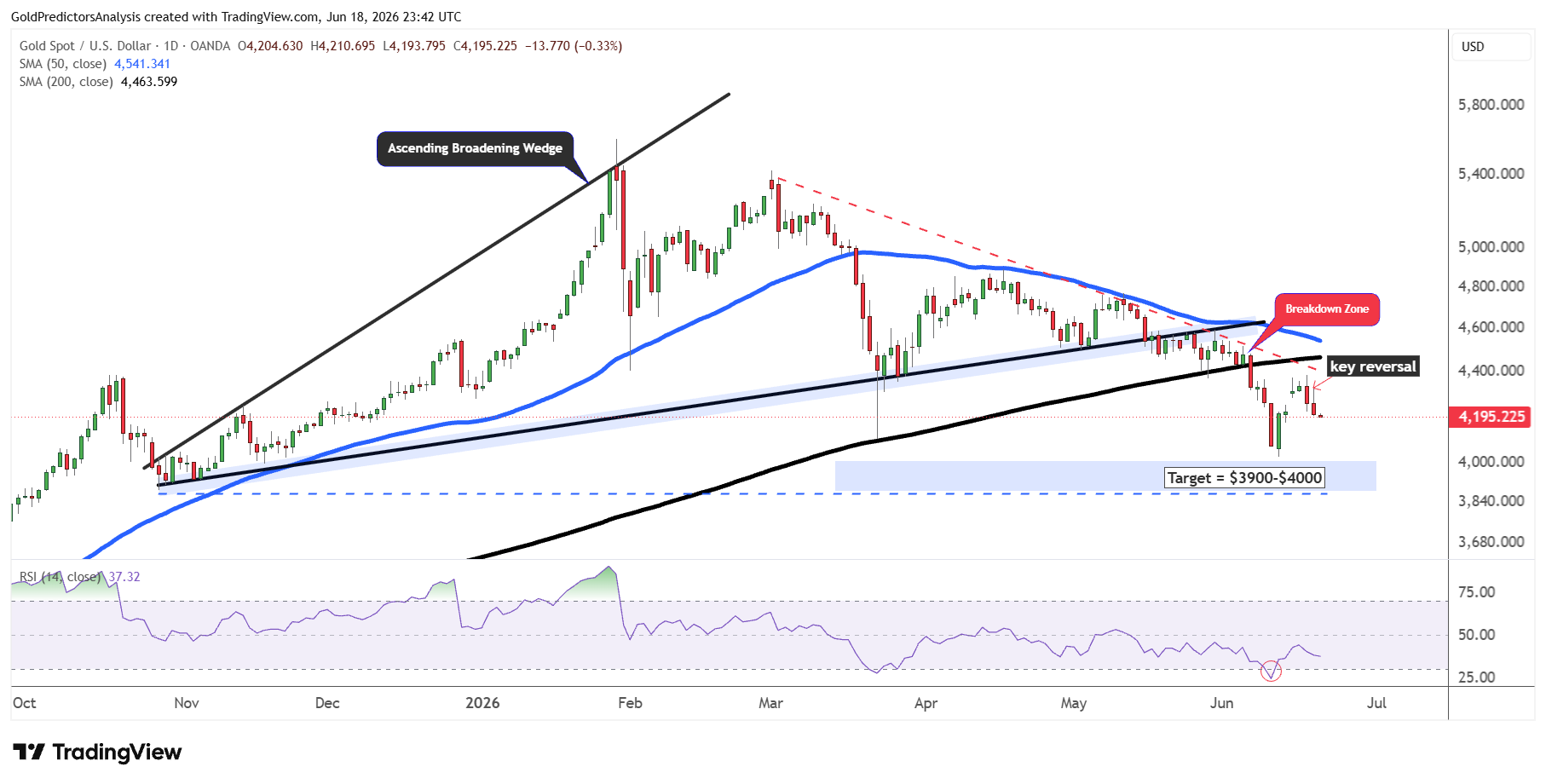
Overall, the gold price has broken the ascending broadening wedge pattern and reached the target of $4,000. This target is defined by the breakout of the ascending broadening wedge pattern at the $3,900-$4,000 range. The recent price action indicates that the gold price is moving again towards the targeted zone.
The weekly chart shows that last week’s candle produced sharp shadow after rebounding from $4,000. But the price failed to break above the $4,350 region and dropped lower. This indicates bearish pressure in the gold market. If gold prices break below the $4,000, it may continue to drop further lower.

Gold Price Forecast
Every new Gold analysis as it publishes, today's technical signal and key levels, live price — on one page.
See all Gold forecastsXAUUSD 4-Hour Chart – Broken Triangle Resistance Caps the Rebound
The 4-hour chart for spot gold also shows that the gold price reversed within the red highlighted zone, which was discussed in the previous article. The formation of tops since March 2026 and the failure to break above $4,500 indicate further downside towards the $4,000 in the short term.
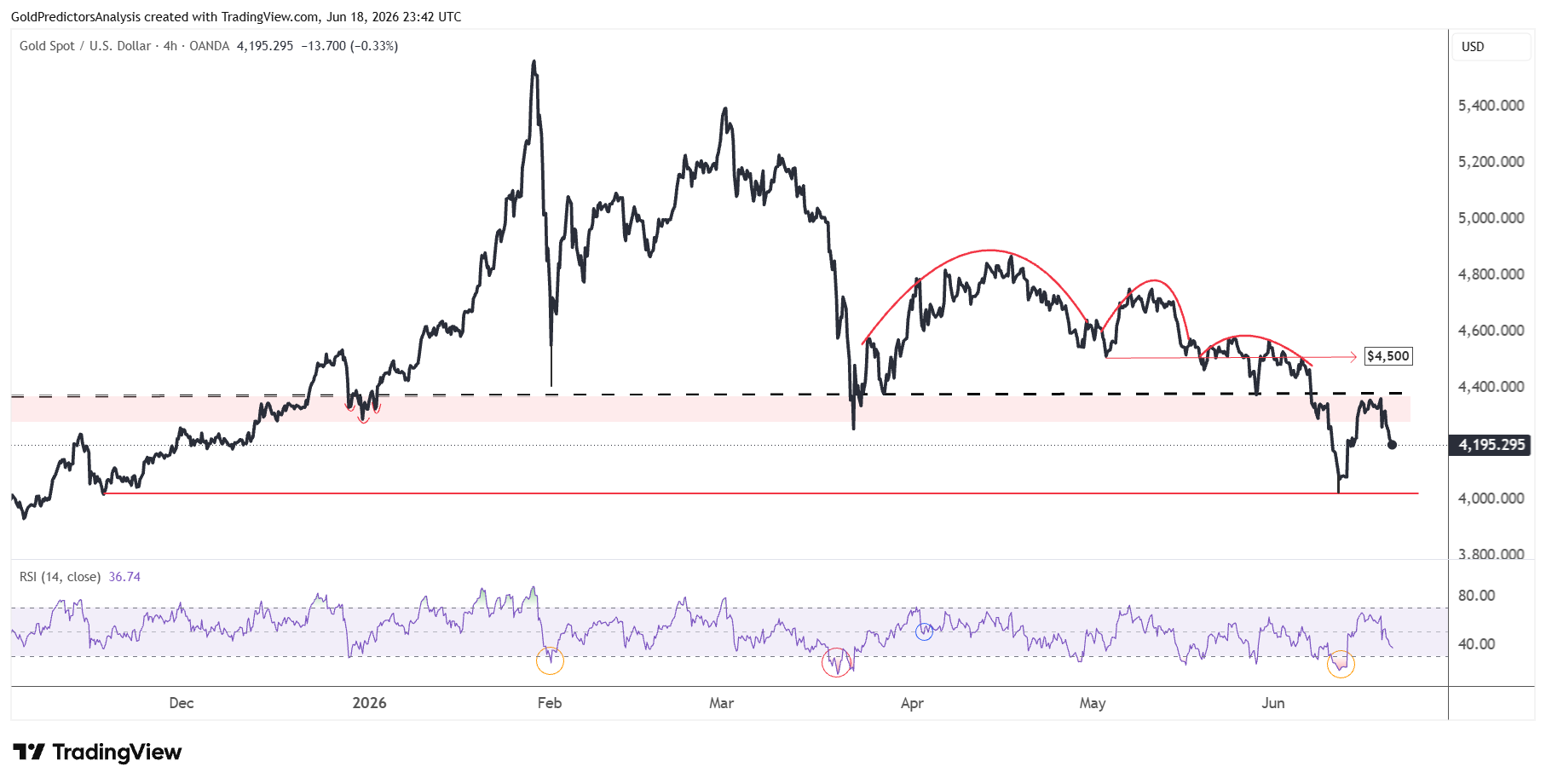
This bearish pressure is also observed at the resistance of the broken triangle pattern at $4,350.

The gold price needs to break above $4,350 in the short term to push towards $4,500. A break above $4,500 will indicate that the bottom is formed and prices will rally towards the $5,000 area.
Silver Price Forecast – XAGUSD Reversal Targets the $50-$60 Buy Zone
XAGUSD Daily Chart – Rejection at $72 Triggers Bearish Pressure
Spot silver also shows strong bearish pressure after forming a key reversal candle at the pivotal resistance of the $72 region. The failure at the resistance introduces a strong drop in silver prices, whereby prices are moving towards the primary buy zone in the $50-$60 area.
The chart shows two zones of interest to investors. The first is the primary zone between the $55-$64 region. The second zone is in the $45-$55 range. Therefore, the $50-$60 zone is the major convergence zone for long-term investors. Any move within the $50-$60 region will offer strong long-term buying opportunities for investors.

XAGUSD 4-Hour Chart – Break Below $60 Opens Further Downside
The key reversal in spot silver from the $70-$72 region is clearer on the 4-hour chart. The chart shows that the price is moving again towards the $60 region. But the price can push lower towards the $55-$60 this time, if the $60 is broken. The spot silver price needs to clearly break above $72 to move towards $78.60.

The key levels of spot silver are further clear on the 4-hour chart, which shows that a break above the $70-$72 region will signal a strong upside. However, the short-term price action remains bearish and points to the $60 area.

Bottom Line
Gold and silver remain under pressure in the short term as the Fed maintains its hawkish stance and traders factor in the potential of future rate hikes. Gold has to defend $4,000 while silver has to hold $60. A break below $4,000 will open the door for further downside. On the other hand, a break below $60 will push the silver price to $50. While the US-Iran peace agreement will help to alleviate inflation pressures and cap downside, it does not eliminate geopolitical risk. Gold and silver prices need to break above $4,500 and $72 to remove the bearish pressure and trigger a rebound.
Read more: Hawkish Fed Puts $60 Support in Silver