Technically Speaking
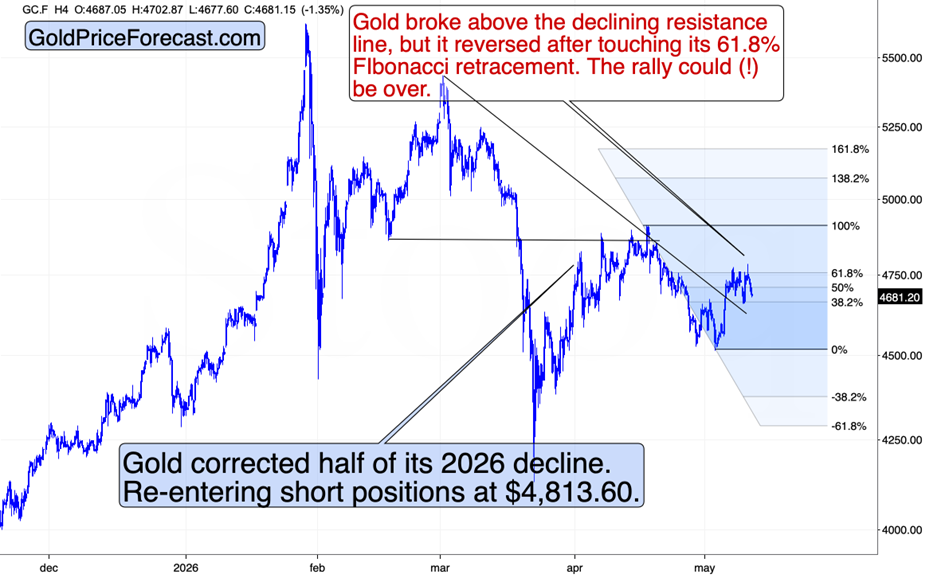
Gold is down today after – once again – failing to hold above its 61.8% Fibonacci retracement. Please note how quickly gold invalidated the rally above its previous May high. Those are both bearish signs for the short term.
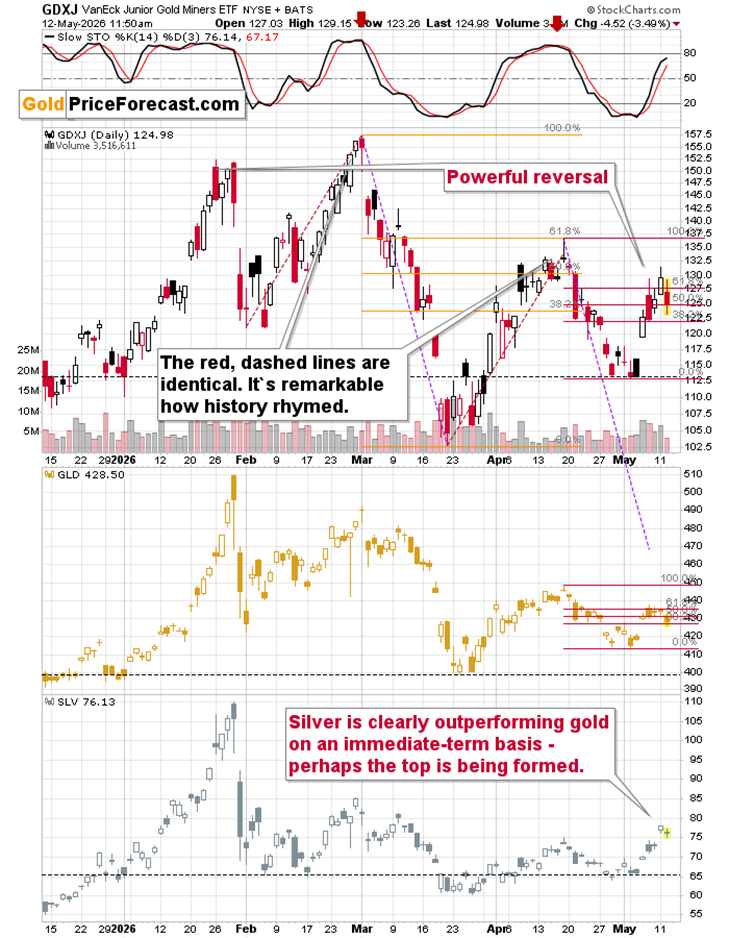
The GDXJ has pretty much erased yesterday’s rally. It looks ready to decline further, especially that…
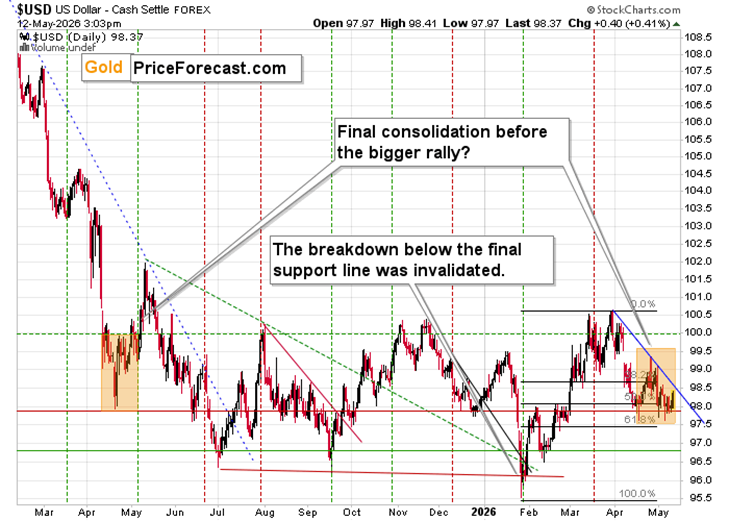
Especially since the USD Index is moving higher today. Once it breaks above the declining, short-term resistance line, it’s likely to rally more visibly.
Interestingly, this would be in line with the analogy to the bottom that we saw last April (marked with orange). If the symmetry continues, the upcoming rally could be truly explosive. That, in turn, would have devastating effects on the prices of commodities, precious metals, and mining stocks.
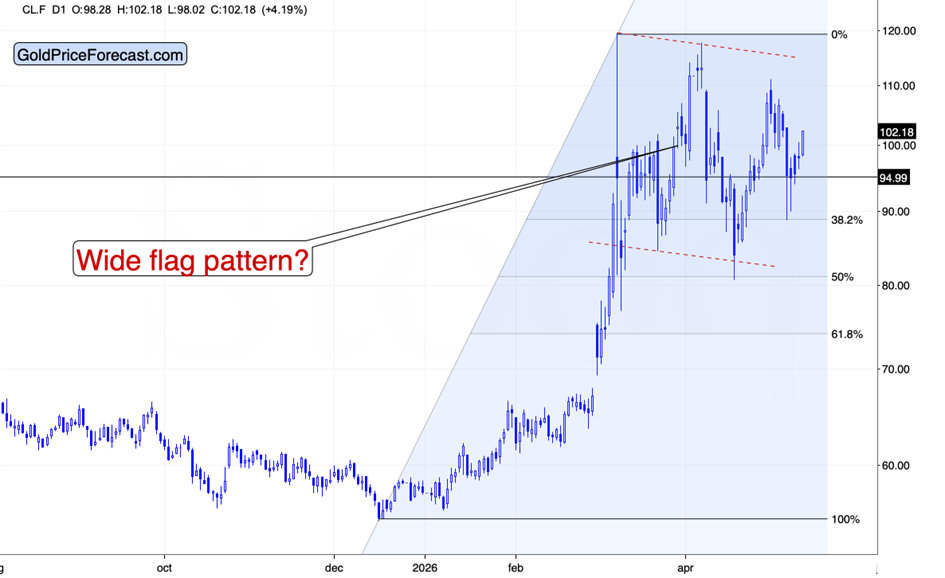
Crude oil is moving higher once again, and since this is an obvious headwind for the world economy, it is also a headwind for stocks and commodities.
Remember – flag patterns tend to be followed by moves that are similar to the moves that preceded them. In this case, crude oil soared from about $55 to about $120. If a similar rally is already underway (from the April low), we can expect crude oil to reach $170 in the following weeks / months. This would be a breakout to new all-time highs – something that no other market could ignore.
And the economic numbers start to support what the technicals have been telling us for months.
Gold Price Forecast
Every new Gold analysis as it publishes, today's technical signal and key levels, live price — on one page.
See all Gold forecastsThe CPI in Detail
Energy costs jumped 17.9% year-over-year, up from 12.5% in March. Gasoline: +28.4% (vs 18.9% in March). Fuel oil: +54.3%. These are the direct oil-shock numbers.
But the core figure is what matters for the Fed. Core CPI rose 0.4% month-over-month (consensus: 0.3%) and 2.8% year-over-year (consensus: 2.7%). Both beat. Core excludes food and energy, so this confirms what I’ve been writing: the oil shock is bleeding into non-energy prices. Shelter inflation accelerated to 3.3% from 3.0%. Services remain sticky.
Real average hourly wages fell 0.5% for the month and 0.3% year-over-year. Workers are losing purchasing power. That’s the stagflationary squeeze: prices rising, real incomes falling.
CME FedWatch now shows zero rate cuts priced for 2026. Earlier this year, at least one cut was expected. Some traders are pricing a 9%+ chance of a rate hike by December. The data I laid out in the “More Reasons to Hike Than to Cut” and “The Chair Without the Votes” Gold Trading Alerts is now consensus.
On May 1, I cited Oxford Economics’ warning that “the spillover effects from higher energy costs will add to core inflation over the next year, peaking three months after the initial energy shock.” The war began February 28. Three months from that is late May, early June. Today’s CPI is the beginning of the peak passthrough window, not the end. The next two prints should be worse.
Oil Back Above $100. Normalization Could Take Until 2027.
WTI crossed back above $101. Brent above $107. The TACO-driven oil crash from last week (Brent briefly dipped below $100 on “deal hopes”) completely reversed. Every TACO oil selloff has reversed within days. This one lasted less than a week.
Aramco CEO Amin Nasser said something on the Q1 earnings call on Monday that deserves attention: “If the Strait of Hormuz opens today, it will still take months for the market to rebalance, and if its opening is delayed by a few more weeks, then normalization will last into 2027.”
That’s from the CEO of the world’s largest oil company. Even in the best-case scenario (Strait opens immediately), oil normalization takes months. If the Strait stays closed into June (which is now the base case given no deal is close), oil markets don’t normalize until 2027.
This has direct implications for the inflation trajectory and therefore for gold. If oil stays elevated through 2026, energy passthrough into core CPI continues. The Fed stays frozen. Rate cuts stay off the table. The channel operates for the rest of the year.
Gas is at $4.50 nationally. Diesel up 61% year-over-year. Jet fuel is pushing airline fares up 14.9% year-over-year.
Beijing
Trump leaves for China today. Meetings with Xi are scheduled for Thursday-Friday (May 14-15). This morning, he called the ceasefire “unbelievably weak” and Iran’s proposals “garbage.”
The Beijing trip creates a window where Trump won’t escalate against Iran (you don’t bomb your host’s ally during a state dinner). But it also creates the conditions for a TACO rally: Trump will almost certainly announce “great progress” or “tremendous deal” from Beijing, the market will rally briefly, and then reality reasserts.
The structural question is whether Xi will pressure Iran. I covered this in detail last week: China’s incentives point toward using Iran as leverage over the US, not delivering Iran to help the US. Trump arriving in Beijing needing something from Xi is leverage for China, not leverage for Trump. That framing hasn’t changed.
OilPrice.com reported that China is expected to announce purchases of US energy, agriculture, and Boeing aircraft at the summit. A US official expressed confidence that the rare earth minerals truce will be extended. These are transactional outcomes, not structural breakthroughs on Iran.
Analysts at Brookings and Peterson Institute both flagged that “the more realistic outcome is that both leaders leave Beijing without triggering a fresh crisis, which, given everything on the table, would itself be a meaningful result.” If “not making things worse” is the realistic best case, that tells you where the bar is.
Yesterday’s Silver and Platinum Surge Reversed in One Session
Yesterday silver surged over 5%, and platinum rallied sharply while gold was flat. I noted that when thinner, less liquid precious metals outperform gold on a short-term basis, it signals speculative froth, not sustainable strength.
Today confirmed it. Silver is down. Platinum is down. Palladium dropped over 2%. Gold is down over 1%. The thinner metals gave back their gains in one session.
This is the same pattern that preceded the March decline, the mid-April GDXJ crash, and the late April selloff. Yesterday was the froth. Today is the reversal. The physical silver tightness story (COMEX registered at 79.8 million ounces, six consecutive years of deficit, May delivery window in progress) is real but doesn’t override the macro channel on a medium-term trading basis.
Thank you for reading today’s analysis – I appreciate that you took the time to dig deeper and that you read the entire piece. If you’d like to get more (and extra details not available to 99% investors), I invite you to stay updated with our free analyses – sign up for our free gold newsletter now.
Thank you.
Sincerely,
Przemyslaw K. Radomski, CFA