Spot Gold Slips as Import Prices Add a Third Inflation Hit
Spot Gold (XAUUSD) is trading at $4,674.37, down $14.77 Thursday. Three straight sessions of selling after a bullish start to the week. Tuesday was CPI. Wednesday was PPI. Thursday is import prices jumping 1.9% with fuel costs posting the biggest increase in four years. Every inflation print this week came in above expectations and every one pushed the rate cut timeline further out. Gold is paying for all of them.

Technical Outlook
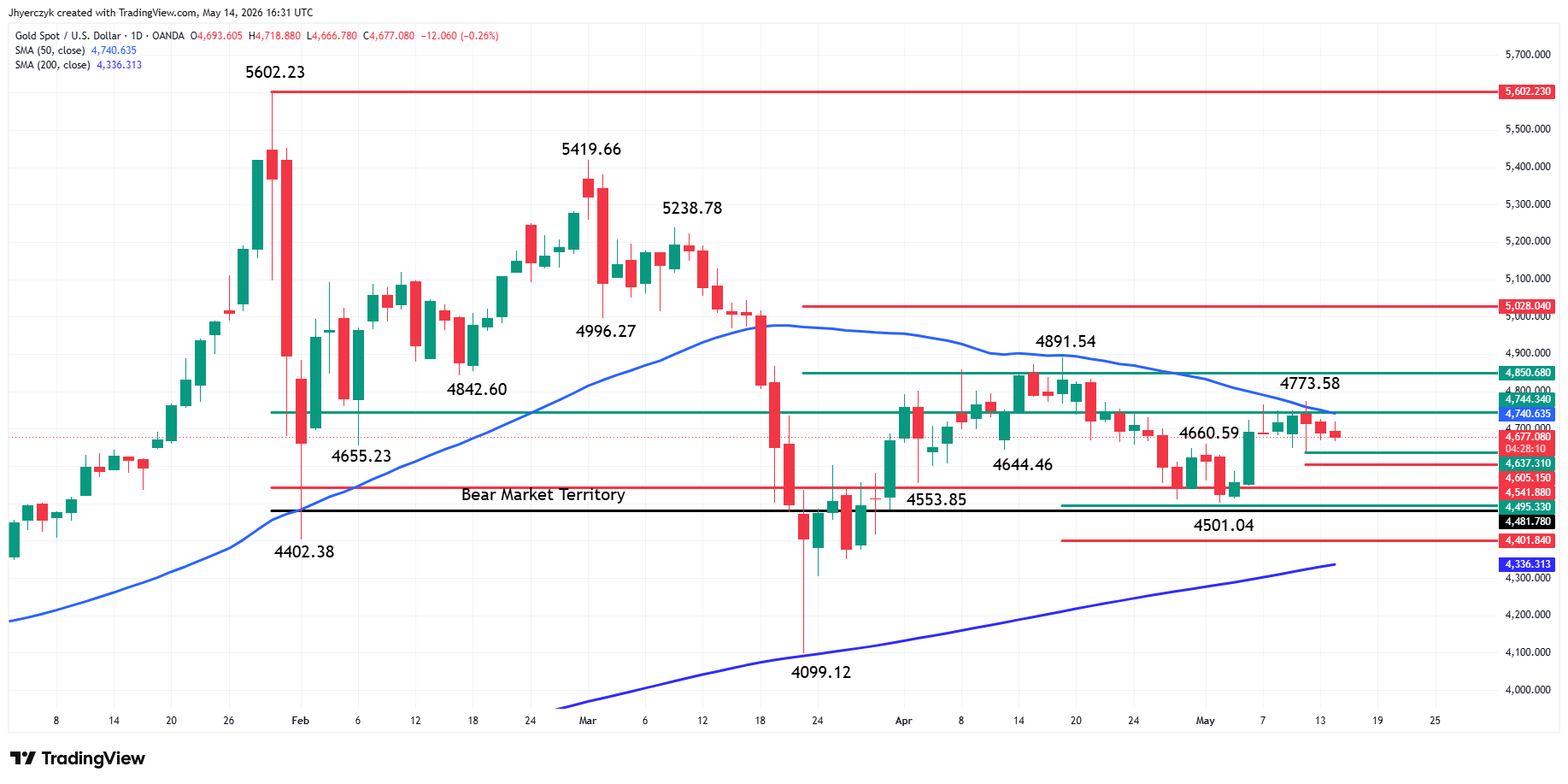
Spot Gold is edging lower at the mid-session on Thursday. After a bullish start to the week, the market is now lower than last Friday’s close, following three straight days of selling pressure. The range is still tight and the market is still trading inside Wednesday’s wide range. This suggests investor indecision and impending volatility.
On the upside, the key area to watch is the resistance cluster formed by the 50-day moving average at $4,740.65 and the long-term 50% level at $4,744.34. Above this area is the intermediate retracement zone at $4,850.68 to $5,028.04. Inside this area is the swing top at $4,891.54.
The nearest support is the retracement zone at $4,637.31 to $4,605.15. Under this level is a series of potential support targets at $4,541.88, $4,495.33 and $4,401.84.
The most important levels are $4,481.78, which is the line that separates the bull market from a bear market, and the 200-day moving average at $4,336.33.
There are many numbers to look at so we’ll break it down to the major levels. The market is currently trading inside the 200-day moving average at $4,336.33 and the 50-day moving average at $4,740.69. For the past two months, gold traders have been buying dips near the 200-day MA and selling rallies into the 50-day MA.
The two moving averages are moving closer to each other with the 50-day coming down and the 200-day moving up. This compression formation will eventually lead to a breakout over the 50-day MA or a breakdown under the 200-day MA. That’s where the volatility comes in.
The second area to watch is the long-term retracement zone at $4,744.34 to $4,541.88. Spot gold has been trading inside this range since March 31. The same rules as the moving averages apply. We’re looking at a choppy, neutral trade inside the zone and set up for a potential breakout over $4,744.34 or a breakdown under $4,541.88.
Combining the two areas zeroes in on $4,740.63 to $4,744.24. Trader reaction to this area will set the near-term tone. Essentially, gold could turn bullish on a sustained move over $4,744.24 or remain weak under $4,740.63, which is the 50-day moving average.
Gold Price Forecast
Every new Gold analysis as it publishes, today's technical signal and key levels, live price — on one page.
See all Gold forecastsWhy Inflation Is Not Helping Gold This Time
Higher inflation used to be a gold trade. Not anymore. The market figured out a long time ago that rising oil is the engine behind this inflation cycle and rising oil keeps the Fed on hold. A Fed on hold means yields stay elevated. Elevated yields mean gold loses the argument because investors have a paying alternative and they take it. That chain has been running since late February and three consecutive hot inflation prints this week confirmed it is still intact. The safe havens in this market are the U.S. Dollar Index and Treasury yields. Gold is not in that category right now.
The Dollar Is on a Four Session Run
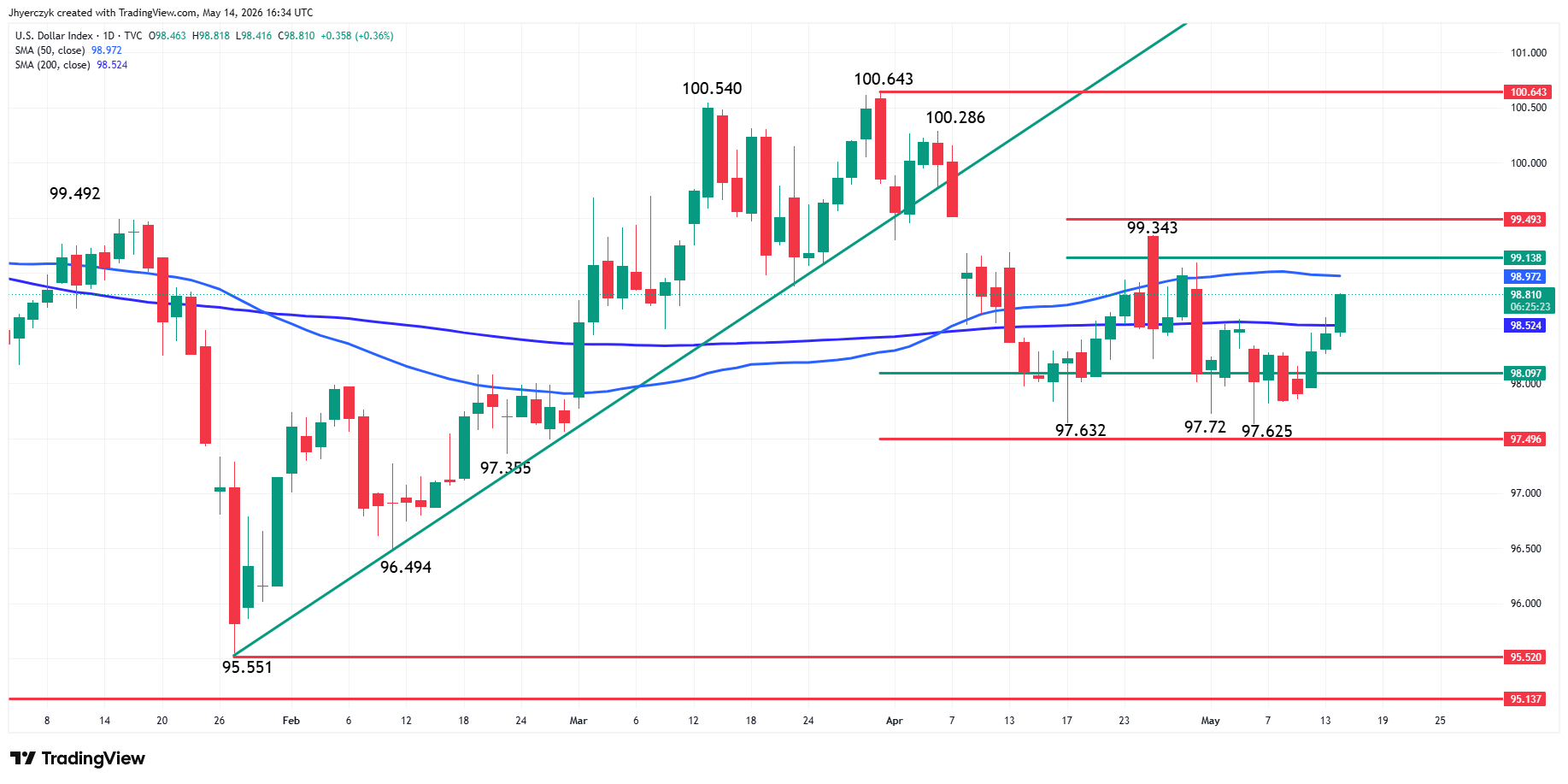
The U.S. Dollar Index climbed for the fourth straight session Thursday, reaching 98.60. Retail sales rose 0.5% last month matching expectations. Weekly jobless claims came in at 211,000, still low enough to tell you the labor market is not breaking. The economy is holding together and the Fed has no reason to move. A strong economy with sticky inflation is exactly the environment where the dollar runs and gold struggles. Every session the U.S. Dollar Index adds to its streak is another session Spot Gold (XAUUSD) gets more expensive for overseas buyers and that demand quietly fades.
The Geopolitical Bid Is Getting Overwhelmed
The Middle East conflict is still live. The Strait of Hormuz is partially open but traders are not treating it as resolved. Under normal conditions a conflict this size sends gold higher on safe-haven demand. This time the geopolitical bid exists but it is getting overwhelmed by the rate story every session. War escalation means higher oil. Higher oil means higher inflation. Higher inflation means the Fed stays on hold. That sequence cancels out the safe-haven argument before it can build any momentum. I’ve watched this dynamic play out for three months now and nothing this week changed it.
Beijing Is a Background Variable
Trump and Xi are still in meetings. Xi said trade talks are making progress but Taiwan tensions remain a concern. A genuine trade breakthrough takes the dollar lower and gives gold some room. That outcome is not confirmed and traders are not betting on it. The mixed signals coming out of Beijing, progress on trade alongside Taiwan friction, are keeping gold from getting either a clear bullish or bearish read from the diplomatic track.
What I’m Watching
The 50-day moving average at $4,740.63 is the ceiling that has rejected gold three sessions running. The compression between the 50-day and the 200-day is tightening and a decisive move is coming.
Which direction depends on one thing. Oil has to drop before yields drop and yields have to drop before the dollar drops and the dollar has to drop before gold runs. That chain has been working against gold all week.
Until something breaks in the energy market or the Fed signals a change, the path of least resistance stays lower and the dip buyers near the 200-day moving average at $4,336.33 are the only thing keeping this market from a harder breakdown.
More Information in our Economic Calendar.