



Gold (XAU) price is very sensitive to the growing geopolitical conflict in the Middle East. The growing confrontation between the United States, Israel and Iran has added uncertainty to world markets. Investors are responding rapidly to all developments as they re-evaluate their risk exposure in currencies, equities and commodities.
While the demand for the U.S. dollar initially boosted it, the overall situation of geopolitical unrest still supports the long-term appeal of gold. This dynamic has led to a volatile gold market with major price swings due to the complex relationship between currencies, equities and safe haven flows.
Dollar Surge on Middle East Tensions Creates Short-Term Pressure on Gold
Escalation of the U.S.-Iran conflict has sparked powerful flight to safety in financial markets. Investors flowed into the U.S. dollar quickly during periods of uncertainty as first choice for liquidity. As a result, the U.S. Dollar Index hit its highest level in over three months.
Rising oil prices also contributed to the strengthening of the dollar as energy shocks prompted central banks reconsider the pace of interest rate reductions. This surge in the dollar put short-term pressure on the price of gold.
Gold moves in an inverse relationship to the dollar as a stronger dollar makes gold more expensive to international buyers. Spot gold dropped to its lowest levels since Feb. 20. This decline was due to currency pressure and not a change in the overall macro environment. Geopolitical risks are still high, and these conditions tend to support demand for gold over longer time horizons.
Stock Market Volatility Drives Short-Term Gold Pullback
The conflict has also caused volatility in global equity markets. The S&P 500 fell as investors reassessed their risk exposure amid increasing geopolitical tensions and energy price shocks.
Gold Price Forecast
Every new Gold analysis as it publishes, today's technical signal and key levels, live price — on one page.
See all Gold forecastsEquity corrections put temporary pressure on gold as traders sell gold positions that are profitable to them in an effort to increase liquidity and comply with margin requirements. This dynamic helped contribute to the sharp pullback in gold prices after the latest escalation in the Middle East.
Despite this drop, the S&P 500 and gold display inverse correlation. When equities fall on the back of geopolitical risk, gold gains strength on the safe haven demand. This rotation is already evident in 2024 and 2025 as the gold to S&P 500 ratio has formed a triple bottom support and broken the neckline of this pattern to continue higher into 2026. If the stock market continues to decline on US-Iran tensions, the ratio will further strengthen towards the target.
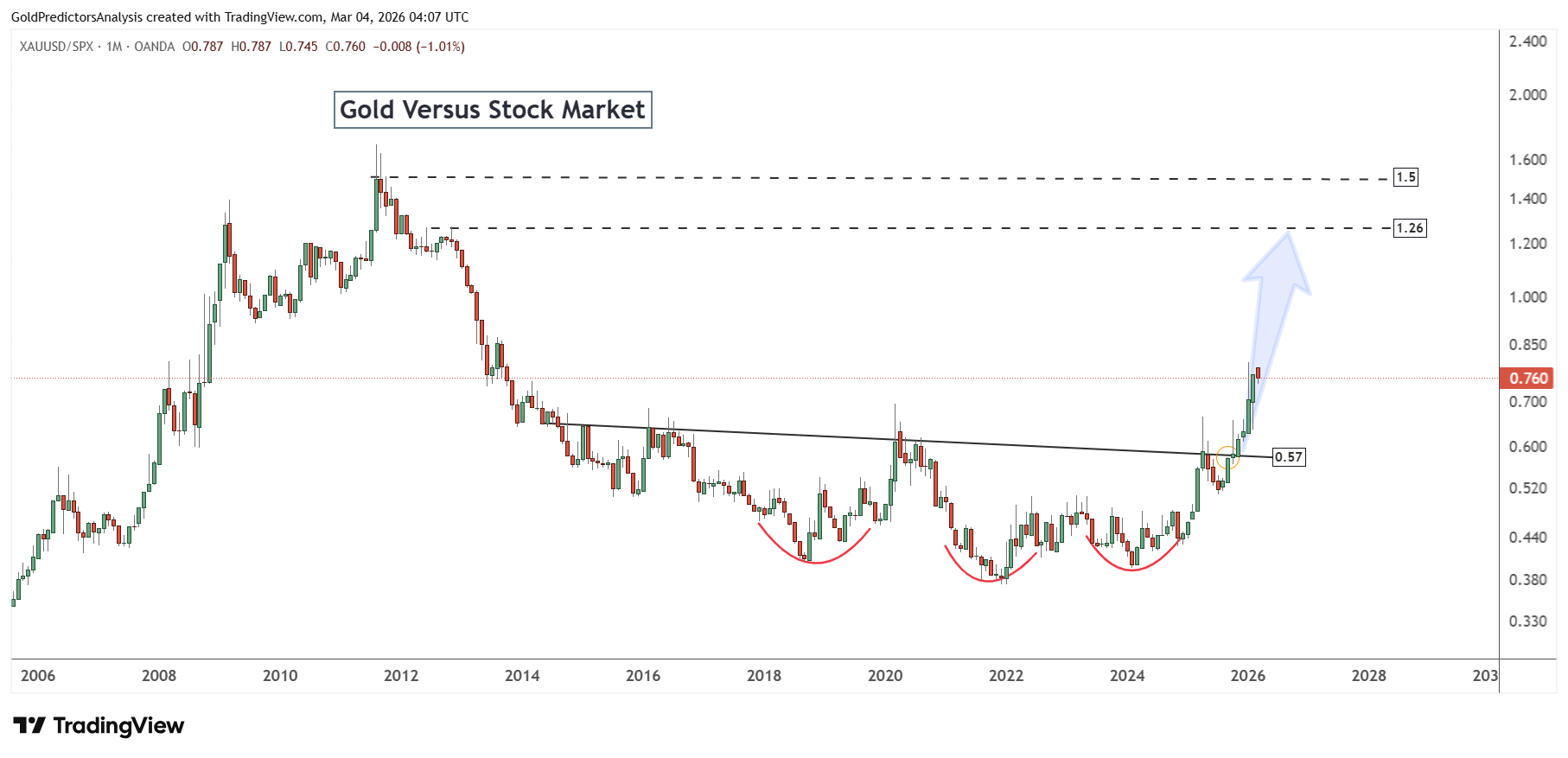
Profit-taking was also exacerbated by the recent rally in gold. The metal took strong start in recent months and even hit a record high of $5,600 earlier this year. Some investors took geopolitical volatility as an opportunity to secure gains made over the course of the rally.
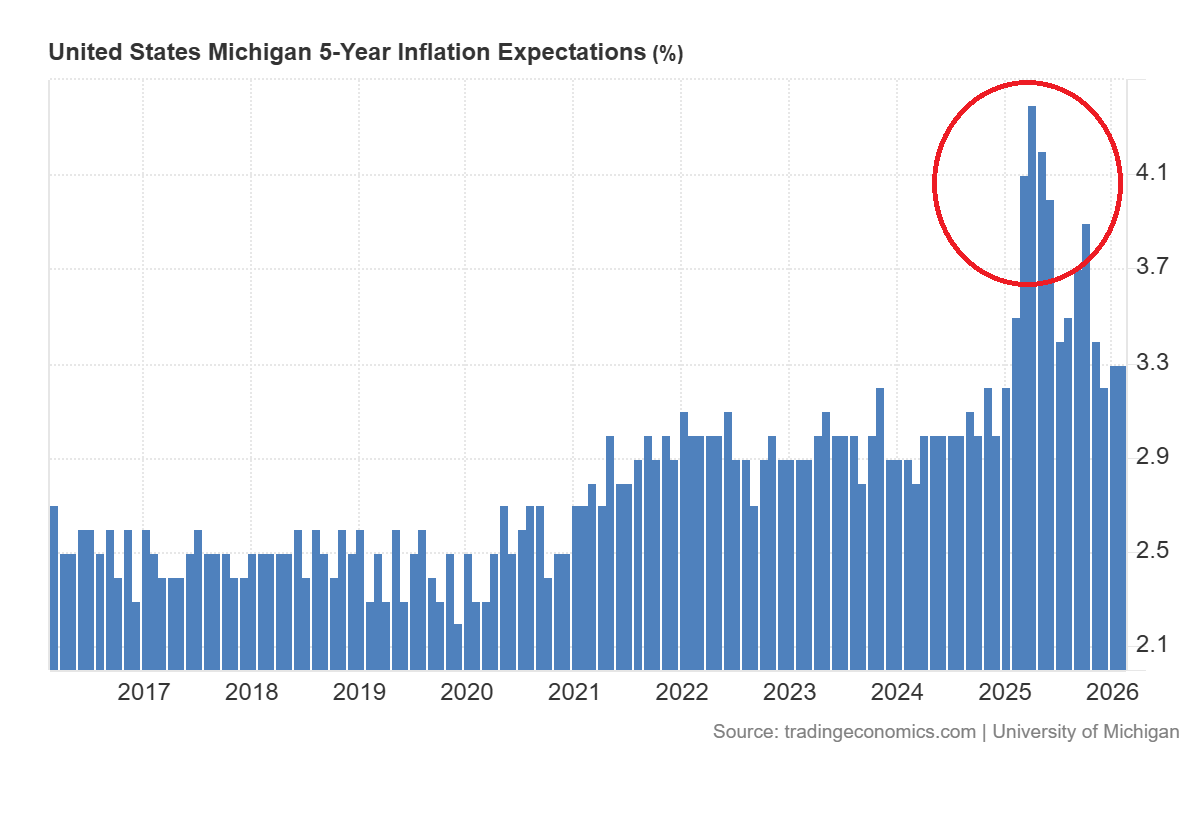
However, there has been no change in broader drivers of the gold market. Persistent geopolitical uncertainty increases the risks of inflation due to higher energy prices and global economic fragility.
This continues to provide support for strong long-term demand for gold as a defensive asset. The closure of the Straits of Hormuz will further drive up oil prices and add new layer of inflation to economy. The inflation expectations have already shot up since 2025, as seen in the chart below.
U.S. Dollar Index Consolidates as Geopolitical Tensions Drive Volatility
The daily chart for the U.S. Dollar Index shows a strong recovery after the U.S.–Israel strike. The technical picture shows strong consolidation between 96.50 and 100.50. If this range holds, the next move in the U.S. Dollar Index will be uncertain.
A drop below 96.50 will take the index towards 90. However, a break above 100.50 will take the index towards 102. If the index remains below 100.50, the overall technical picture for the U.S. Dollar Index remains strongly bearish.
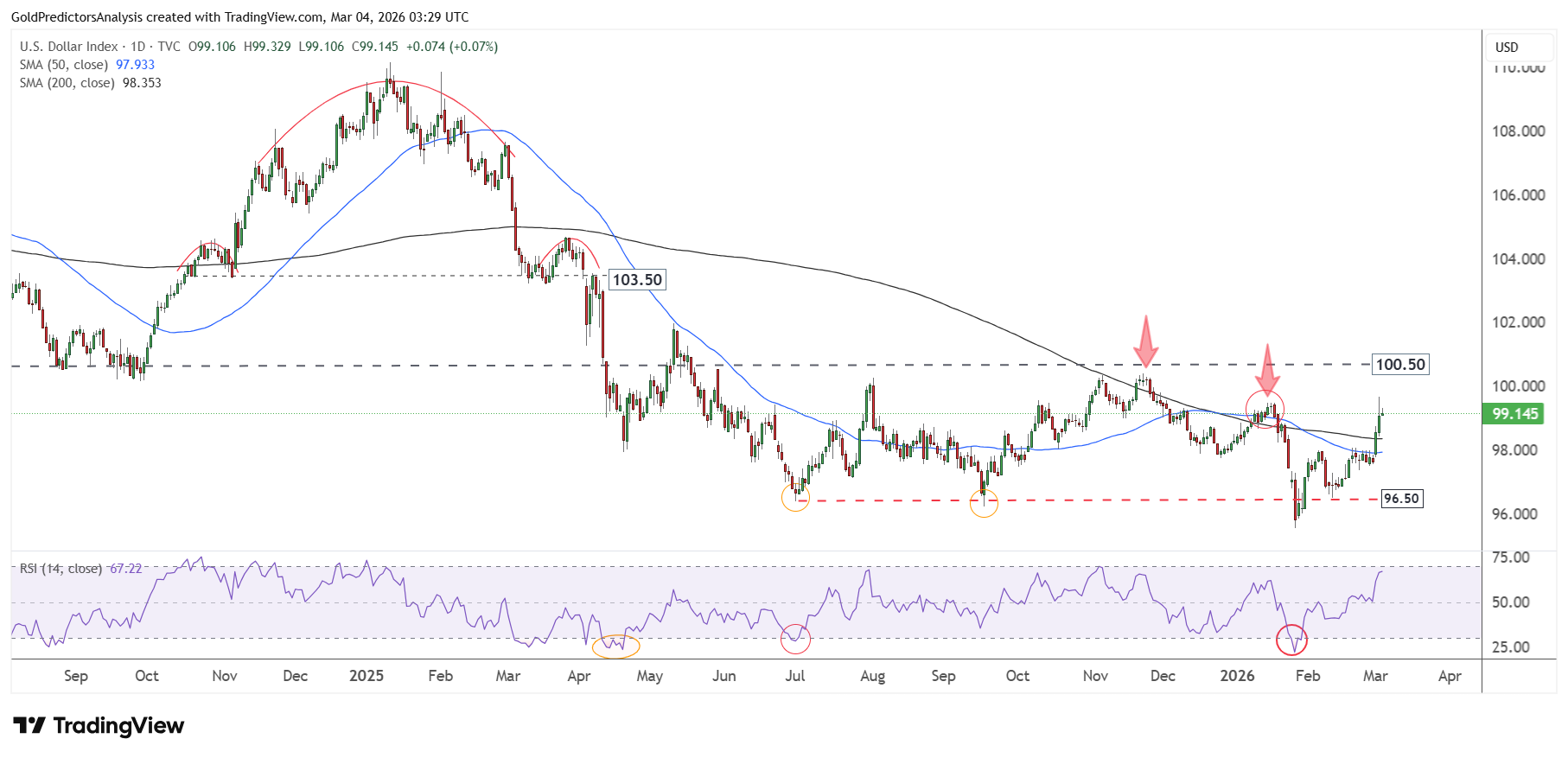
The recent rebound in the index is causing a strong recovery in gold and silver (XAG) prices. This correction will offer a strong buying opportunity for precious metals traders.
Gold Bullish Structure Holds Despite Volatility
The daily chart for spot gold shows that the price has dropped from $5,400 and plunged below $5,090 to mark a low at $4,996. However, the price recovered above $5,090 and closed the daily candle higher.
As long as the $5,090 support level holds, the next move in the gold market will likely be higher towards $5,600. However, a successful break below $5,090 will indicate a drop towards $4,700 to $4,800. The 50-day and 200-day SMA are trending higher, which indicates a strong bullish trend in gold. However, the market is driven by US-Iran headlines, which keep the volatility high.
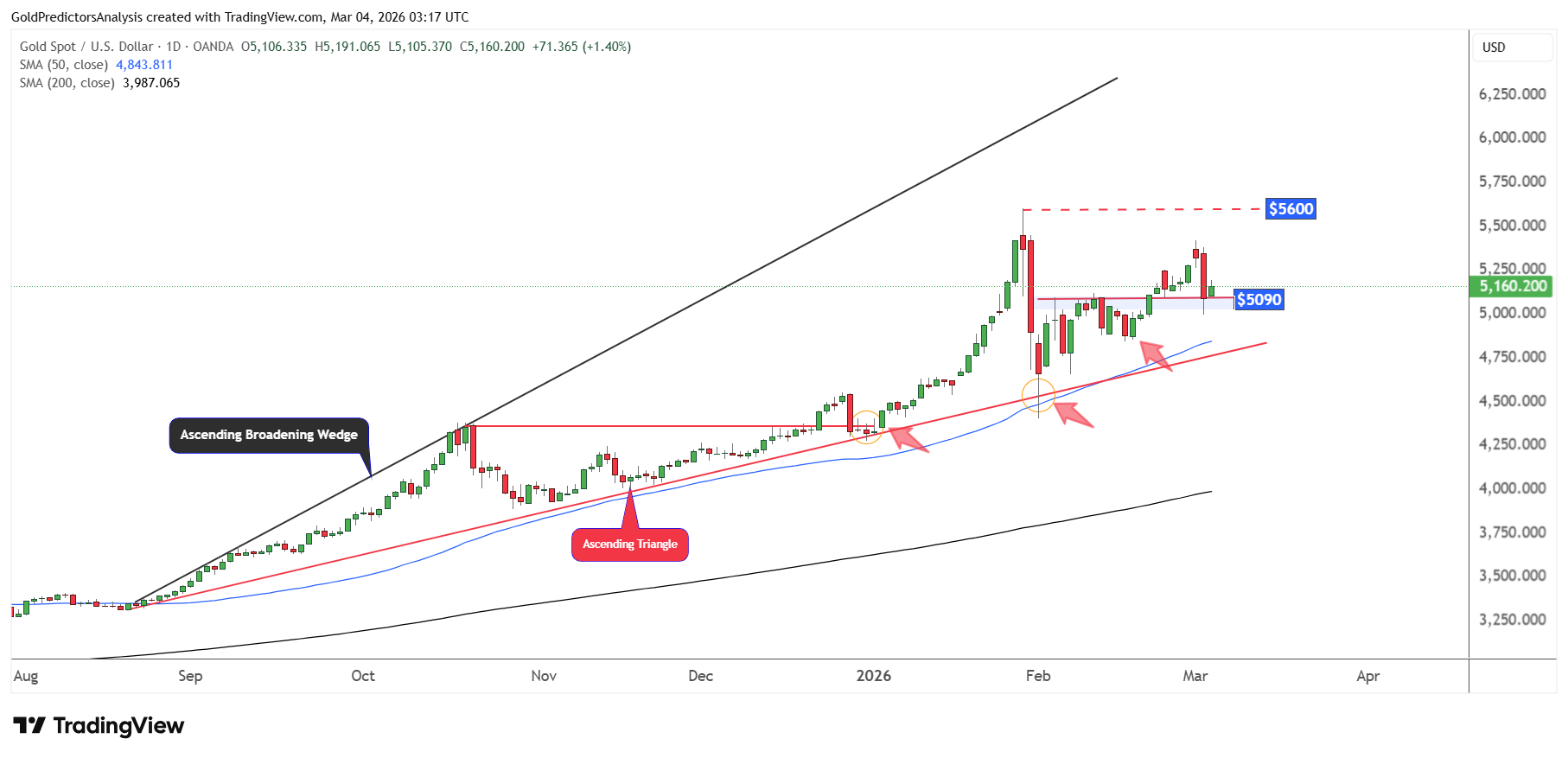
The 4-hour chart for spot gold also confirms that the drop from $5,400 was exactly towards $5,090, whereby the price is rebounding higher from this level. A break below $5,090 will take spot gold towards $4,770. However, a recovery above $5,400 will indicate a move towards $5,600.
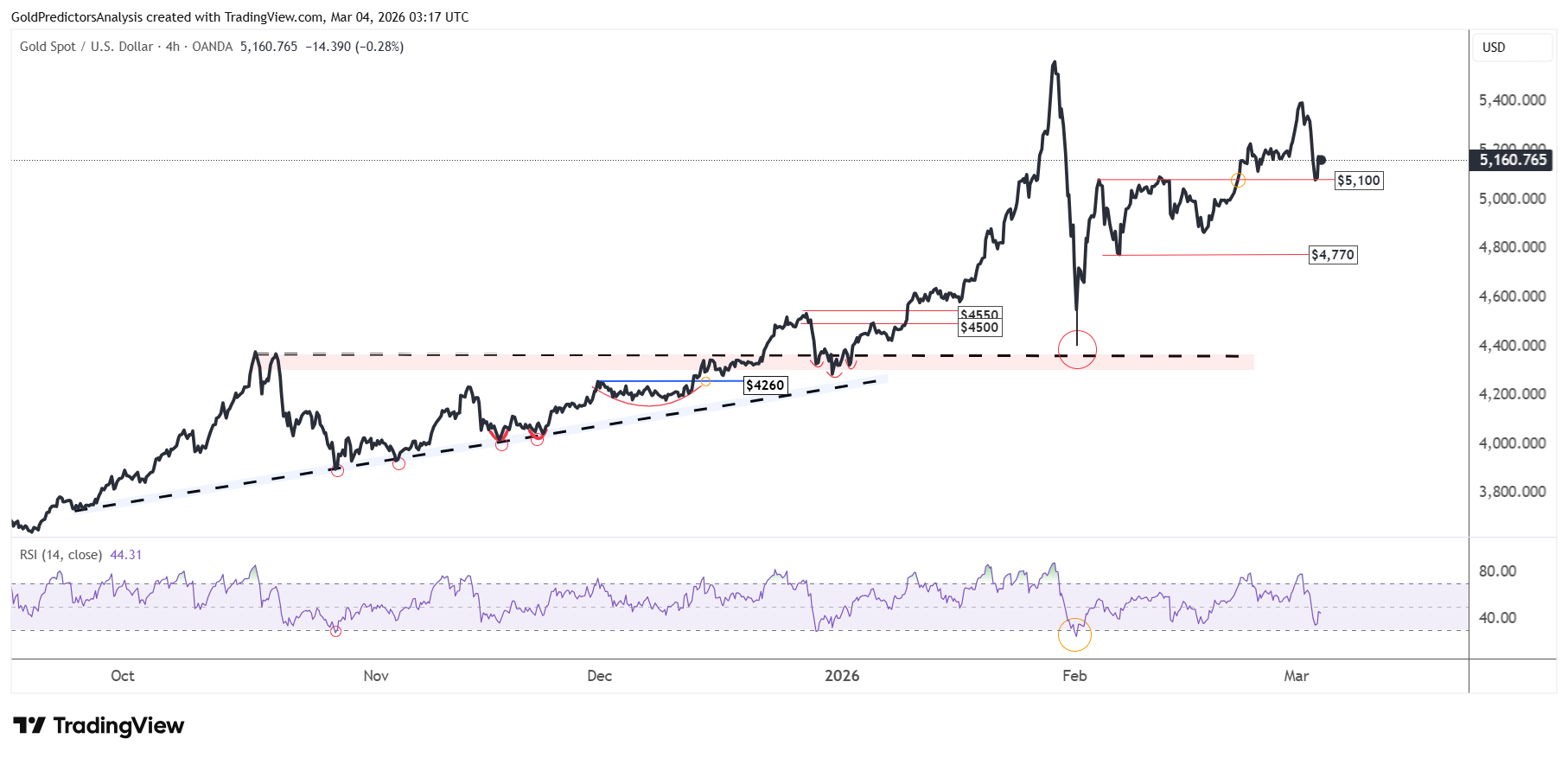
The overall structure for gold remains strongly bullish, and the escalating crisis in the Middle East will likely support gold. However, strong volatility may lead to wide moves in either direction. Therefore, traders and investors must be cautious in the short term.
Bottom Line
Gold continues to be driven by the interplay among geopolitics, the US dollar and the volatility of equity markets. The present Middle East crisis has heightened uncertainty and forced investors to response to revise their risk exposure. Short term movements may continue to be volatile with headlines affecting currencies, equities and commodities. However, the overall environment is still favourable for gold.
Persistent geopolitical risk, increasing inflation pressures due to high energy prices and weak global growth continue to provide support for safe haven assets. Therefore, if $5,090 holds and the price pushes above $5,400, gold will likely have a move towards $5,600 despite any near-term fluctuations. On the other hand, a break below $5090 will indicate further downside to the $4,700-$4,800 zone.
If you’d like to know more about how to trade gold and silver, please visit our educational area.