Consolidation Phase Near Decision Point
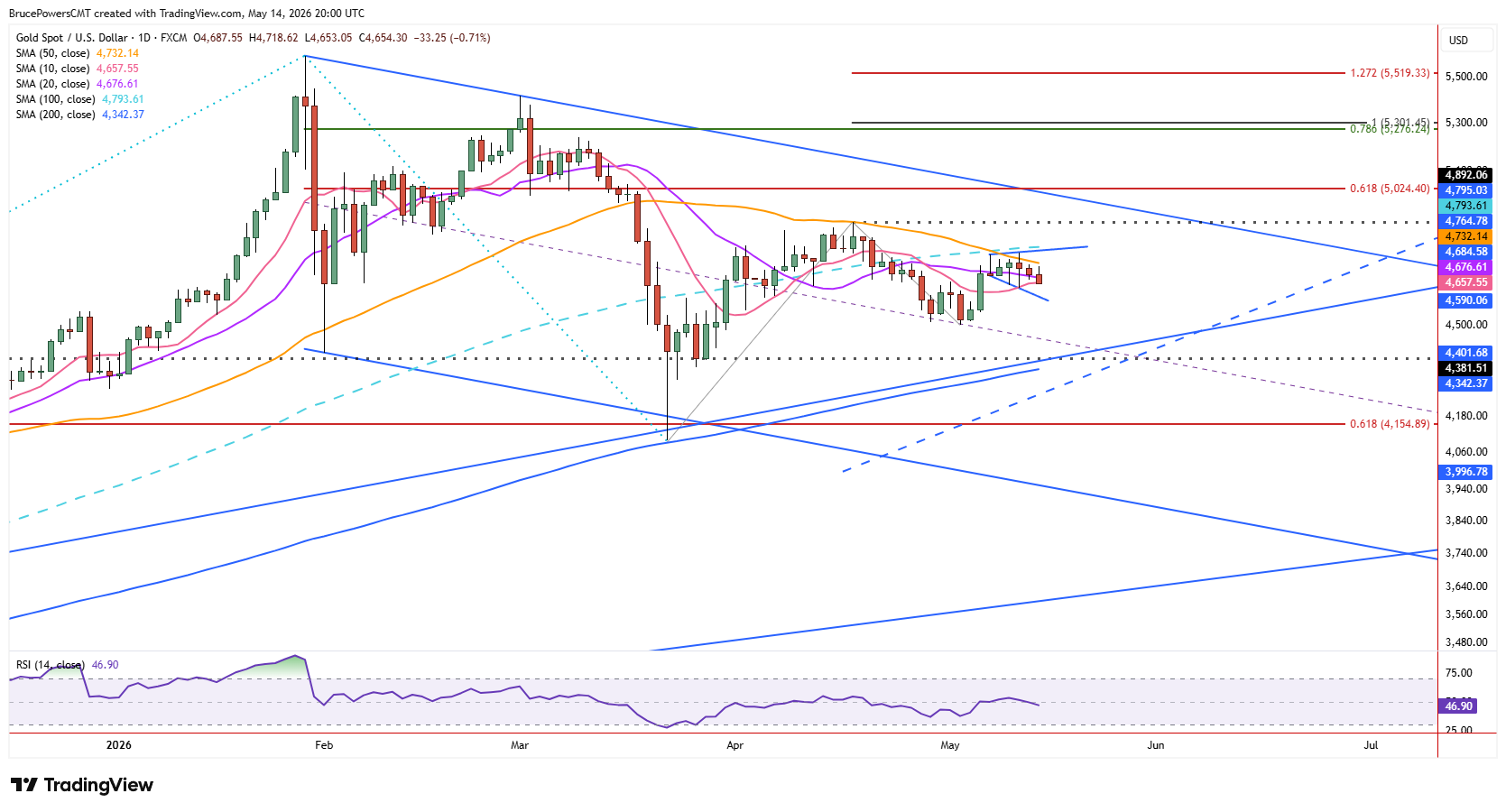
Gold remained inside a six-day range during Thursday’s session, as it tries to determine the next direction. Either a continuation of the bearish correction with a turn back down, or an upside breakout and signs of a bullish reversal appears most likely. A confluence resistance zone has been tested during formation of a relatively tight range, with a low of $4,638 and a high of $4,773. That range is from Tuesday, and it is outside the prior four days and the two days after. This highlights a compressed consolidation phase where price is coiling near key decision levels following recent directional swings.

Broadening Structure Signals Expanding Volatility
Subsequently, the consolidation pattern takes the form of a small broadening formation where the boundary lines of the pattern are heading away from each other. This means that an expansion of the pattern may occur on a breakout, either up or down, rather than a sustainable breakout that leads to further movement in the direction of the breakout.
Although the broadening formation is currently present, the reaction of price near its parameters will determine its validity going forward. Suffice it to say that upon a move through the top or bottom of the pattern, additional confirmation is needed, more so than if the broadening pattern was not present. This makes follow-through behavior particularly important in distinguishing between a false break and a sustained directional move.
Resistance Confluence at 100-Day Moving Average
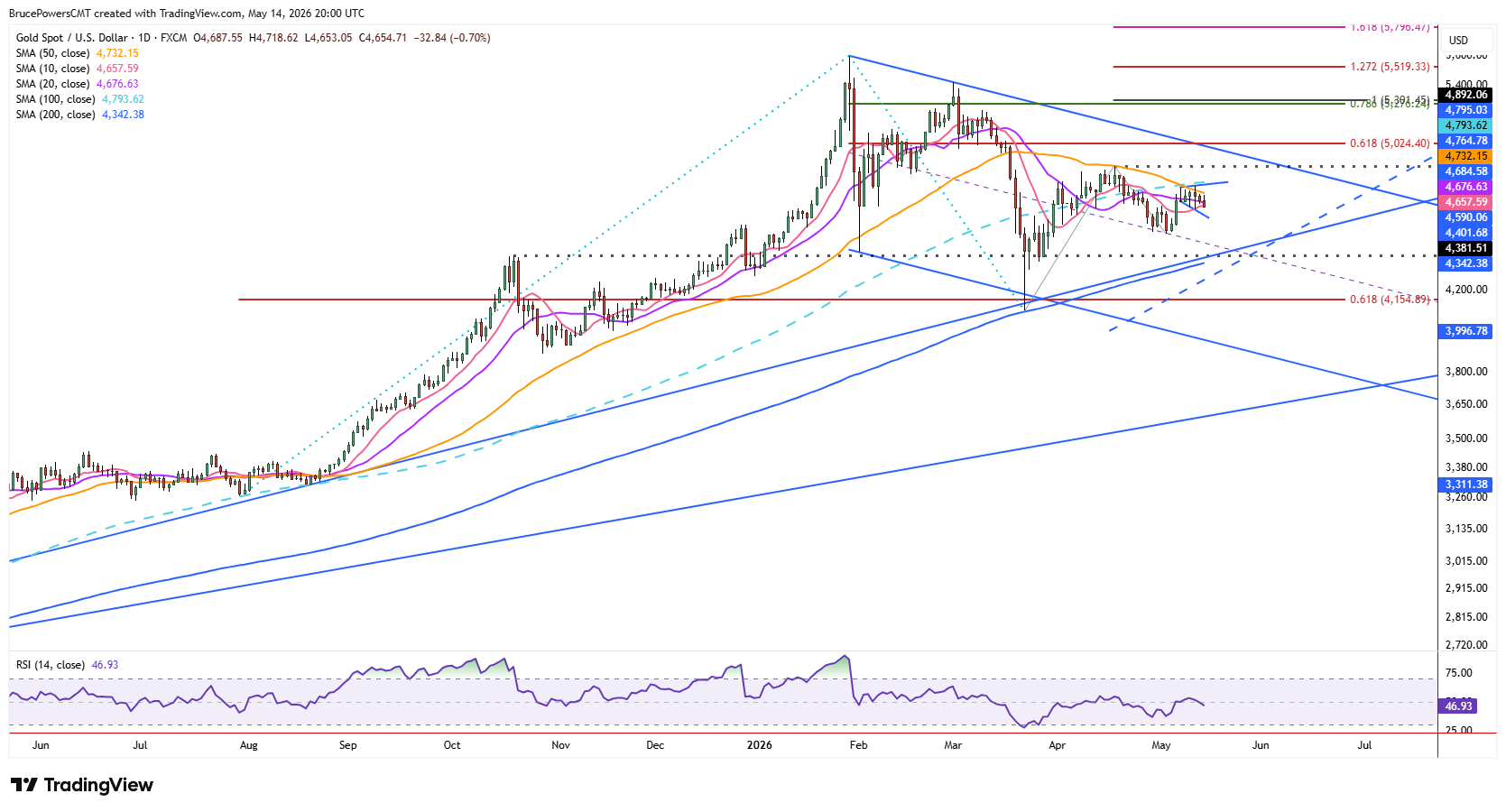
Key near-term resistance is not only at the top of the pattern at $4,774 but also near the 100-day moving average, now at $4,794. Gold would need to sustain an advance above that average before it has a chance to continue higher, since it is a long-term trend indicator and was successfully tested as resistance during the prior advance in April. This creates a layered resistance zone where momentum must build decisively to shift broader trend conditions.
Upside Continuation Targets if Breakout Holds
A decisive advance above the 100-day average puts gold in a position to target the prior lower swing high of $4,891, followed by the 61.8% Fibonacci retracement at $5,024. If reached, the downtrend line would have been recovered, putting gold in a position to target the 78.6% Fibonacci retracement confluence zone near $5,276 to $5,301, approximately.
Gold Price Forecast
Every new Gold analysis as it publishes, today's technical signal and key levels, live price — on one page.
See all Gold forecastsBearish Breakdown Path Remains Active
Alternatively, the current bearish retracement that followed the January peak is retained with a drop first below $4,638 and then the higher swing low of $4,500. Lower targets end with the 200-day moving average, currently near $4,342. A sustained break below these levels would instead reinforce downside continuation within the larger corrective structure.