


Spot Gold Pulls Back as Ceasefire Breaks Down and Dollar Strengthens
Spot Gold (XAUUSD) is trading at $4804.18, down $27.42 or 0.57% at 11:52 GMT Monday. The U.S. Dollar Index is strengthening and the Middle East is heating up again. That combination is putting pressure on gold early in the week.
Ceasefire Is Already Unraveling
Last week’s ceasefire between the U.S. and Iran gave markets a few days of calm and that calm is already gone. The agreement is coming apart fast and traders are repositioning. The war-driven trade is back. Oil is higher, yields are higher and the U.S. Dollar Index is higher. Gold is caught in the middle of all three.
Strait of Hormuz Closed Again
The Strait of Hormuz is closed again after renewed disruption to tanker traffic. Higher oil is stoking inflation concerns and that’s pushing Treasury yields and the U.S. Dollar Index higher. When yields rise gold struggles because it pays nothing. When the U.S. Dollar Index strengthens, Spot Gold gets more expensive for foreign buyers and demand drops. Gold is supposed to be an inflation hedge but higher interest rates cap that bid. That’s the wall gold is running into right now.
U.S. Seizes Iranian Vessel
The situation escalated further after the U.S. seized an Iranian vessel. Iran warned of retaliation and walked away from planned talks. Gold is still tracking risk sentiment closely. If tensions keep rising gold could find support from safe-haven buying. But as long as the U.S. Dollar Index and yields keep climbing, that safe-haven bid is going to keep getting offset by the rate headwind.
Technical Outlook
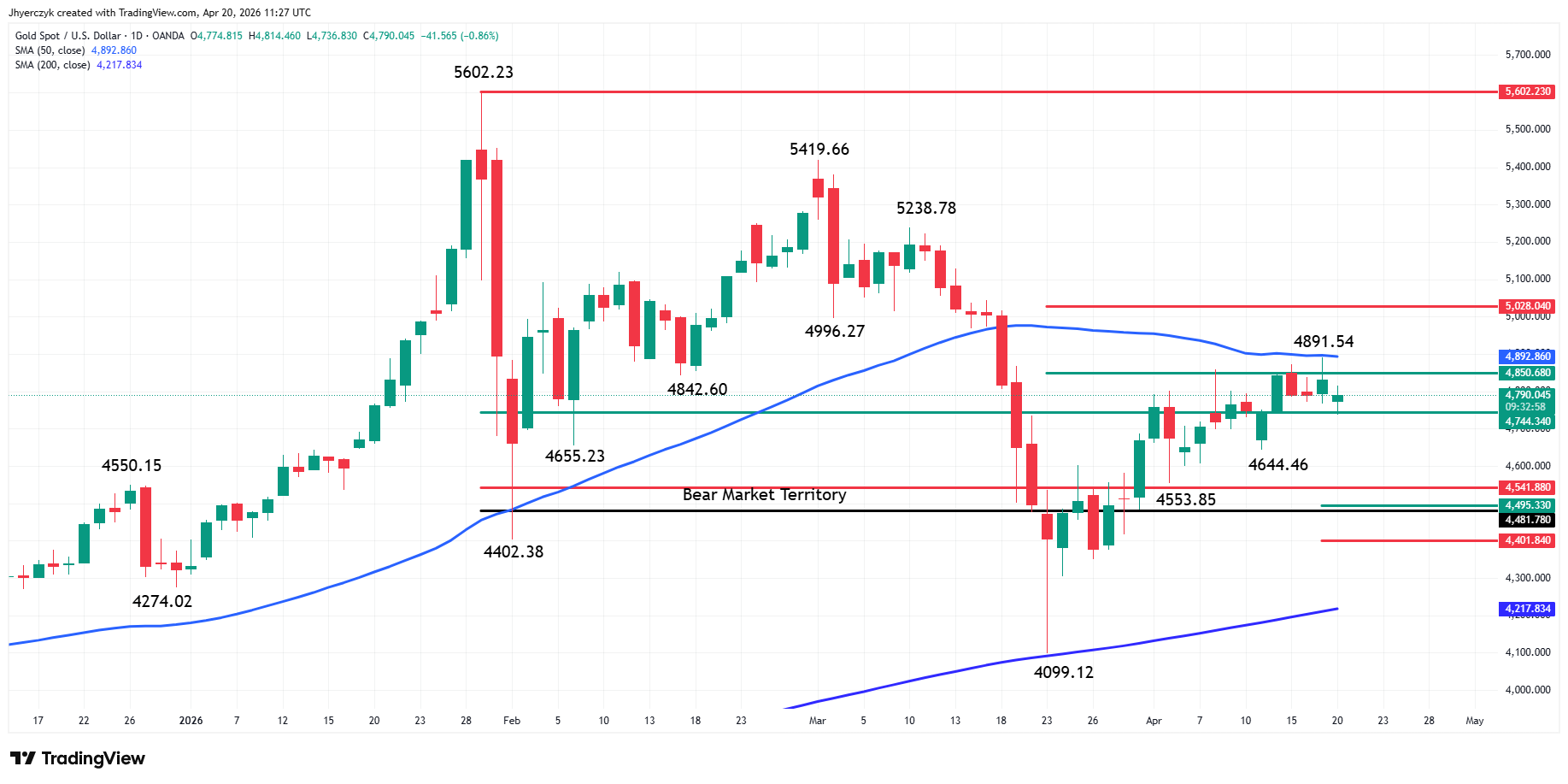
Technically, XAUUSD is sending mixed signals. Using the 200-day moving average at $4217.83, we are in an uptrend, but the 50-day moving average at $4892.84 is indicating weakness, based on the current price of $4804.18.
Gold Price Forecast
Every new Gold analysis as it publishes, today's technical signal and key levels, live price — on one page.
See all Gold forecastsThe main swing chart is down with the nearest resistance at $5238.78 and $5419.66 and the nearest major swing bottom at $4099.12. The minor swing chart controlling the momentum is up. A trade through $4891.54 will resume the trend, while a trade under $4644.46 changes the minor trend to down.
The swings in the market have also produced three retracement zones. The resistance zone at $4850.68 to $5028.04 stopped the rally at $4891.54 on Friday.
The major retracement zone support is $4744.34 to $4541.88. The upper level of this zone is currently being tested. If prices collapse through this level, we could end up falling all the way back to 61.8% support at $4541.88, followed closely by short-term support at $4495.33 to $4401.84.
Essentially, we can’t call the market bullish until we can sustain a move over the 50-day moving average at $4892.84. But we’re not going to call it bearish either because of the strong 200-day moving average support at $4217.83. So our current take is neutral with a slight upside bias.
More Information in our Economic Calendar.