
Market Overview
Gold and silver stepped up on Monday, grabbing onto a three-week long bounce as investors did some portfolio house-keeping in the face of escalating trade tensions and a rapidly weakening US dollar. Gold futures rose by around 1-2% in a single day, marking their third week of gains in a row, while trading volumes in global derivatives picked up sharply – a sign that big institutions are getting back in on the action.
People in the industry point to the fact that many investors are taking out new hedging bets because the US just raised its import tariffs to 15% – a move that, if it sticks, will add about 0.3-0.5% points to inflation over the course of a year.

Central Banks are Keeping the Demand Fire Burning
And the official sector buying is still the big driver of support here. According to the World Gold Council, central banks just snapped up 1,000+ metric tonnes of gold in 2025, which is one of the strongest multi-year runs on record. And reserve managers in emerging markets are still shifting their dollar-heavy portfolios out of the dollar and into something a bit more stable, because of all the uncertainty and fiscal deficits they’re seeing.
On top of all that, gold ETFs started to see some inflows at the start of 2026 after they’d been seeing some outflows late last year, which is a pretty good sign that things are still looking up for gold.
Silver’s Getting a Boost From Two Different Sources
Silver basically moved in line with gold – but because it’s used in so many industrial applications, it’s got an extra source of support. The Silver Institute thinks global demand for silver will come in at over 1.2 billion ounces this year, with a lot of that coming from new renewable energy installations and electronics.
On the other hand, new mine supply is going to be pretty tightly constrained because there just aren’t that many new mines opening up. And so far as yields are concerned, they’re still pretty low, and there’s a lot of uncertainty out there in the markets, which makes precious metals look like a pretty good place to put your money – at least, that’s what the strategists are saying in a shifting economic landscape.
Gold Price Forecast
Every new Gold analysis as it publishes, today's technical signal and key levels, live price — on one page.
See all Gold forecastsGold (XAU/USD) Reclaims $5,141 Fibonacci Level as Bulls Target $5,303
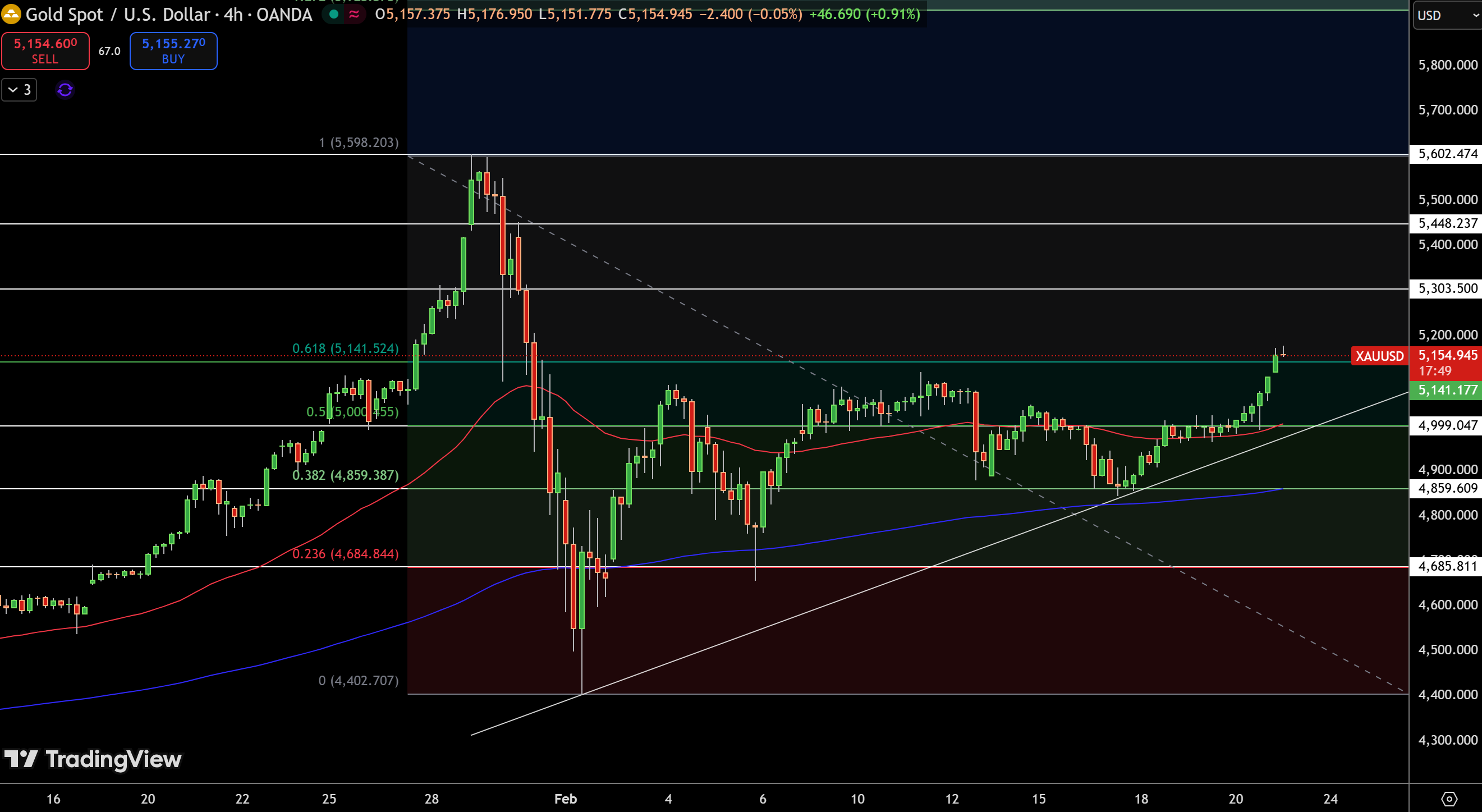
Gold is trading in the $5,155 region on the 4-hour chart – a level that’s helped gold break above the 0.618 Fibonacci retracement level at $5,141. This recent breakout has come on the back of a whole series of higher lows, all along that upwards trendline that started at $4,402 – and that trendline is still looking solid. Short-term momentum is definitely looking a bit more positive.
Gold has pretty convincingly broken above that 50-period moving average, now at $4,999, and the 200-period MA at $4,859 is still pointing upwards as well, which reinforces the idea that the big picture trend is still strongly upwards. The zone between $5,141 and $5,155 is now acting as immediate support. If the bulls can keep the momentum going, they will have the zone between $5,303 and $5,448 in their sights.
Trade idea: You could look to buy above $5,150 with a view to hitting $5,303, but be prepared to stop-loss at $5,000 if things go against you.
Silver (XAG/USD) Breaks Descending Trendline Near $86 — Bulls Regain Control
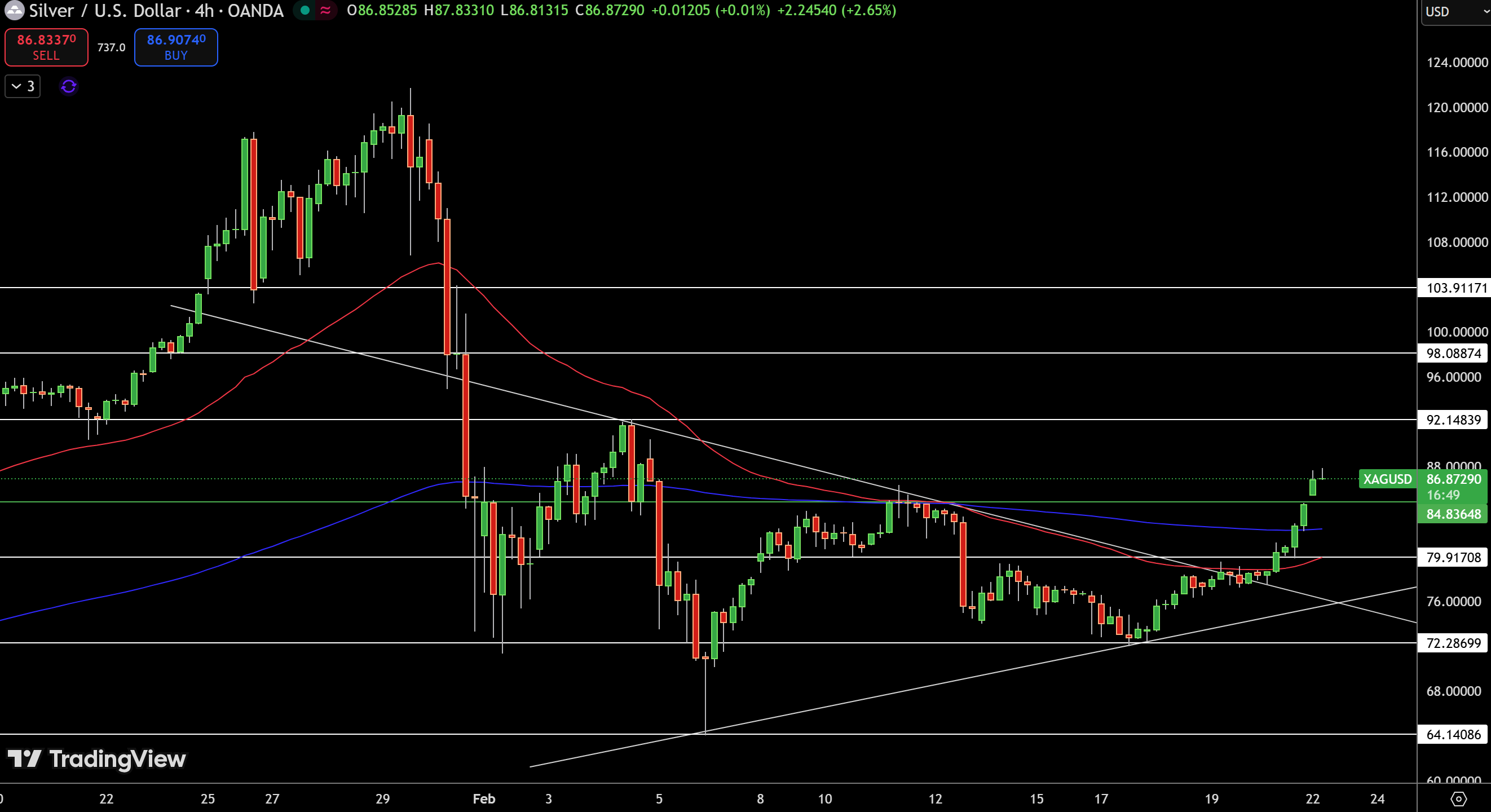
Silver on the 4 hour chart is now trading at around $86.87 , and that’s a nice milestone – the price has finally cleared that descending trendline that’s been capping price for months now – basically since late January. It’s the result of a string of higher lows that took off from that base at $72.28 – and that’s a pretty strong sign of better structure coming into play.
The price has now surged over both the 50-period moving average which is around $84.83 and that 200-period MA hovering near $84.50 – which is all very bullish for buyers right now. The area that used to be resistance between $84.80–$86.00 is now acting as a solid support level. The immediate hurdle for price is $92.14 , then $98.08 after that.
Trade idea: If you’re looking to buy in, try waiting for a pullback to around $85.00. Then you can target $92.00 , with a stop loss below $79.90.