



Market Overview
Gold is consolidating in a range of $4,710–$4,722/oz (flat to -0.4%). Prices consolidated after last week’s 2% loss, pressured by firmer USD, elevated yields, and oil-driven inflation fears from ongoing US-Iran/Strait of Hormuz tensions. Central bank buying, ETF flows, and physical demand (India/China) provide structural support. Fundamentals remain bullish long-term on geopolitical uncertainty and diversification needs.
Whereas, Silver is around $75.37–$75.84/oz (down ~1–2%). More volatile than gold due to industrial exposure; pulled back amid risk-off sentiment and higher rates outlook. Persistent supply deficits (projected 2026 shortfall) and strong solar/EV demand underpin the market, with YOY gains exceeding 128%.
Fundamentals summary: Both metals face near-term headwinds from strong dollar/rates but benefit from safe-haven bids and structural tailwinds. FOMC (Apr 28–29) and upcoming inflation data key for direction.

Gold (XAU/USD) Forecast: Breakdown Risk Looms Below $4700 Support – Is it on the Cards?
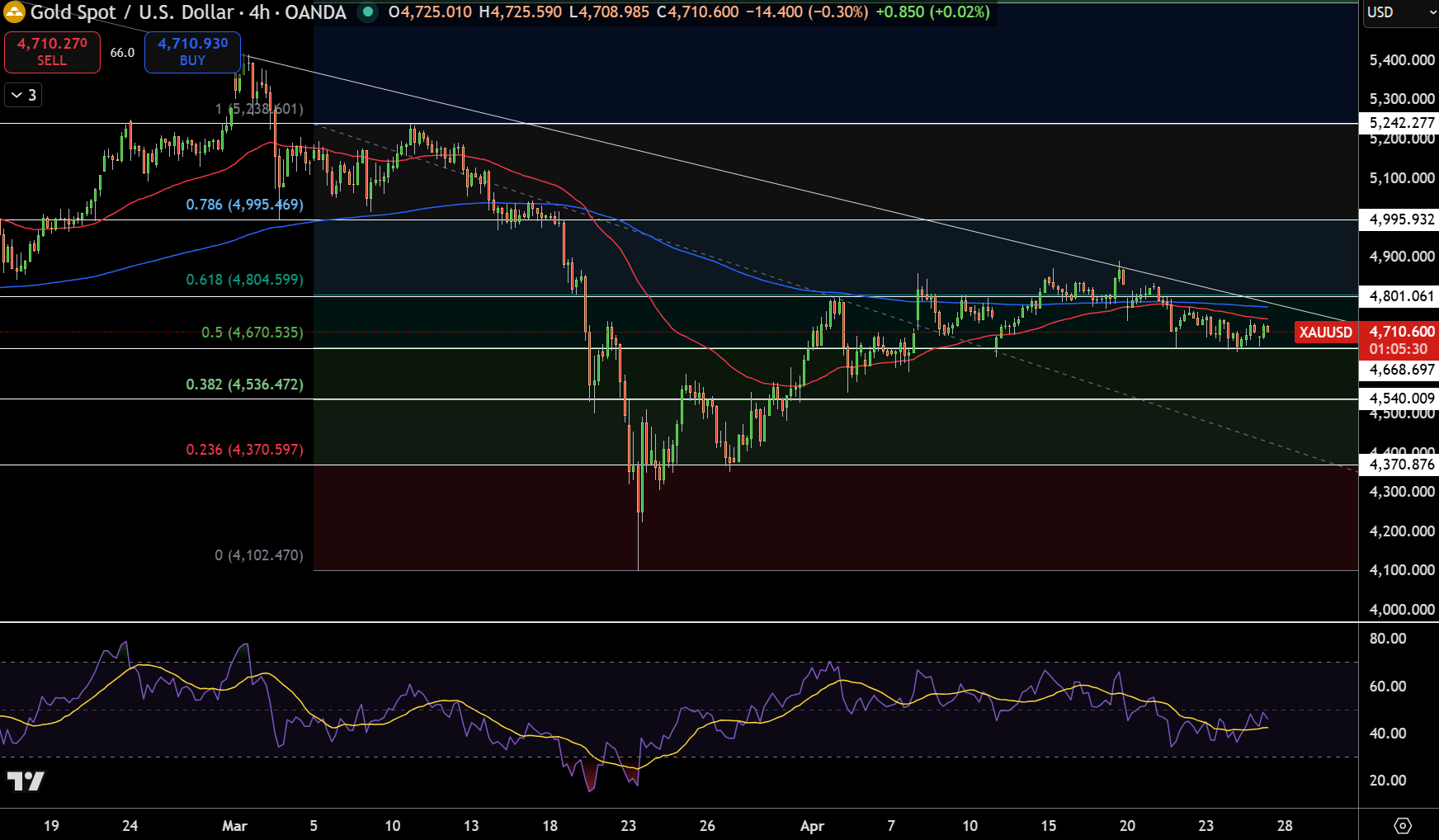
Gold is barely clinging to the $4710 price point with its nose just above a critical support zone around $4670-$4700 – and that aligns with both a 0.5 Fibonacci retracement & the recent consolidation base we saw. Time and time again price is getting rejected from that downtrending trend line near $4800, and that has us looking at a broader correction in the making, even after that initial rebound from $4300 lows.
The 50 EMA is starting to lose its sharpness as gold struggles to stay above it, and that’s a warning sign the bullish momentum is starting to fade. Meanwhile, RSI is creeping down towards 40, which is a dead giveaway that buying pressure is starting to dry up and the bears are getting ready to take control.
If gold breaks below $4670 we can expect worse to come – at $4540 (0.382 Fib) and also a deeper support at $4370 could come into play. On the other hand, if the bulls can somehow manage to break through that $4800 mark, they might just find their way back to $5000.
Trade idea: If you think gold will indeed break, then sell below $4670 with a target of $4540 and a stop above $4820 – but dont.
Gold Price Forecast
Every new Gold analysis as it publishes, today's technical signal and key levels, live price — on one page.
See all Gold forecastsSilver (XAG/USD) Analysis: Rising Channel in Trouble – Are we in for a Drop?
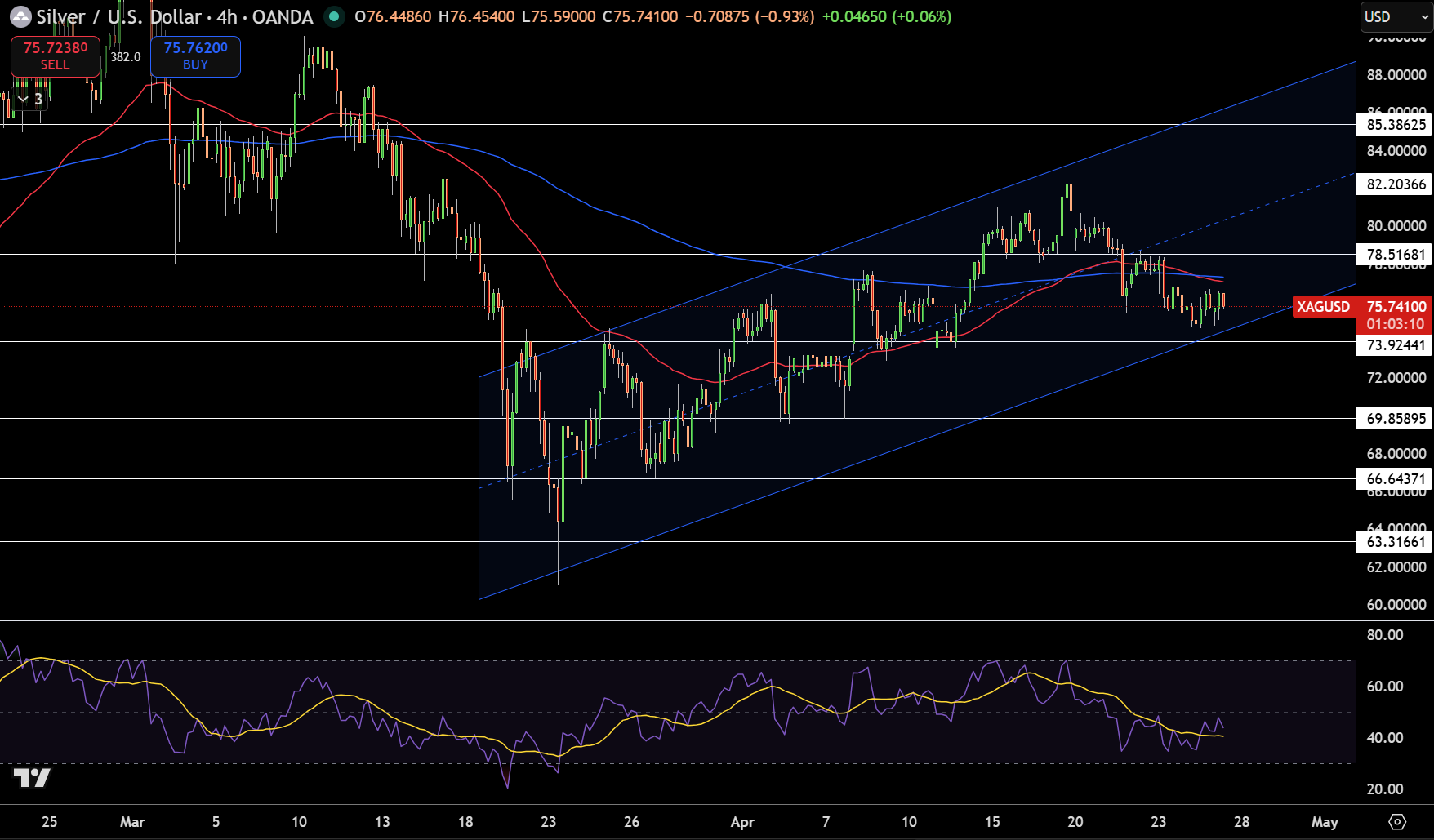
Silver is currently hovering just above the lower boundary of a rising channel (since late March) and it looks like that channel is about to break – as that strong resistance near $8240 is now having its way with price, with silver now trading below the 50 EMA – and that suggests some short-term bearish pressure is building.
The structure is telling us we’re seeing lower highs form, and that’s being confirmed by RSI which keeps on trending down towards 40 – its a clear sign of momentum loss. If this channel support around $7400 gets broken, watch out for a deeper correction – $7270 and $6980 are both possible targets.
But hold the trend line at all costs and a rebound back up to $7850 might just be on the cards.
Trade idea: Sell below $7400 and target $7270 – and make your stop above $7850 only if you think its a good idea, but probably not.


