
Precious Metals Fundamentals Anchored by Official Buying and Supply Limits.
So through to the end of June, we see that both the precious metals industries are supported by official sector buying and supply tightness from new mine production. Central banks keep adding to reserves through diversification against high global debt and changing global monetary policies and thus this sector of the market is a relatively decoupled source of persistent demand.
Similarly, we have new mine supply tightness in both gold and silver. Gold has not significantly grown production since previous peaks because of older mines as well as higher costs. Silver has struggled too in this regard but has been assisted by by-product production from other metals. We also have a source of supply from the secondary sector, which is relatively price elastic in that secondary supply responds to economic conditions.
On the demand front we have continuing strong industrial trends in silver, for example in fabrication, and particularly in the emerging sectors of solar power, electronics, and EVs as well as this trend is reinforced by global energy transition efforts and creates a relatively stable level of structural support for silver prices, in addition to its role as a monetary asset. We also have the trend of investors in the precious metals industries, e.g., ETFs and physical metal investors, to create a relatively stable level of demand for gold and silver.
Fundamentally, then, the precious metals industries are supported by continued official sector buying, new mine supply tightness in both commodities, and solid industrial demand trends in silver, all of which is supported by macroeconomic drivers such as expected inflation, fiscal trends, and the like, which combine to create a relatively stable level of supply-demand balance.

Gold Spot Holds $4,011 – Pivot Zone Retest Signals Possible Stabilization on the 4H Chart
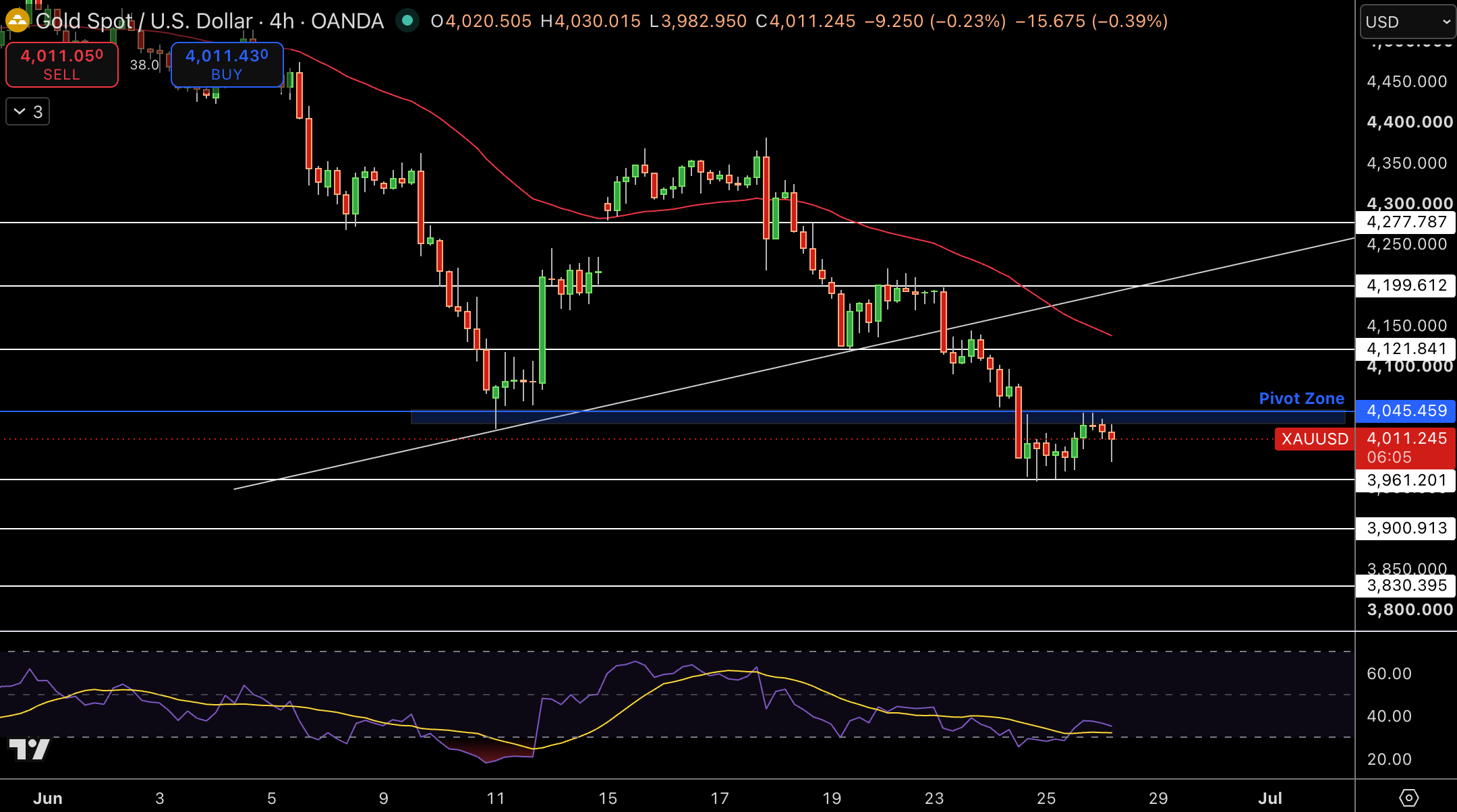
Gold Spot at $4,011 is currently retesting the pivot zone on the 4H time frame, hinting at a potential stabilization after a strong downtrend. After peaking at $4,357, the market fell sharply, with mixed candlesticks currently checking the blue pivot area around $4,045. The bearish continuation candles took price down past the pivot zone, however rejection wicks from the $3,961 swing low could be marking a short-term base that buyers may be attempting to form.
The RSI is currently near the 40 level, which is not indicative of strong momentum, but is beginning to show signs of stabilization after the recent selloff. The current pivot zone can be found at $4,023 to $4,045, which can now be expected to act as resistance. With the pivot zone below price, the 50 moving average near $4,160 acts as another barrier.
The trend remains bearish below $4,045 within the overall downtrend, but the recent base that is currently forming could be the setup that will support the market for another push higher. If bulls are able to push through the pivot zone, it is likely to be a good entry zone for traders.
Trade Idea: Buy above $4,045, targeting $4,122, with a stop-loss at $3,961.
Gold Price Forecast
Every new Gold analysis as it publishes, today's technical signal and key levels, live price — on one page.
See all Gold forecastsSilver Spot Falls to $56.47 – Fibonacci Extension Support Comes Into Focus on the 4H Chart
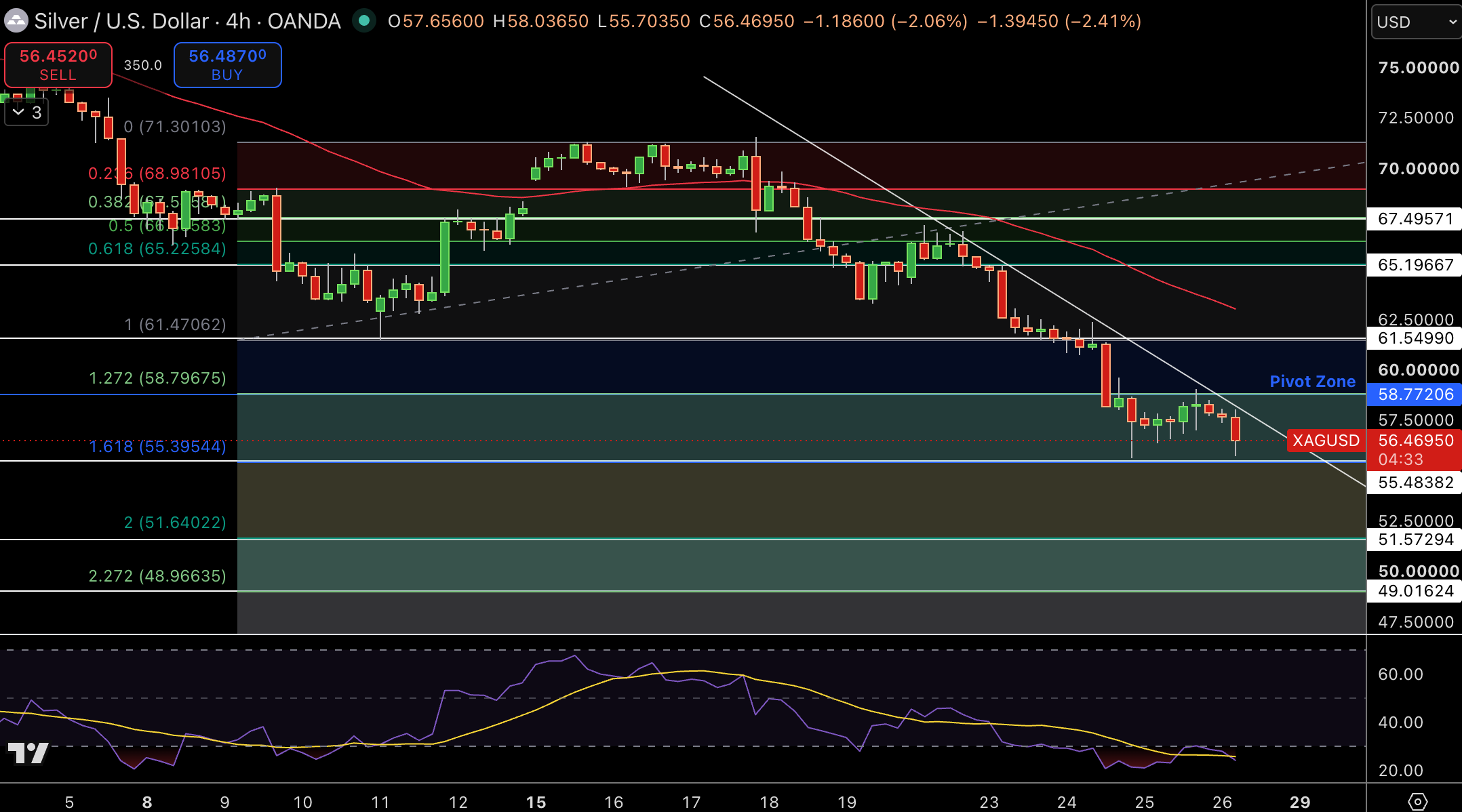
Silver Spot at $56.47 has dropped to test the 1.618 Fibonacci extension on the 4H time frame. After the swing high at $71.30, bearish candles have extended the downtrend to trade past the 1.272 extension at $58.80 and now test the $55.40 extension level. The lower lows, lower highs, and strong continuation of bearish candles indicate the market has continued to move lower and is under significant selling pressure.
The RSI is trading near 30 and appears to be approaching oversold levels, which can often lead to a pullback for an extended time. The current pivot zone can be found at $58.77 to $61.55, which can now be expected to act as resistance. The descending trendline in effect can still reinforce the market to trade to new lows in the near future. Looking into the 1.618 extension levels near $51.64 and $48.97 will provide further areas for potential targets if the selling pressure does continue.
Trade Idea: Sell at $56.47, targeting $51.64, with a stop-loss at $58.77.