Market Overview
Gold price (XAU/USD) found some strong upward momentum and was pretty much being bought up at the $4,723 level, and go as high as $4,735 at its peak. It all comes down to rising Geopolitical tensions in the Middle East that are causing investors to pile into Gold as their go to safe-haven asset.
Despite Gold getting a bit of a boost, Silver (XAG/USD) is still trading at $72.63 and its actually down 0.23% on the day – investors are a bit cautious and the stronger US dollar is weighing down on Silver’s demand.
US-Iran Conflict – The Next Round
As we’ve been saying, Gold is on the rise thanks to tension between the US and Iran that’s causing all sorts of uncertainty on the global markets. Investors are getting a bit spooked and looking for places to hide their cash, and for them Gold is as solid an option as any.
Irans Foreign Minister has said that if his country is attacked again he wont be holding back – its a pretty chilling message. Meanwhile, Saudi Arabia has said they’re not going to take much more crap and are hinting at possible military action of their own.
Its fair to say that all this is ratcheting up the risk of a much bigger conflict which is sending more investors running for cover towards Gold as their safe-haven asset of choice.
Fed Policy and Inflation – What Does it Mean for Gold
In the context of Golds gain, it is worth noting that surging oil and energy prices are causing real inflation concerns, which in turn means that central banks may have to keep interest rates tighter for longer, and this is not going to do Golds prices any favors.
Gold Price Forecast
Every new Gold analysis as it publishes, today's technical signal and key levels, live price — on one page.
See all Gold forecastsOn the monetary policy front, the US Federal Reserve decided to keep interest rates exactly where they were, but at the same time their top dog Jerome Powell was warning that all this rising oil and inflation could make it harder to keep the economy in check. And while he also made it clear that future interest rate hikes are still very possible – the overall message was that the Fed is being very cautious right now in order to keep the economy stable.
Which, on the one hand, sounds a bit like good news for investors, but on the other is making the US dollar a bit stronger – and that in turn is making gold a lot more expensive for investors from other countries.
Gold Price Forecast: $4,634 Support in Focus After Sharp $5,238 Reversal
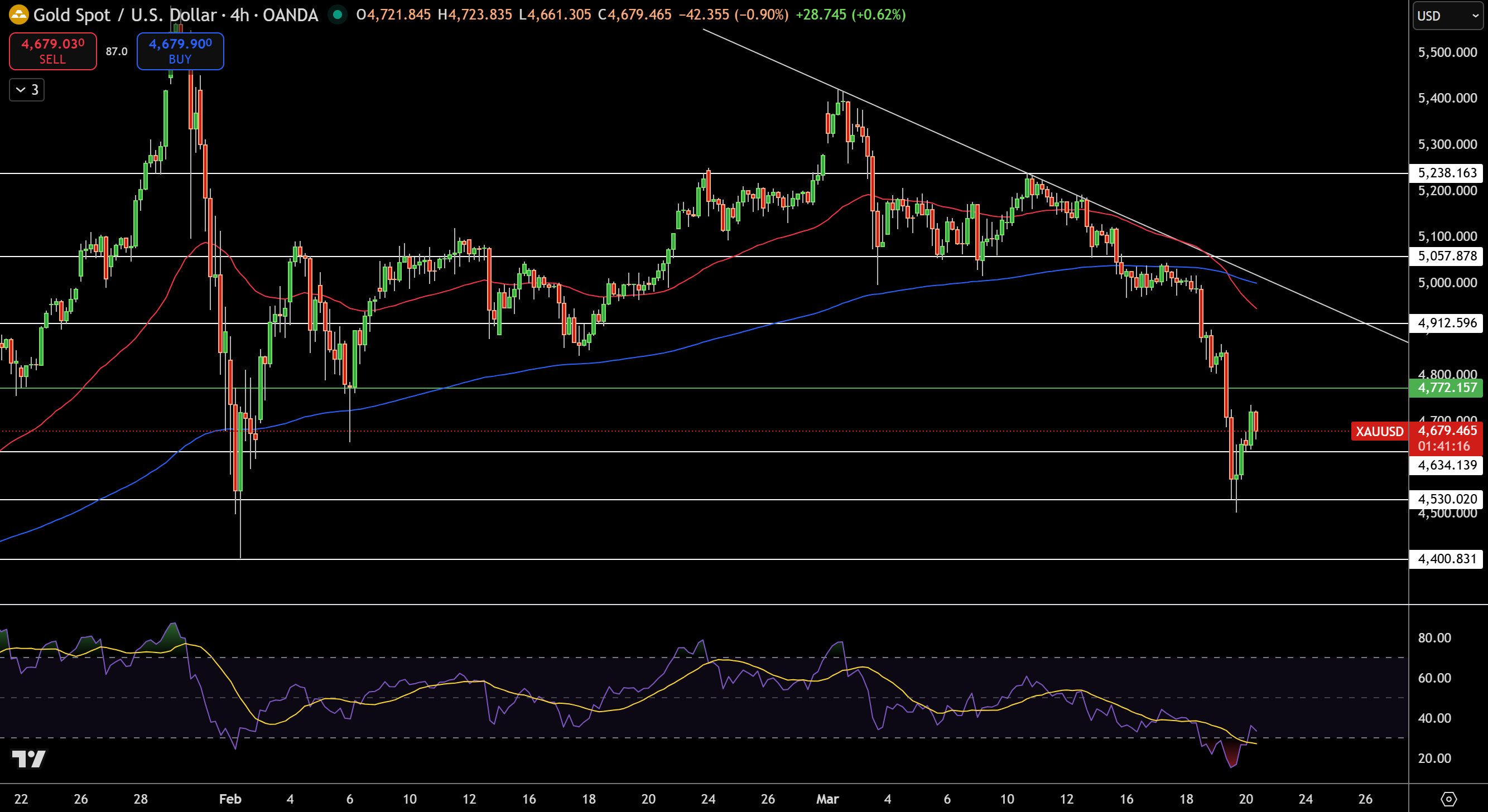
Gold is clinging to $4679 on the 4 hour chart after what was a pretty dramatic drop from the $5238 high. and a few brief seconds at the $4634 support mark – for now, at least that level has held firm. The bigger picture has turned distinctly bearish – price has broken below those key 50 and 200 period moving averages and is also respecting a downward trendline that formed back in March.
That selloff really gathered pace down below the $4912 support, which triggered the sort of panic selling that we’ve seen several times before. The immediate level of interest is just above us at $4772, then also $4912. If gold can’t get back above either of those levels then the downside risk starts to build – and we could see the price drop to $4530 and potentially even $4400. On the other hand, a sustained recovery above $4912 would go a long way to easing the pressure.
Silver Price Forecast: $74.46 Support Break Puts $67.50 in Focus
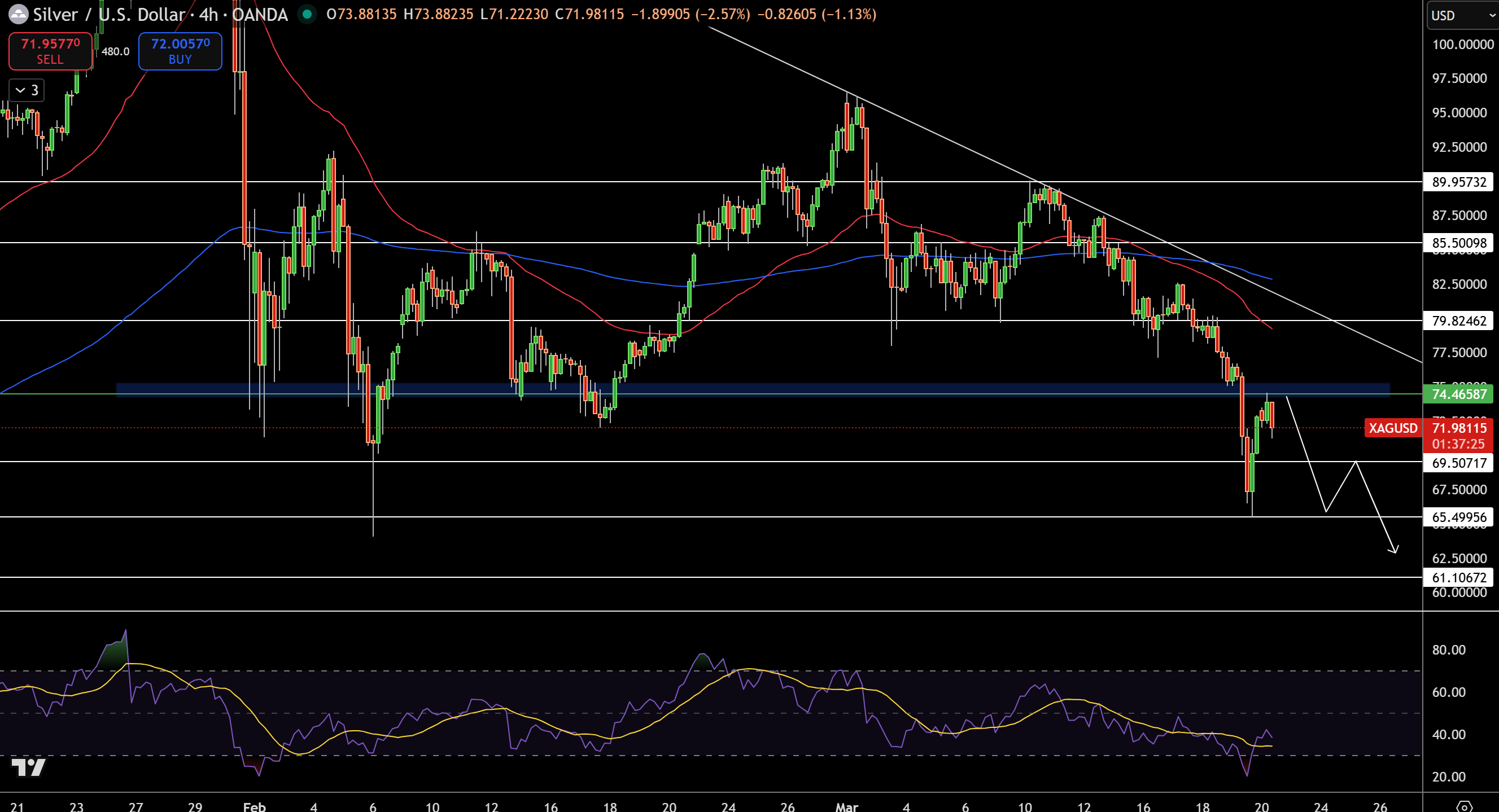
Silver is trading at $71.98 on the 4 hour chart after a pretty decisive break below the $74.46 support level – and that has confirmed a broader bearish shift from the $89.85 swing high. Price remains pinned beneath that downward trendline – and also both those 50 & 200 period moving averages – which is all adding to the downward pressure.
That downturn towards $67.50 really did trigger some very oversold RSI readings down around 30 and we’ve had a bit of a rebound as a result. But to be honest, momentum still isn’t that strong – and rallies seem to be struggling to make any real headway above $7450.
If silver can’t get back up above $74.50 the downside risk starts to build – and we could see the price drop to $67.50 and potentially even $65.50. A sustained close above $7982 would be the only real way to ease the bearish momentum and stabilise the whole structure.