
The Iran War: A Fragile Ceasefire Under Strain
Developments in the Middle East continued to drive volatility across financial markets last week, with conflicting signals from Tehran and Washington keeping traders on edge.
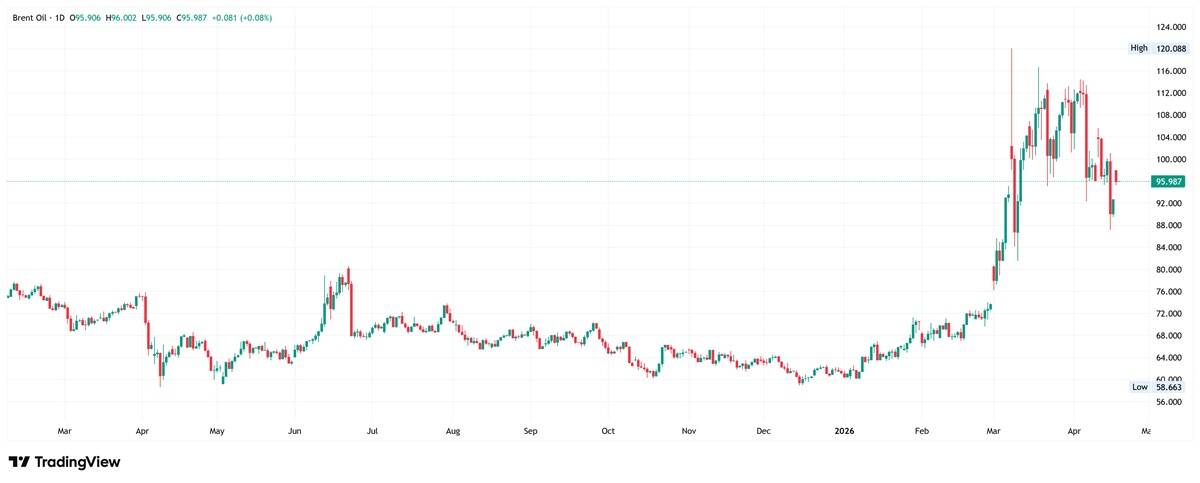
A brief spell of optimism emerged after Iran’s foreign minister declared that the Strait of Hormuz was “completely open” to commercial traffic, triggering a sharp drop in oil prices and a pullback in interest rate hike expectations. That relief proved short-lived. Within 24 hours, the Islamic Revolutionary Guard Corps fired on at least two commercial vessels in the Gulf and broadcast warnings that the waterway remained closed, forcing ships that had attempted the transit to turn back.
By the weekend, Iran had formally announced it was shutting the strait again, citing what it described as repeated breaches of trust stemming from the ongoing US naval blockade on Iranian ports.
Iran’s parliamentary speaker and chief negotiator Mohammad Bagher Ghalibaf said on state television that the two sides still have a long way to go before any agreement can be reached. US President Donald Trump struck a frustrated tone, insisting that negotiations were still progressing but warning that Washington would not tolerate what he described as “blackmail” over the strait. The public contradictions between Iran’s foreign ministry and its military establishment have laid bare the difficulty facing both sides as they attempt to reach a durable settlement.

Inflation
The Iran conflict has reshaped the inflation outlook across major economies, with a fresh batch of CPI readings due this week set to reveal how far the energy shock has fed through into broader consumer prices.
In Canada, headline inflation is expected to rebound to around 2.5% in March after falling to 1.8% in February, driven largely by the surge in gasoline prices. Bank of Canada Governor Tiff Macklem acknowledged the rise is coming but expects it to remain below 3%, while stressing that officials will tread carefully given already fragile economic growth.
The United Kingdom is likely among the most exposed of major advanced economies to the conflict’s fallout, given its heavy reliance on imported energy. The Bank of England remains openly divided between prioritising its inflation target and protecting an economy that, despite a stronger-than-expected February — with CPI holding at 3.0% year-on-year, unchanged from January — remains vulnerable to further shocks.
In New Zealand, inflation climbed to 3.1% in the December quarter against a backdrop of weak growth and high unemployment, a difficult combination for policymakers. The Reserve Bank of New Zealand held rates at 2.25% at its last meeting but has signalled it stands ready to tighten aggressively if inflation proves persistent. Finance Minister Nicola Willis has cautioned that prices could rise significantly higher than previously forecast if the conflict drags on.
Japan rounds out the picture with core inflation at 1.6% in February, technically below the Bank of Japan’s 2% target, yet markets still broadly expect a rate hike to 1.00% by end-June. With the policy rate still below neutral and four years of above-target inflation on the books, the BOJ faces pressure to act, even as the evolving Middle East situation clouds the near-term outlook.
Growth
Flash PMI readings from across the globe will also dominate the economic calendar this week, offering the most timely read yet on how the Middle East war and the associated spike in energy prices are filtering into business and consumer activity.
Thursday is the key day, with provisional purchasing managers’ index data due for the United States, the United Kingdom, France, Germany and the eurozone. Australia and Japan report slightly earlier in the week, alongside a flash estimate from India. Together, these releases will paint a near real-time picture of conditions in manufacturing and services across the world’s major economies in March — the first full month since the conflict escalated sharply.
Beyond the headline activity readings, markets will also be parsing the price expectations components closely, as central banks around the world watch for any signs that energy costs are feeding through into broader business pricing intentions. For policymakers already navigating a difficult trade-off between cooling inflation and supporting slowing economies, any evidence of renewed price pressures embedded in this week’s PMI data could prove pivotal in shaping the path of interest rates in the weeks ahead.
Earnings
Corporate earnings season reaches full stride this week, with a wide range of bellwether companies reporting across sectors and geographies. Together, these results will be scrutinised for any early signs of how higher energy costs, supply chain pressures and geopolitical uncertainty are feeding into corporate margins and forward guidance.
The week opens on Monday with results from NVIDIA, alongside US retailers Lowe’s, Target and TJX Companies. Tuesday brings a broad cross-section of industrials and healthcare names, including 3M, Halliburton, General Electric, UnitedHealth and Raytheon Technology, as well as United Airlines — whose outlook will be watched closely for evidence of demand softness amid elevated fuel costs — and European names UCB and Beiersdorf.
Wednesday’s focus falls on Tesla and Boeing, two companies whose supply chains and cost structures make them particularly sensitive to the current environment, alongside IBM, AT&T and Philip Morris. Thursday is the busiest day of the week, featuring Lockheed Martin, American Airlines, Intel, Union Pacific, American Express and Gilead Sciences from the US side, and a cluster of major European reporters including Sanofi, STMicroelectronics, SAP, Nokia, Dassault Systèmes and Orange. The week closes on Friday with Procter & Gamble, ENI, Nomura and Western Union.
Sources: Reuters, CNN, The Wall Street Journal, SP Global, BBC