
The US fueled geopolitical tensions over the weekend, capturing Venezuelan President Nicolas Maduro, influencing demand for safe-haven assets, and USD/JPY trends.
Traders had the opportunity to react to the weekend events on Monday, January 5. US control of Venezuela is likely to have ramifications on supply-demand dynamics for crude oil and Bitcoin (BTC). The news sent USD/JPY higher in early trading.
While market reaction to President Maduro’s capture was key, finalized manufacturing sector PMI data supported a tighter monetary policy environment, affirming the bearish medium-term outlook for USD/JPY.
Below, I’ll discuss the macro backdrop, the near-term price catalysts, and technical levels traders should closely watch.

Manufacturing Sector Prices Spotlight the BoJ
The S&P Global Japan Manufacturing PMI increased from 48.7 in November to 50.0 in December, hovering at the 50 neutral level. Several components supported the BoJ’s Summary of Opinions and statements that US tariff risks to the economy had cooled. According to the finalized December PMI survey:
- Demand for Japanese goods declined at the slowest pace in 18 months. Weaker external demand from Asia weighed on total new orders.
- Manufacturers increased staffing levels at the fastest rate in four months in anticipation of a jump in new business.
- Goods producers signaled a pickup in average operating expenses, leading to a sharp increase in charge inflation.
Tighter labor market conditions, rising prices, and an improving demand backdrop support further BoJ rate hikes. Rising employment would likely boost wage growth, fueling demand-driven inflation, affirming the cautiously bearish short- and bearish medium-term outlook for USD/JPY.
Notably, the manufacturing sector accounts for approximately 20% of Japan’s GDP, limiting the influence of the headline PMI on the BoJ’s policy stance. However, weakness in the Japanese yen pushed import prices higher, leading goods producers to increase selling prices due to rising input prices. The BoJ has frequently cited concerns about the weak yen eroding households’ disposable incomes.
December’s PMI data would give the hawks a stronger footing. However, the Services PMI figures will be crucial for USD/JPY, given that the sector accounts for roughly 70% of Japan’s GDP and is a key inflation driver. The S&P Global Services PMI will be out on Wednesday, January 7.
USD/JPY briefly climbed from 157.119 to 157.250 before falling to a low of 157.086 after the release of the finalized Manufacturing PMI.
USD/JPY Price Forecast
Every new USD/JPY analysis as it publishes, today's technical signal and key levels, live price — on one page.
See all USD/JPY forecasts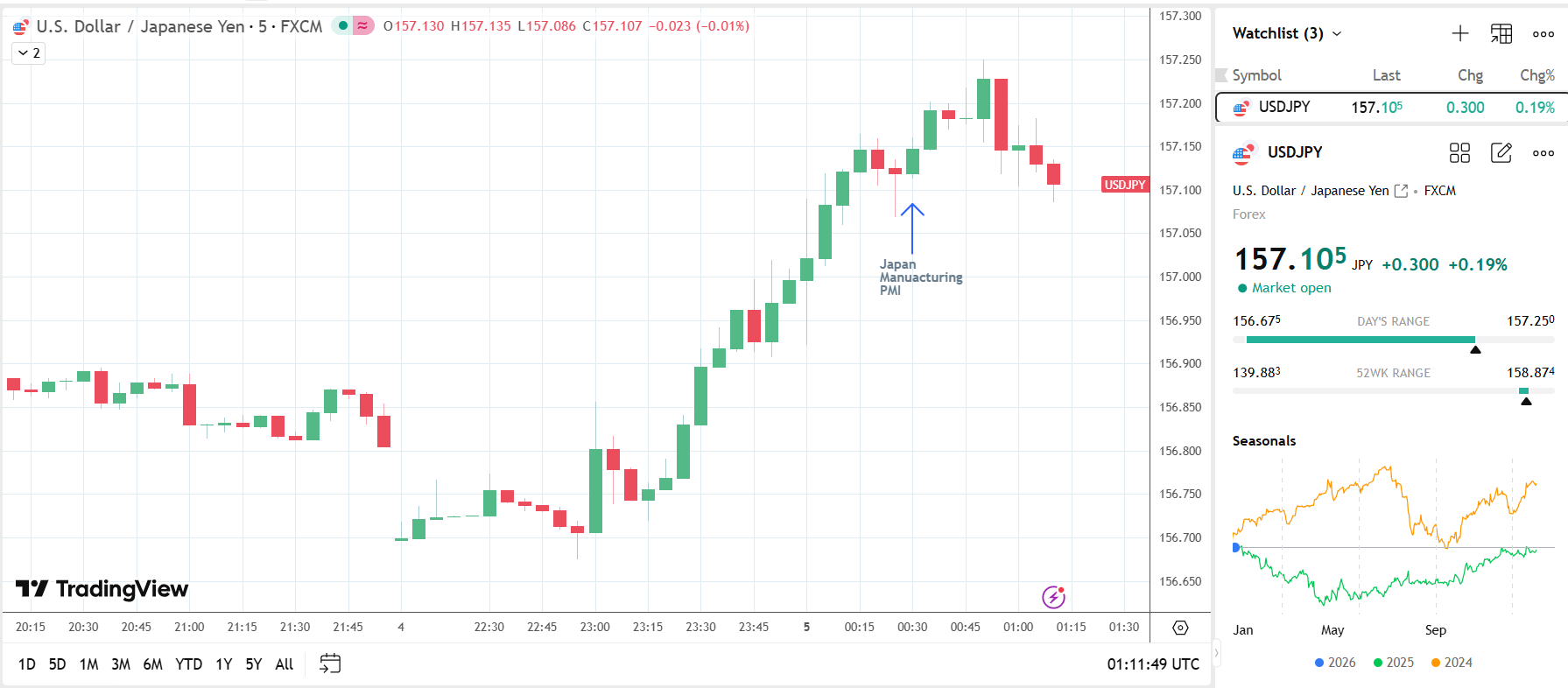
US ISM Manufacturing PMI and Fed Speakers in Focus
Later on Monday, US private sector PMI figures are likely to influence demand for the US dollar and the USD/JPY pair. Economists forecast the ISM Manufacturing PMI to increase from 48.2 in November to 48.3 in December.
Typically, a less pronounced contraction, rising employment, and higher prices support a less dovish Fed policy stance, which would lift demand for the US dollar. While the sector accounts for around 10% of the US GDP, the underlying PMI data provide insights into the effect of tariffs and the higher interest rate backdrop on prices.
Last week, the less influential S&P Global US Manufacturing PMI revealed that tariffs continued to drive prices higher, suggesting a more hawkish Fed policy stance. However, the ISM Services PMI, due out on January 7, will be key, given that the sector accounts for roughly 80% of US GDP and is the key inflation contributor.
While the PMI data will influence US dollar demand, Fed commentary remains key for USD/JPY trends. Increased calls to cut rates to bolster the labor market would dampen demand for the US dollar, pushing USD/JPY lower.
According to the CME FedWatch Tool, the probability of a March Fed rate cut increased from 51.1% on January 2 to 54.0% on January 3.
Looking ahead, expectations of further BoJ rate hikes, a new Fed Chair, potentially favoring lower rates, and a cooling US labor market remain key drivers. These scenarios continue to support a bearish short- to medium-term outlook for USD/JPY.
Technical Outlook: USD/JPY on a Downward Trajectory
For USD/JPY price trends, technicals, and fundamentals will continue to require close monitoring.
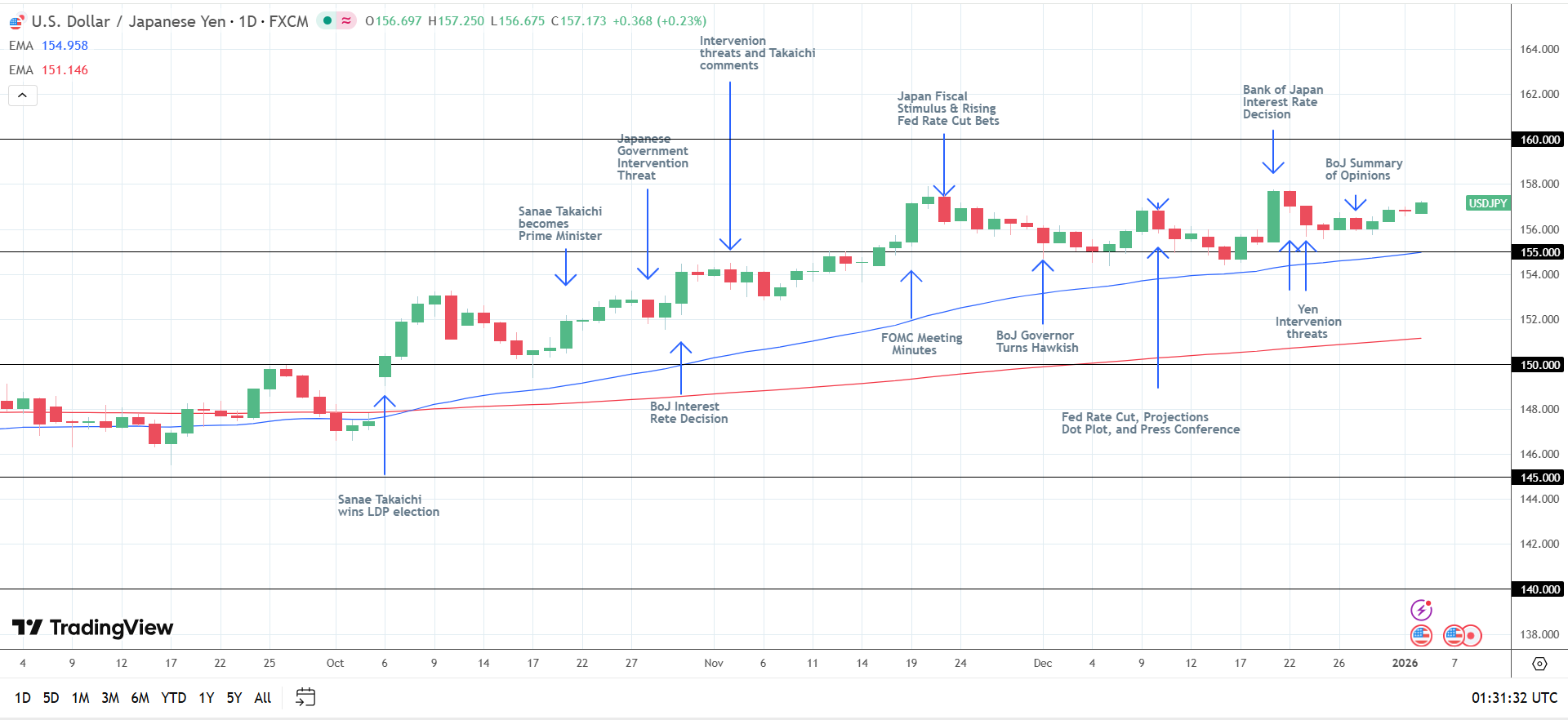
Looking at the daily chart, USD/JPY traded above its 50-day and 200-day Exponential Moving Averages (EMAs), signaling a bullish bias. While technicals remained bullish, bearish fundamentals are developing, outweighing the technical structure.
A break below the 155 support level and the 50-day EMA would indicate a bearish near-term trend reversal. A sustained fall through the 50-day EMA would expose the 200-day EMA. If breached, 150 would be the next key support level.
Crucially, a sustained fall through the 50-day and 200-day EMAs would reinforce the bearish price outlooks for USD/JPY.
Position and Upside Risk
In my view, expectations of narrower US-Japan rate differentials and threats of yen intervention signal a negative price outlook. However, the BoJ neutral interest rate and incoming US economic data will be key.
A higher neutral interest rate level would indicate multiple BoJ rate hikes and a narrower US-Japan interest rate differential. A narrower rate differential would reverse yen carry trades into US assets, pushing USD/JPY toward 140 over the longer term.
However, upside risks to the bearish outlook include:
- Dovish BoJ chatter and neutral interest rate in the range of 1% and 1.25%.
- Strong US economic indicators.
- Hawkish Fed rhetoric.
These scenarios would send USD/JPY higher. However, the ever-present threat of yen interventions is likely to cap the upside at around the 158 level, based on the latest communication.
Read the full USD/JPY forecast, including chart setups and trade ideas.
Conclusion: Focus on the BoJ Neutral Rate
In summary, the USD/JPY trends reflect expectations of narrowing rate differentials. Market focus will remain on the BoJ’s neutral rate, economic data, and the Fed’s forward guidance on rate cuts.
A neutral rate in the range of 1.5% to 2.5% would indicate a more aggressive BoJ rate path. Expectations of multiple BoJ rate hikes reaffirm the cautiously bearish short- and bearish medium-term bias for USD/JPY. Additionally, dovish Fed chatter and a potential unwinding of yen carry trades. A yen carry trade unwind would likely send USD/JPY toward 140 over the longer 6-12 month time horizon.
For more in-depth analysis, review today’s USD/JPY trading setups in our latest reports and consult the economic calendar.