USD/JPY extended its losses in early trading on Wednesday, February 11, as the dust settled from Prime Minister Sanae Takaichi’s landslide election victory.
Intervention warnings triggered a sharp drop in USD/JPY from a post-election result high of 157.660 to a February 11 low of 153.833. Price action in USD/JPY underscored the effectiveness of intervention warnings. Analysts previously predicted a markedly weaker yen if the Liberal Democratic Party (LDP) – Japan Innovation Party (JIP) gained a supermajority in the Lower House.
Meanwhile, US economic data will influence USD/JPY later on February 11 amid shifting bets on an H1 2026 Fed rate cut. Crucially, speculation about a Bank of Japan rate hike and Fed rate cuts continues to support a bearish medium-term outlook.
Below, I’ll discuss the macro backdrop, near-term price catalysts, and technical levels traders should closely watch.

Intervention Warnings Counter Debt-to-GDP Jitters
Expectations of a weaker Japanese yen in the aftermath of Prime Minister Takaichi’s landslide election win failed to materialize this week. Economists expected the yen to weaken, with USD/JPY potentially breaking above 160.
However, Japan’s top currency official Mimura and Finance Minister Katayama swiftly threatened to tackle any yen volatility stemming from the election outcome. These threats overshadowed the potential impact of fiscal spending policies on Japan’s debt-to-GDP ratio, Japanese Government Bond (JGB) yields, and yen demand.
Notably, the Japanese government has been more vocal about intervening since Prime Minister Takaichi took office in October 2025. USD/JPY dropped to a 2026 low of 152.092 on January 27, weighed by intervention threats and the Bank of Japan’s hawkish quarterly projections.
Crucially, the government’s stance on yen volatility and the BoJ’s hawkish policy outlook support a bearish short- to medium-term outlook for USD/JPY.
USD/JPY Price Forecast
Every new USD/JPY analysis as it publishes, today's technical signal and key levels, live price — on one page.
See all USD/JPY forecasts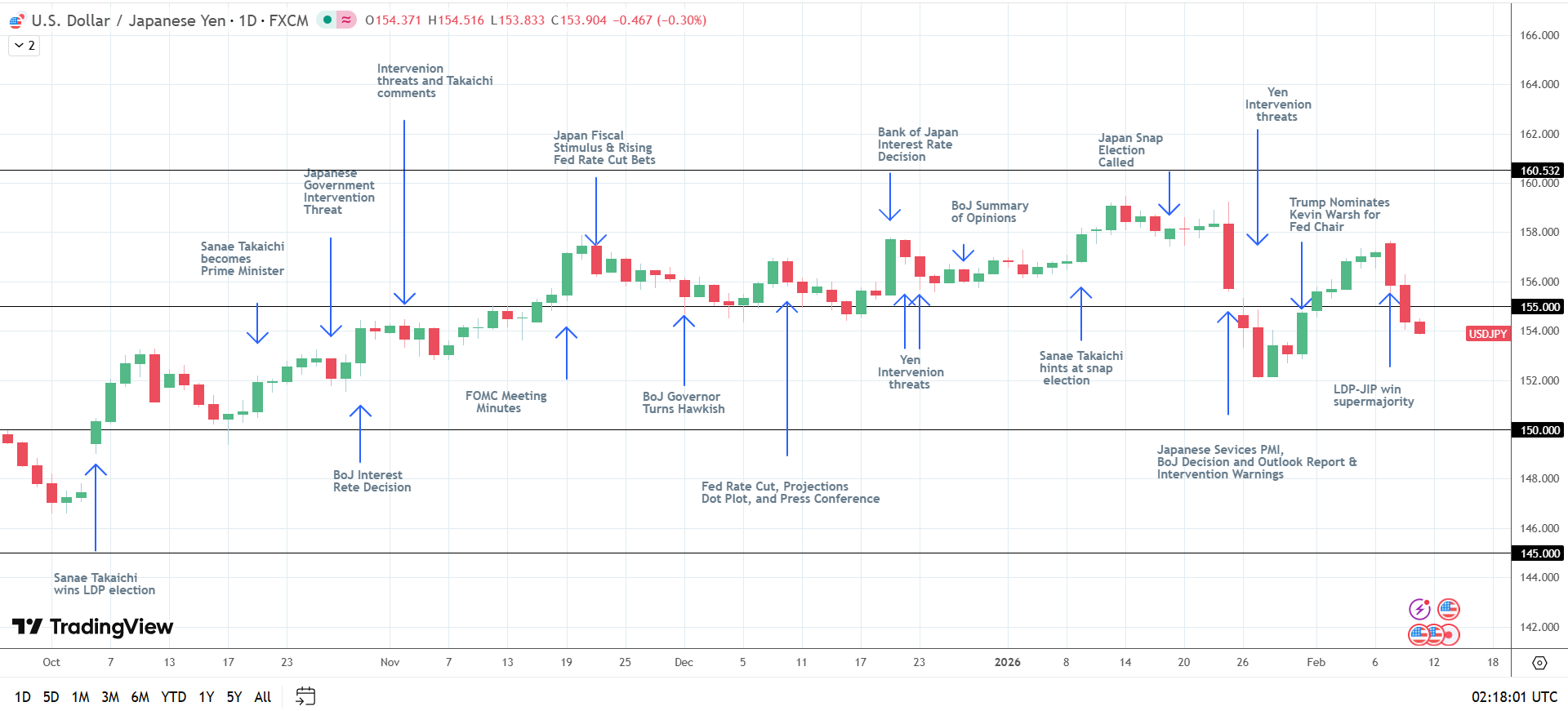
US Jobs Report to Spotlight the Fed
While Prime Minister Takaichi’s fiscal spending plans and the BoJ’s policy outlook influence demand for the yen, US labor market data will be key for the US dollar.
On Wednesday, February 11, the delayed US jobs report will fuel speculation about an H1 2026 Fed rate cut. Economists expect average hourly earnings to rise 3.6% year-on-year (YoY) in January, down from 3.8% in December. Meanwhile, economists forecast unemployment to remain at 4.4%.
Softer wage growth could raise bets on an H1 2026 Fed rate cut, weighing on the US dollar. Typically, slower wage growth curbs consumer spending, dampening demand-driven inflation. Cooling inflationary signals would support a more dovish Fed rate path. Given these dynamics, an unexpected rise in unemployment would likely weigh more heavily on the US dollar.
Today’s data follows weaker-than-expected US JOLTs job openings and retail sales data. The numbers lifted bets on an H1 2026 Fed rate cut. According to the CME FedWatch Tool, the chances of a June Fed rate cut increased from 56% on February 3 to 75.2% on February 10.
Importantly, a more hawkish BoJ policy stance and a more dovish Fed rate path would indicate narrowing US-Japan rate differentials in favor of the yen. Narrowing rate differentials would be bearish for USD/JPY.
Technical Outlook: Key Levels to Watch
For USD/JPY price trends, traders should track technical indicators, incoming economic data, government fiscal policies, and central bank chatter.
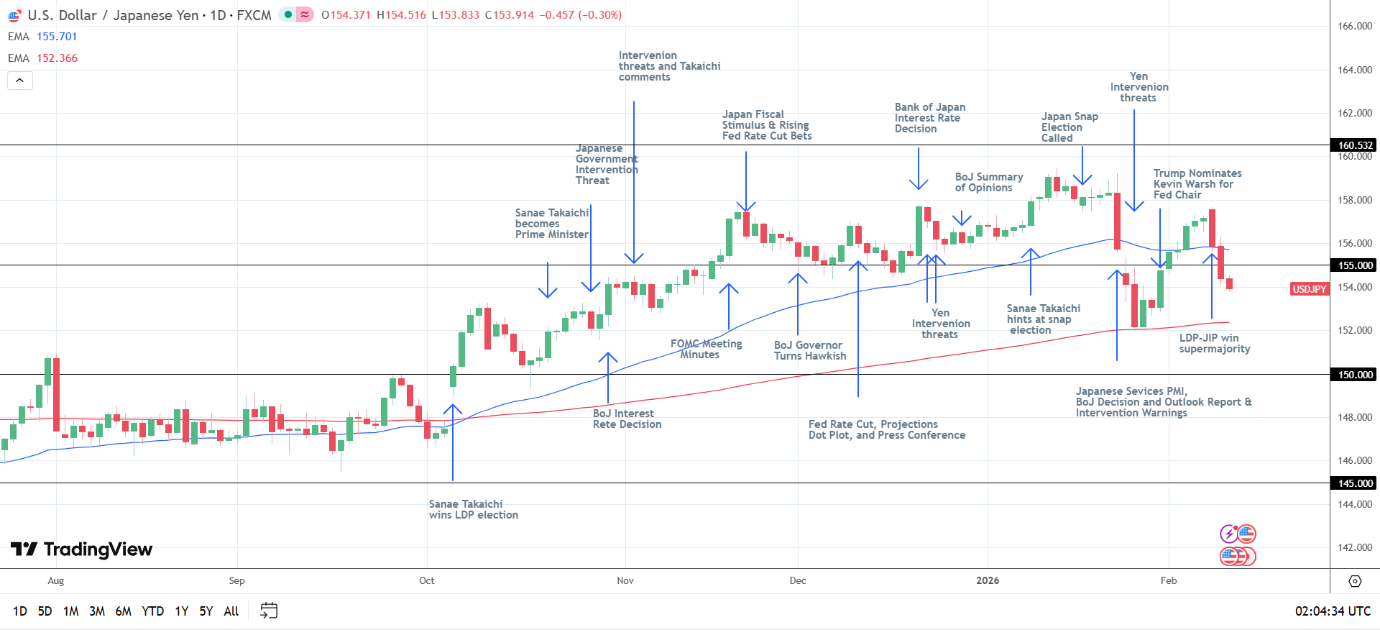
On the daily chart, USD/JPY trades below its 50-day Exponential Moving Average (EMA), but holds above the 200-day EMA. The EMA positions signal a bearish near-term but bullish longer-term bias. Favorable yen fundamentals align with the short-term technicals, supporting a bearish medium-term outlook.
A break below the 200-day EMA would signal a bearish trend reversal, bringing the 150 support level into play. If breached, 145 would be the next key support level.
Notably, a sustained fall through the EMAs would reinforce the negative medium- to longer-term price outlook.
Positioning and Risk Outlook
In my view, the prospect of BoJ rate hikes and Fed rate cuts supports a negative price outlook. However, upside risks to the bearish outlook include:
- Dovish BoJ rhetoric and a lower neutral interest rate (potentially 1% – 1.25%), signaling few rate hikes to reach policy normalization.
- US economic data cool bets on an H1 2026 Fed rate cut.
These factors would send USD/JPY higher. However, yen intervention threats are likely to cap the upside at around 160.
Read the full USD/JPY forecast, including chart setups and trade ideas.
Conclusion: Fiscal Policies, the BoJ, and the Fed in the Spotlight
In summary, USD/JPY trends remain hinged on Prime Minister Takaichi’s spending plans, the BoJ’s policy stance, and the Fed’s rate path.
While the LDP-JIP coalition’s supermajority and fiscal spending plans are bullish for USD/JPY, intervention warnings support a bearish near-term outlook. Meanwhile, a higher BoJ neutral rate (1.5%-2.5%), signaling multiple BoJ rate hikes. A more hawkish BoJ rate path would likely strengthen the yen over the medium term. Additionally, expectations of multiple Fed rate cuts would indicate narrowing rate differentials, reaffirming the bearish medium-term outlook for USD/JPY.
Looking beyond the medium-term (1-3 months). A stronger yen and yen carry trade unwinds would likely send USD/JPY toward 140 over the 6-12 month time horizon.
For more in-depth analysis, review today’s USD/JPY trading setups in our latest reports and consult the economic calendar.