XRP snaps two-day winning streak as White House meeting on crypto legislation shows no signs of breaking the TradFi-DeFi deadlock.
Representatives from the banking and crypto communities met at the White House for a second time on Tuesday, February 10, looking to find common ground on stablecoin yield legislation.
Failure to reach an agreement left XRP under selling pressure, with the bulls defending $1.4. Despite the lack of progress on the Market Structure Bill, robust demand for XRP-spot ETFs cushioned the downside.
XRP’s extended February losses support a bearish short-term outlook, while the medium-term outlook remains bullish.
Below, I will explore the key drivers behind recent price trends, the medium-term (4-8 weeks) outlook, and the technical levels traders should watch.

TradFi-DeFi Standoff on Stablecoin Yields Weighs on XRP
On February 10, the White House held a second gathering to reach a consensus on stablecoin yield-related legislation.
On one side, the US banking community is pushing back on legislation that allows stablecoin rewards. US banks have argued that stablecoin yields, significantly higher than interest on deposits, would lead to an exodus of bank depositors to DeFi. Bank of America CEO Brian Moynihan recently warned that over $6 trillion in deposits could migrate from the US banking system to stablecoins.
Markedly lower deposits would mean the banks would have to access wholesale funding for lending. Wholesale funding is more expensive than interest on deposits, resulting in narrower net interest margins, impacting profits.
On the other side, crypto firms such as Coinbase (COIN) are pushing for legislation to allow stablecoin rewards, a lucrative source of income for exchanges.
For context, Coinbase withdrew its support for the Banking Committee’s draft text for the Market Structure Bill in January. Coinbase CEO Brian Armstrong warned that the Banking Committee’s text would kill rewards on stablecoins and allow banks to ban their competition. The Banking Committee responded by postponing its markup vote on the draft text, triggering an XRP sell-off.
Updates from the Tuesday meeting suggested that TradFi and DeFi remain at loggerheads, challenging the US administration’s push for an agreement by the end of February.
Mixed Updates from White House Session
Blockchain Association Executive Vice President Dan Spuller remarked on Tuesday’s session, stating:
“Today’s follow-up shifted from broad discussion to serious problem-solving. This was a smaller, more focused session. Stablecoin rewards were front and center. Banks did not come to negotiate from the bill text, instead arriving with broad prohibitive principles, which remain a key disagreement. The Trump Admin’s decision to keep convening stakeholders reflects a real commitment to working through these issues as the Senate Banking Committee continues its work.”
Ripple Chief Legal Officer Stuart Alderoty offered a more optimistic summary of the session, saying:
“Productive session at the White House today – compromise is in the air. Clear, bipartisan momentum remains behind sensible crypto market structure legislation. We should move now – while the window is still open – and deliver a real win for consumers and America.”
The ongoing delay to the Market Structure Bill remains a headwind for XRP. However, expectations that the US Senate will eventually pass the Market Structure Bill support the bullish medium- to longer-term outlook.
XRP Price Forecast: Short-, Medium-, and Long-Term Targets
February’s 14% slump reaffirmed the negative short-term outlook (1-4 weeks), with a target price of $1.0.
However, optimism over the passage of the Market Structure Bill and increased XRP utility continue to fuel buying interest in XRP-spot ETFs, reinforcing the bullish medium- to long-term price projections:
- Medium-term (4-8 weeks): $2.5.
- Longer-term (8-12 weeks): $3.0.
Key Downside Risks to the Bullish Medium-Term Outlook
Several events could derail the constructive medium-term bias. These include:
- A hawkish Bank of Japan, with a higher neutral interest rate (potentially 1.5%-2.5%). Multiple BoJ rate hikes could narrow US-Japan rate differentials in favor of the yen. Narrowing rate differentials could trigger a yen carry trade unwind, as seen in mid-2024. A yen carry trade unwind would validate the bearish trend reversal.
- Soft US economic indicators and increased risk of a US recession.
- Delays and/or partisan opposition to the Market Structure Bill.
- Extended periods of XRP-spot ETF net outflows.
These scenarios would weigh on XRP, sending XRP toward $1.0, reaffirming the bearish short-term outlook.
Technical Analysis: Levels to Watch
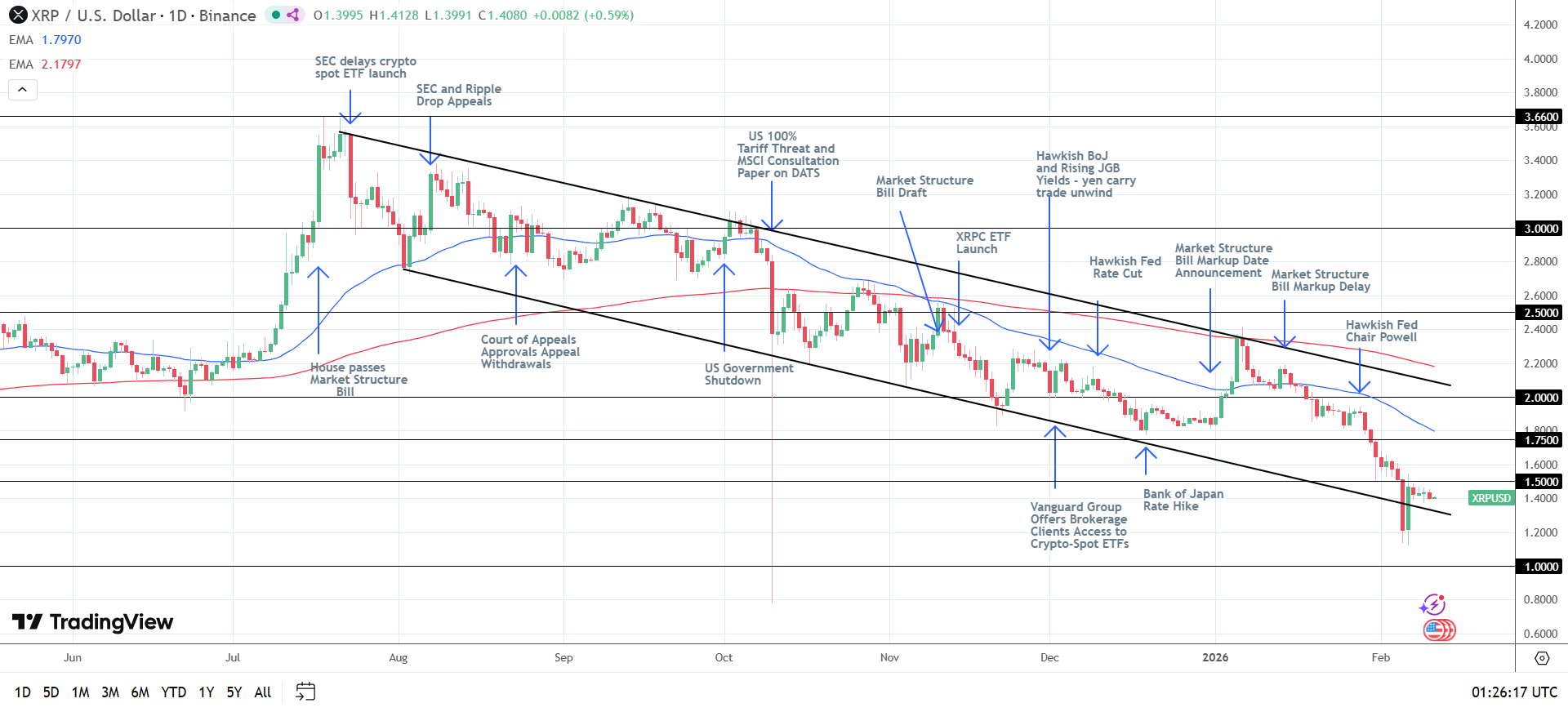
XRP fell 2.58% on February 10, reversing the previous day’s 0.42% gain to close at $1.3998. The token faced heavier selling pressure than the broader crypto market cap, which declined by 1.93%.
Tuesday’s pullback left XRP well below its 50-day and 200-day EMAs, signaling bearish momentum. However, several favorable fundamentals continue to counter bearish technicals, supporting a bullish medium-term outlook.
Key technical levels to watch include:
- Support levels: $1.0 and then $0.7773.
- 50-day EMA resistance: $1.7970.
- 200-day EMA resistance: $2.1797.
- Resistance levels: $1.50, $2.0, $2.5, and $3.0.
On the daily chart, a break above $1.50 would pave the way toward the 50-day EMA. A sustained move through the 50-day EMA would indicate a near-term bullish trend reversal. A bullish trend reversal would bring the 200-day EMA into play.
A sustained breakout above the EMAs would reinforce the bullish medium-term price targets.
Fundamental Events Driving Near-Term Price Action
Near-term price drivers include:
- XRP-spot ETF flow trends.
- US economic indicators and the Fed’s policy stance. This week, the US jobs and CPI reports will be key for the Fed.
- Crypto-related regulatory developments.
- The Bank of Japan’s neutral rate and policy stance.
- Increased geopolitical tensions.
Bearish Structure Intact: $1.0 Remains Critical Support
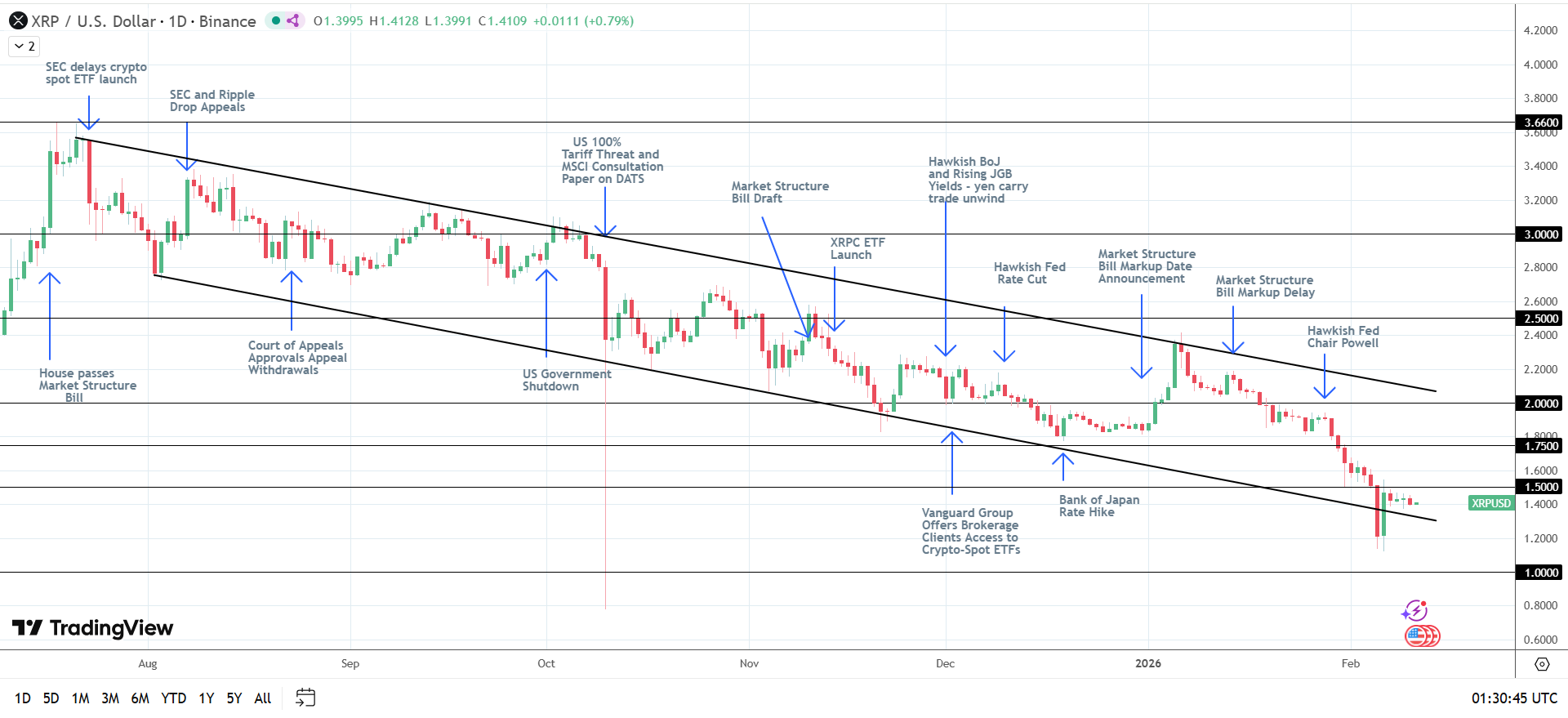
XRP’s 2026 sell-off affirmed the existing bearish trend. A break below the lower trendline would bring the February 6 low of $1.1227 into play. If breached, $1.0 would be the next key support level. A fall through $1.0 would reaffirm the bearish short-term outlook and further validate the bearish structure.
Conversely, a break above $1.5 would enable the bulls to target $2.0 and the upper trendline. A sustained move through the upper trendline would invalidate the bearish structure and indicate a bullish trend reversal, reaffirming the constructive medium-term bias.
- Short-term (1-4 weeks): $1.0.
- Medium-term (4-8 weeks): $2.5.
- Longer-term (8–12 weeks): target of $3.0.
XRP Outlook: Crypto Legislation, US Data, and ETF Flows Remain Key Drivers
Looking ahead, crypto-related legislative developments are critical for XRP’s price trajectory. Progress toward an agreement on stablecoin yields would likely fuel XRP demand.
However, US economic indicators, central bank rhetoric, and XRP-spot ETF flows will also dictate near-term price trends.
A more dovish Fed policy stance and a lower BoJ neutral rate (potentially 1%-1.25%) would boost sentiment. Furthermore, robust inflows into US XRP-spot ETFs and the progress of the Market Structure Bill would affirm the positive medium-term outlook.
In summary, these factors suggest a medium-term (4–8 weeks) move to $2.5. The US Senate’s passing the Market Structure Bill would reinforce the longer-term (8–12 weeks) price target of $3.0.
Beyond 12 weeks, these scenarios are likely to drive XRP to its all-time high of $3.66 (Binance). A break above $3.66 would affirm a 6- to 12-month price target of $5.