



Japanese economic indicators cooled bets on an April BoJ rate hike, while Fed Minutes and key US reports tempered Fed rate cut bets. These dynamics sent USD/JPY briefly to a February 20 high of 155.651. However, the US Supreme Court ruling on President Trump’s tariffs fueled US policy uncertainty, weighing on demand for the US dollar.
USD/JPY dropped below 155 in early trading on Monday, February 23, as traders considered the prospect of monetary policy divergence and government policies. Traders should closely monitor central bank rhetoric and US and Japanese government policy announcements throughout the session. US economic indicators will also influence US dollar demand.
Despite key economic indicators shifting sentiment toward BoJ and Fed rate paths, expectations of eventual BoJ rate hikes and Fed rate cuts continue to support the bearish medium-term outlook for USD/JPY.
Below, I’ll discuss the macro backdrop, near-term price catalysts, and technical levels traders should closely watch.
Japanese Consumer Price Inflation and Services Inflation Send Mixed Signals
Last week, Japanese inflation figures signaled a marked cooling in headline inflation, challenging expectations of an April BoJ rate hike. The annual inflation rate tumbled from 2.1% in December to 1.5% in January, while core inflation fell from 2.4% to 2.0%, the BoJ’s target rate.
However, the so-called ‘core-core’ inflation rate eased from 2.9% to 2.6%, holding well above the Bank’s 2% target rate. Core-core inflation aligns with the view that the drop in headline inflation may be attributed to temporary factors, such as lower energy prices. Typically, the ‘core-core’ inflation rate carries more weight with policymakers, keeping an April rate hike on the table.
Crucially, services sector activity and inflation bolstered the case for an April hike. The S&P Global Japan Services PMI increased from 53.7 in January to 53.8 in February. Furthermore, service providers indicated a pickup in expenses and a sharper rise in selling prices.
These trends suggest a pickup in inflationary pressures, supporting a more hawkish BoJ policy stance. The services sector accounts for roughly 70% of Japan’s GDP, and BoJ Governor Kazuo Ueda has previously warned of the Bank’s focus on the sector’s price trends.
Given the mixed inflation numbers, USD/JPY is likely to be more sensitive to Bank of Japan monetary policy cues. The BoJ may view last week’s CPI report as favorable for households and the domestic demand outlook. Typically, softer consumer price inflation boosts households’ purchasing power and consumer confidence, fueling private consumption. An upswing in consumption would raise demand-driven inflation and contribute to GDP growth.
USD/JPY Price Forecast
Every new USD/JPY analysis as it publishes, today's technical signal and key levels, live price — on one page.
See all USD/JPY forecastsEconomist Views on Japan’s Private Sector and Inflation
East Asia Econ remarked on last week’s PMI and inflation numbers, stating:
“Manufacturing sentiment is up, and falling headline inflation should further boost the mood of households too. For the BOJ, the critical issue will be whether these improvements in soft data feed into real aggregate demand, in turn supporting its confidence about the trend in underlying inflation.”
Ongoing expectations of a BoJ rate hike continue to support the bearish short- to medium-term outlook for USD/JPY.
US Tariffs, Economic Indicators, and the Fed in Focus
While market bets on a BoJ rate hike linger, Trump’s tariff policies, US economic data, and Fed chatter will influence buying interest in the US dollar.
Later on Monday, factory orders, the Dallas Fed Manufacturing Index, and the Chicago Fed National Activity Index will provide insights into the US economy. Given that the factory order numbers are for December, the Dallas Fed and Chicago Fed data will likely have more influence on the Fed rate path. Softer numbers would raise expectations of a June Fed rate cut, weakening the US dollar.
Beyond the numbers, President Trump’s tariff policies, US-Iran-related headlines, and Fed chatter will also influence USD/JPY trends.
According to the CME FedWatch Tool, the probability of a June cut fell from 68.6% on February 13 to 51.1% on February 23, strengthening the US dollar.
Nevertheless, market expectations of multiple Fed rate cuts and the BoJ’s more hawkish policy outlook remain key to the negative short- to medium-term outlook for USD/JPY.
Technical Outlook: Key Levels to Watch
For USD/JPY price trends, traders should closely assess technical indicators, key economic data, government policies, and central bank rhetoric.
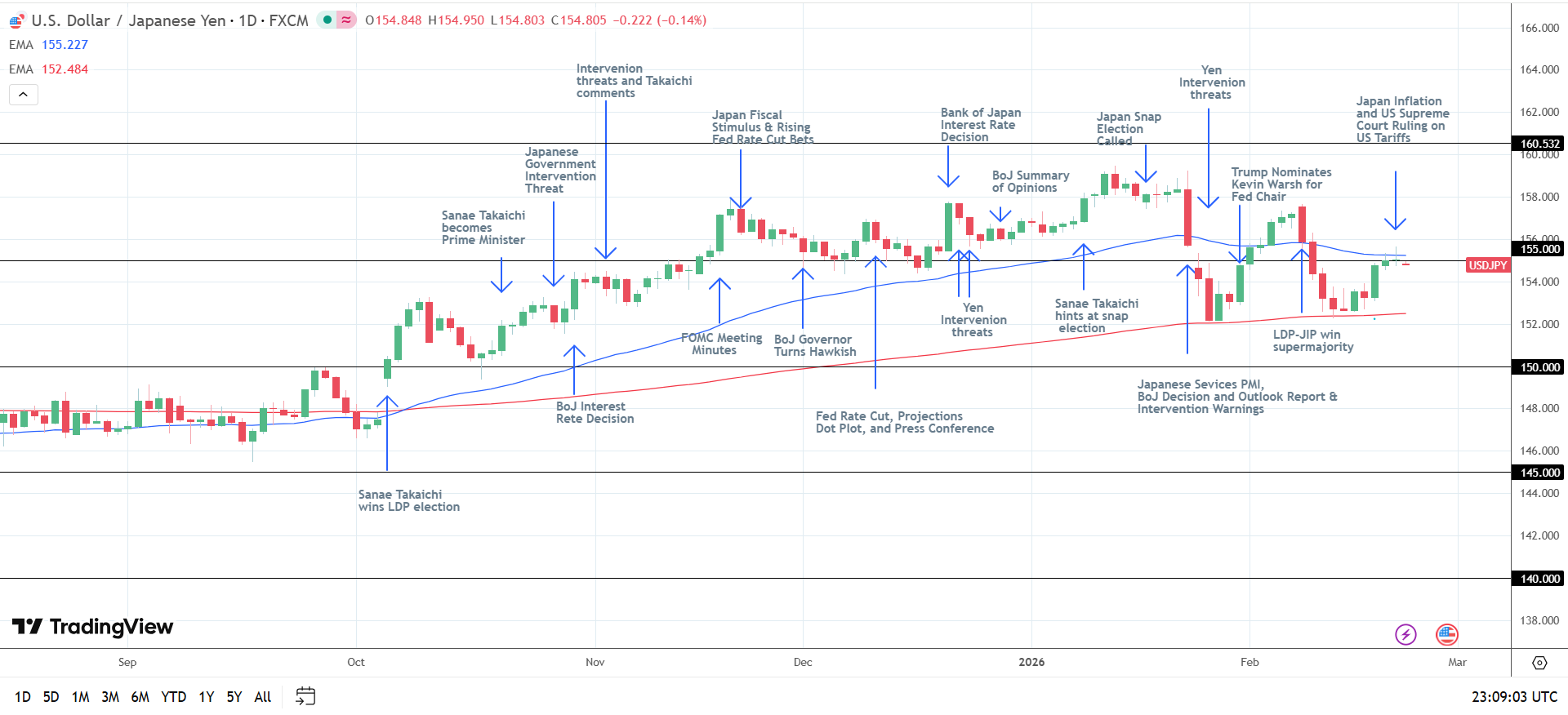
On the daily chart, USD/JPY remains below its 50-day Exponential Moving Average (EMA), but holds above the 200-day EMA. The EMA positions indicate a bearish near-term but bullish longer-term bias. Despite a bullish longer-term bias, favorable yen fundamentals align with the short-term technical. These fundamentals offset the longer-term technical, supporting a bearish medium-term outlook.
A drop below 153 would expose the 200-day EMA. A sustained fall through the 200-day EMA would indicate a bearish trend reversal, exposing the 150 support level. If breached, 145 would be the next key support level.
Importantly, a sustained fall through the EMAs would reaffirm the negative medium- to longer-term price outlook.
Positioning and Risk Outlook
In my view, the prospect of BoJ rate hikes and Fed rate cuts supports a negative price outlook. However, upside risks to the bearish outlook include:
- Dovish BoJ chatter and a lower neutral interest rate band (dovish: potentially 1%-1.25%). A lower neutral rate would suggest fewer rate hikes to achieve policy normalization.
- Strong US economic data dampens expectations of an H1 2026 Fed rate cut.
These scenarios would drive USD/JPY higher. However, yen intervention threats are likely to cap the upside near 160.
Read the full USD/JPY forecast, including chart setups and trade ideas.
Conclusion: The BoJ, Trump’s Tariff Policies, and the Fed in Focus
In summary, USD/JPY trends remain hinged on the BoJ’s policy outlook, incoming economic indicators, the Fed rate path, and government policies.
Given the BoJ’s road toward monetary policy normalization, a hawkish BoJ neutral rate band (1.5%-2.5%), signaling multiple BoJ rate hikes, would likely strengthen the yen over the medium term. Additionally, multiple Fed rate cuts would narrow US-Japan rate differentials in favor of the yen. Narrowing rate differentials would reinforce the bearish medium-term outlook for USD/JPY.
Looking beyond the medium term (1-3 months). A stronger yen and yen carry trade unwinds would likely push USD/JPY toward 140 over 6-12 months.
For more in-depth analysis, review today’s USD/JPY trading setups in our latest reports and consult the economic calendar.