
It’s a big day ahead for the yen and the US dollar, with key economic data set to swing monetary policy expectations. USD/JPY bounced back this week as Japanese GDP data supported a more dovish BoJ policy stance, clashing with hawkish Fed Minutes. Crucially, softer-than-expected Q4 GDP numbers overshadowed a surge in demand for Japanese goods.
On Friday, February 20, Japanese inflation data influenced sentiment toward the BoJ’s rate path, demand for the yen, and the USD/JPY pair. Headline inflation dipped below the BoJ’s 2% target, with ‘core-core’ inflation easing moderately.
Later on Friday, the US Personal Income and Outlays report, private sector PMI numbers, and Q4 GDP data will influence market bets on a June Fed rate cut.
Despite shifting sentiment toward BoJ and Fed policy stances, expectations of eventual BoJ rate hikes and Fed rate cuts support the bearish medium-term outlook for USD/JPY.
Below, I’ll discuss the macro backdrop, near-term price catalysts, and technical levels traders should closely watch.

Japanese Inflation Cools, Weighing on BoJ Rate Hike Bets
On February 20, Japanese inflation figures cooled bets on an April BoJ rate hike, weighing on the yen. The annual inflation rate slid from 2.1% in December to 1.5% in January. Meanwhile, the so-called ‘core-core’ inflation rate eased from 2.9% to 2.6%, holding above the BoJ’s 2% target.
While the BoJ focuses more on the ‘core-core’ inflation rate, policymakers are unlikely to brush aside the dip in headline inflation. Cooling inflation signals weaker demand, supporting a less hawkish rate path.
USD/JPY rose from 154.950 to 155.112 in response to the numbers, suggesting a less hawkish BoJ policy stance.
USD/JPY Price Forecast
Every new USD/JPY analysis as it publishes, today's technical signal and key levels, live price — on one page.
See all USD/JPY forecasts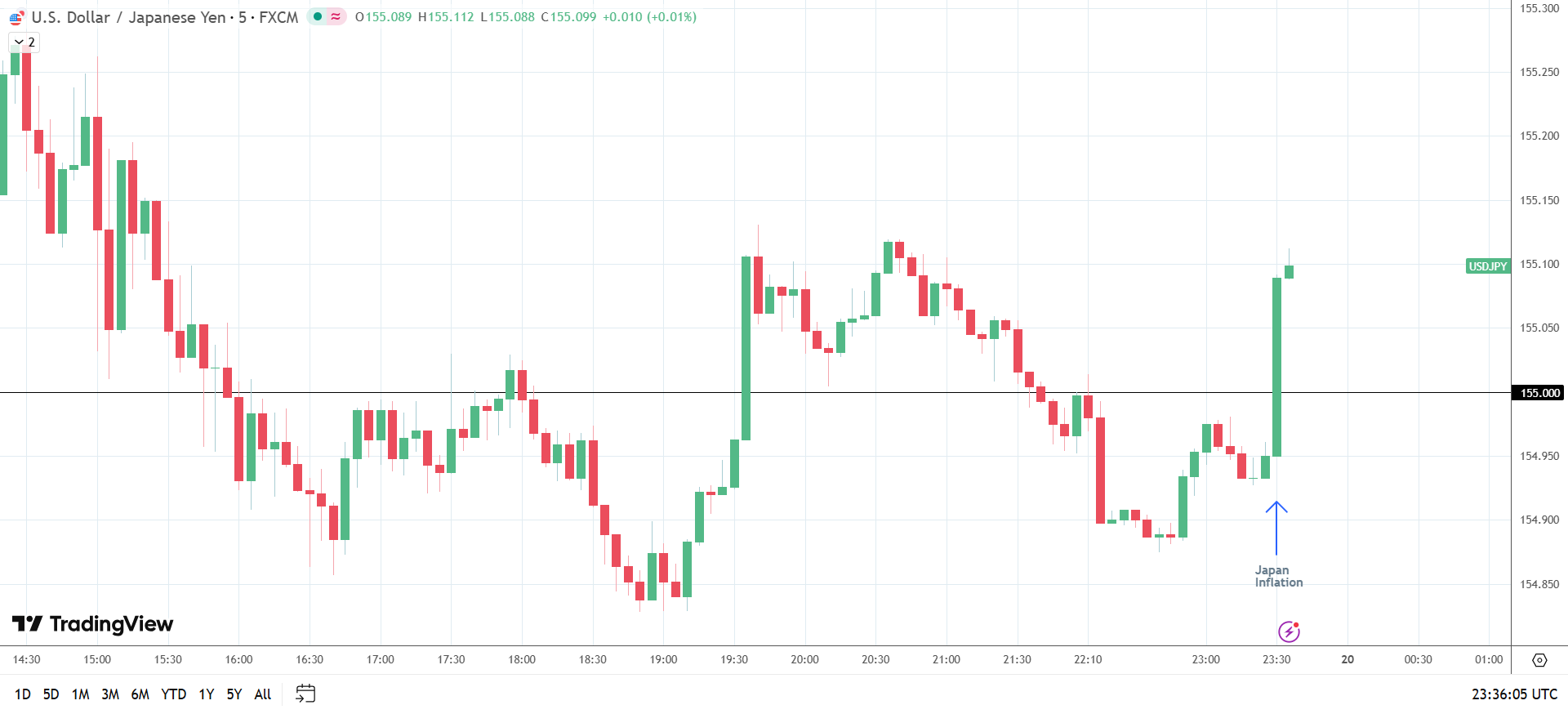
Japan Private Sector PMIs in Focus
Later in the morning session, Japanese private sector PMIs will provide insights into the Japanese economy midway through the first quarter. Economists forecast the Services PMI to fall from 53.7 in January to 53.3 in February. A lower-than-expected PMI reading would indicate a loss of economic momentum, given that the services sector accounts for roughly 70% of Japan’s GDP.
Beyond the headline PMI, traders should consider employment, input price, and output price trends. An upswing in job creation and rising input and output prices would support the BoJ’s hawkish quarterly CPI projection for 2026, overshadowing January’s softer inflation numbers.
While the Services PMI tends to have a greater influence on the yen, the BoJ’s focus on the effect of US tariffs on demand will spotlight the Manufacturing PMI. Economists expect the Manufacturing PMI to rise from 51.5 in January to 52.0 in February.
A pickup in the headline PMI, coupled with rising factory gate prices, would align with the BoJ’s view that US tariff risks have abated. These dynamics would remove one obstacle for an H1 2026 BoJ rate hike.
Rising services inflation and further evidence of easing US tariff risks are likely to revive bets on an H1 2026 BoJ rate hike, lifting demand for the yen.
US Economic Indicators to Spotlight the Fed
While Japanese data will influence the BoJ’s policy stance, key US economic indicators will affect expectations of a June Fed rate cut and US dollar demand.
Later on Friday, the US Personal Income and Outlays Report, Q4 GDP data, and the Services PMI will take center stage. However, following the softer-than-expected US CPI Report, the Personal Income and Outlays report is likely to draw more attention.
Economists forecast the Core PCE Price Index to rise 2.9% year-on-year in December, after increasing 2.8% in November. A pickup in the Fed’s key inflation indicator would cool Fed rate cut bets, boosting demand for the US dollar. However, traders should also consider personal income and spending trends, which provide clues on inflation’s trajectory.
Weaker personal income and spending would suggest easing demand-driven inflation, supporting a more dovish Fed rate path.
Last week’s weaker-than-expected US CPI report raised expectations of a June Fed rate cut. However, the hawkish Fed Minutes cooled rate cut bets, underscoring increased uncertainty about the Fed’s policy outlook. These uncertainties are likely to increase USD/JPY sensitivity to the upcoming economic data.
According to the CME FedWatch Tool, the probability of a June cut fell from 62.3% on February 12 to 58.5% on February 17, strengthening the US dollar.
Rising expectations of a Fed rate cut and a BoJ rate hike would reinforce the negative medium-term outlook.
Technical Outlook: Key Levels to Watch
For USD/JPY price trends, traders should closely monitor technical indicators, key economic indicators, government policies, and central bank chatter.
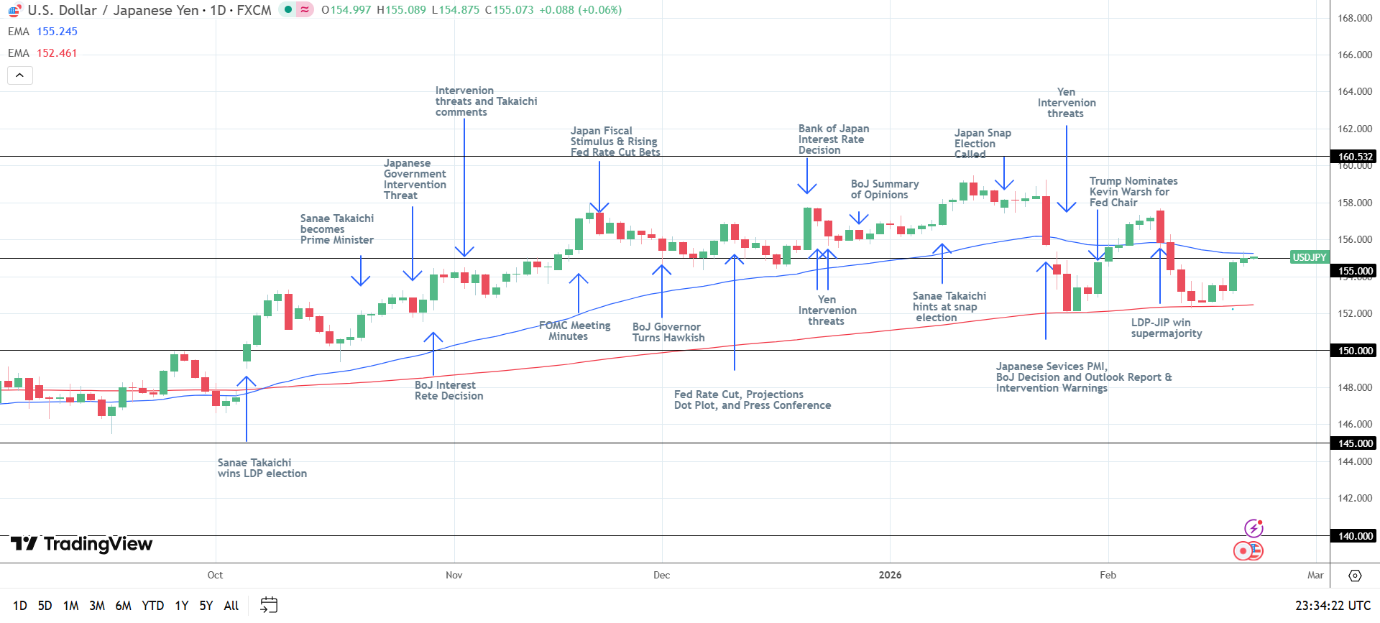
On the daily chart, USD/JPY trades below its 50-day Exponential Moving Average (EMA), but remains above the 200-day EMA. The EMA positions signal a bearish near-term but bullish longer-term bias. Despite a bullish longer-term bias, improving yen fundamentals align with the short-term technical and support a bearish medium-term outlook.
A sustained break below the 200-day EMA would signal a bearish trend reversal, bringing the 150 support level into play. If breached, 145 would be the next key support level.
Importantly, a sustained fall through the EMAs would reinforce the negative medium- to longer-term price outlook.
Positioning and Risk Outlook
In my view, expectations of BoJ rate hikes and bets on Fed rate cuts support a negative price outlook. However, upside risks to the bearish outlook include:
- Dovish BoJ rhetoric and a lower neutral interest rate band (dovish: potentially 1%-1.25%). This would indicate fewer rate hikes to achieve policy normalization.
- Stronger US economic indicators cool bets on an H1 2026 Fed rate cut.
These events would send USD/JPY higher. However, yen intervention threats are likely to cap further upside near 160.
Read the full USD/JPY forecast, including chart setups and trade ideas.
Conclusion: The BoJ, Takaichi’s Fiscal Policies, and the Fed in Focus
In summary, USD/JPY trends hinge on the BoJ’s policy outlook, incoming economic indicators, and the Fed’s rate path.
Considering the path toward monetary policy normalization, a hawkish BoJ neutral rate band (1.5%-2.5%), indicating multiple BoJ rate hikes, would likely strengthen the yen over the medium term. Additionally, multiple Fed rate cuts would narrow US-Japan rate differentials in favor of the yen. Narrowing rate differentials would reaffirm the bearish medium-term outlook for USD/JPY.
Looking beyond the medium term (1-3 months). A stronger yen and yen carry trade unwinds would likely send USD/JPY toward 140 over 6-12 months.
For more in-depth analysis, review today’s USD/JPY trading setups in our latest reports and consult the economic calendar.