


The Canadian dollar will face two opposing pressures ahead of the end of February. Recently, the labor department in Canada released a mixed labor survey for January that at face value seemed quite positive having an unemployment rate of 6.5% which was a 16 month low.
However, after further examination, it becomes more complicated as there were a total of 25,000 jobs lost in January while there were also 28,000 manufacturing jobs lost. There were also 23,000 jobs lost in Ontario which is Canada’s primary manufacturing province due to the effect US tariffs have had on their manufacturing base and exports
Furthermore, the drop from 6.8% to 6.5% in the unemployment rate was primarily due to a drop in participation in the labor force from 65.4% down to 65%. Again, this is not the environment that would encourage the Bank of Canada to change their current monetary policy.
Jaime Martinez Medina, Global Market Strategist at PU Prime commented:

The Canadian dollar enters the final stretch of February facing opposing forces that are likely to keep USD/CAD in a two-way trading environment rather than a clear directional trend.
Canada’s latest labor report initially appeared encouraging, with unemployment falling to 6.5%, a 16-month low. However, the details were less constructive. The economy lost 25,000 jobs in January, including 28,000 manufacturing positions, with significant weakness concentrated in Ontario. The drop in unemployment was largely driven by lower labor force participation, rather than genuine job creation. This backdrop does little to justify a shift in the Bank of Canada’s current stance and reinforces expectations that the easing cycle has likely reached its end for now.
The dominant driver remains the interest rate differential. The Federal Reserve maintains a policy rate 125 basis points above Canada’s, providing sustained support for the U.S. dollar. As long as U.S. yields remain elevated relative to Canadian yields, capital flows are likely to favor USD-denominated assets. Markets do not expect meaningful Fed easing before mid-year, limiting near-term upside for the Canadian dollar.
At the same time, tariff uncertainty continues to weigh on Canada’s outlook. Trade tensions and the potential for additional U.S. measures have increased growth risks, with estimates suggesting a measurable drag on Canadian GDP through 2026. These policy risks create an additional premium embedded in USD/CAD.
Oil prices, while stable, are acting more as a floor than a catalyst. With crude trading in a narrow range and long-term forecasts subdued, energy alone is unlikely to drive CAD appreciation.
Institutional forecasts generally point to gradual CAD strengthening through 2026, but not an abrupt reversal. In the near term, the two-year yield spread remains the key signal. Unless U.S. data softens materially or Canadian yields rise, USD/CAD is likely to remain supported within its current range.
The Rate Differential Rules Everything
As it stands, the U.S. Federal Reserve maintains an interest rate of between 3.5% and 3.75%, whereas Canada’s Bank of Canada has an interest rate of 2.25%, meaning that there is a 125-basis-point difference between the two. This differential is why the CAD has not seen more strength relative to the U.S. thus far.
In addition, the BoC has lowered interest rates nine times from a peak of 5% to their current level; it is believed by many economists that the cutting cycle is over. At its January meeting, the Fed continued to hold its interest rate steady, and market expectations do not anticipate any U.S. interest rate cuts until at least June. The continued strength of the U.S. dollar due to a higher interest rate environment also creates challenges for the Canadian dollar remaining at lower trading levels as long as the rate differential remains in favor of the U.S.
Institutional desks at RBC, Scotiabank, TD Bank, and Goldman Sachs are all projecting gradual gains for the Canadian dollar through the end of 2026, indicating that these institutions are projecting year-end prices to be in the range of CAD$1.30 to CAD$1.33. These banks are not projecting a sudden change in trend, but a gradual return to longer-term averages is anticipated to develop.
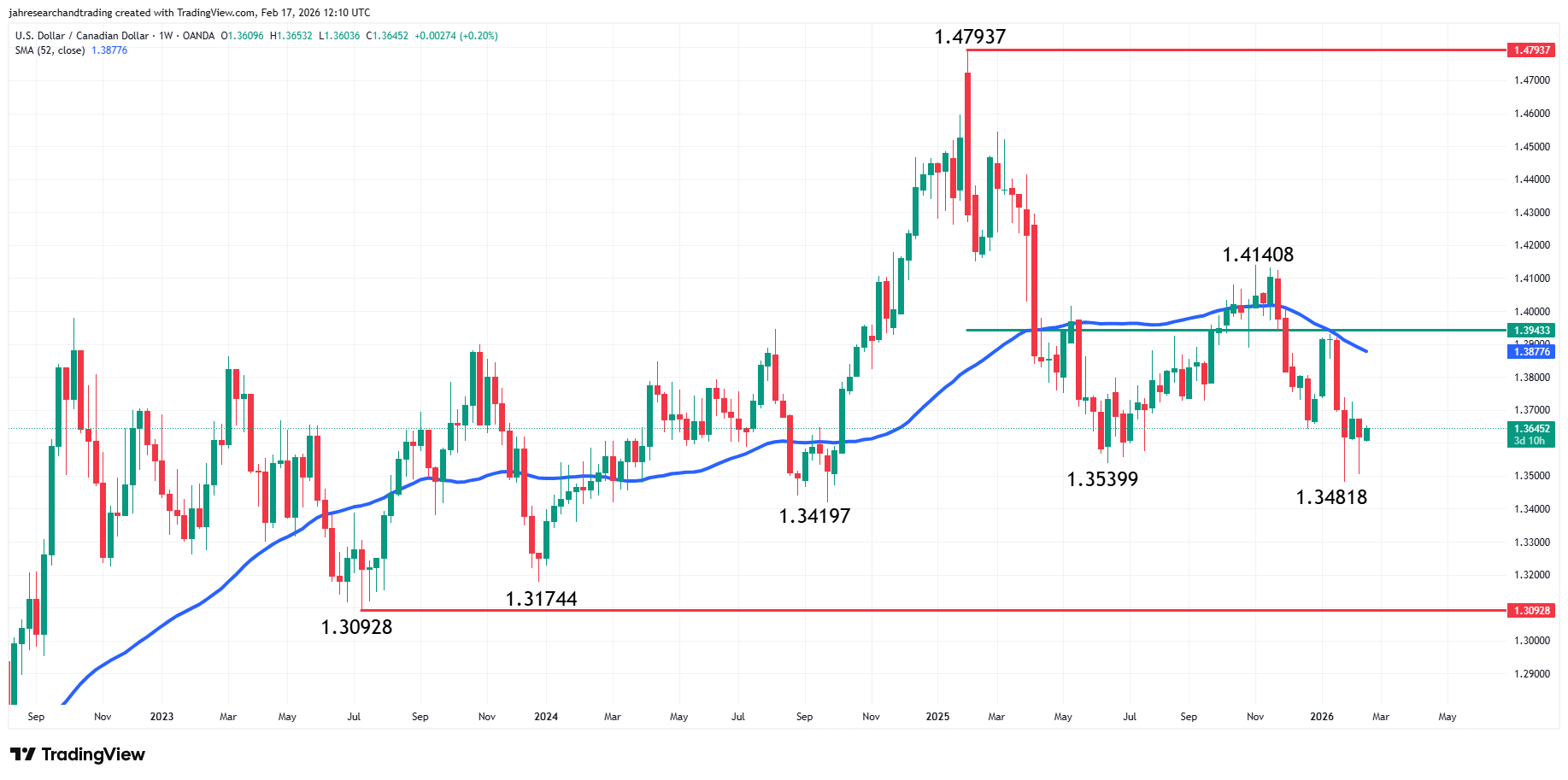
US Dollar/Canadian Dollar weekly candlestick chart. Source: TradingView.
USD/CAD Price Forecast
Every new USD/CAD analysis as it publishes, today's technical signal and key levels, live price — on one page.
See all USD/CAD forecastsUS Data Continues to Dominate
US data continues to be the driving force behind USD/CAD, as evidenced by the trend seen in the January payroll report. Non-farm payrolls rose 130,000 in January versus 55,000 expected, and the unemployment rate fell to 4.3% (down from 4.4% in December). Additionally, year-over-year wage growth was reported at 3.7%. This set of numbers gave the Fed no reason to move up their timeline for an action, which is why USD responded positively to the news.
A Different Side of the USD Story
The January CPI report, however, showed a different side of the USD story. Headline inflation was at 2.4%, down from 2.7% last month and below the 2.5% consensus forecast. Core CPI was at 2.5%, marking the first time the Core CPI has dropped below this level since April 2021. While this data could eventually lead to weak demand and weaken USD, one data point is not sufficient to change market expectations. The Fed has been clear that they require continued progress before taking action. As such, the markets added slightly to June cut expectations, but sentiment remains subdued.
Uncertainty in Tariff Policy
Uncertainty Surrounding Tariffs
There is still uncertainty surrounding tariffs, as well as continual confusion over this policy decision by the recently passed US Congress. On a partisan basis, the US House of Representatives voted 219 to 211 last week to attempt to repeal President Trump’s imposition of his 25% tariffs on Canadian imports, which is a rare act of bipartisan criticism of the President’s trade policies. Six Republicans voted with the Democrats to overturn the tariffs; however, the resolution must now go before the US Senate, where similar legislation has already been passed. Despite this fact, the likely outcome is that the President will veto this latest congressional attempt to remove the tariffs and therefore no change will result on tariffs until at least 2027 at the earliest.
Economic Impact of These Tariffs
Analysts are putting together their forecasts for the economic impact of these tariffs over our planning horizon to 2027, and most are estimating that these tariffs will reduce Canadian GDP by 1.2% between now and 2026. We are also starting to see the impact of the tariffs on manufacturing data, which will be continuing over the next several months as the international community re-evaluates their economic relationship with Canada.
Furthermore, President Trump has stated that he will impose an additional 100% tariff on all Canadian imports if Canada proceeds with a trade agreement with China. This increases the uncertainty of doing business with and/or trading with Canada. Finally, most Canadian banks are indicating that the Comprehensive Trade Agreement is a wildcard in determining the value of the Canadian dollar against the US dollar, because trade news releases can move the value of the USD/CAD without taking into account the underlying fundamentals.
Oil Provides a Floor, Not a Catalyst
As of February, WTI Crude has settled between $62 and $64. The steady prices have negated against any major sell offs in the CAD; however, momentum should be generated by other sources rather than energy alone. The descriptive term for oil according to an institution in the market, currently, would be “a floor” not necessarily “a catalyst”. If, in the next couple of months or years an example where oil has broken above any resistance is witnessed, the market will determine if CAD relative value increases. Nevertheless, at this time, according to EIA, 2026 estimates for average Brent are $58 per barrel therefore suggesting no immediate increase in value of the Canadian Dollar based on commodity related increases.
The Signal to Watch
The Bond Yield Spread Provides an Indication
The most important sign for where the USD/CAD will go, is the difference between the two-year yields on bonds in the US and Canada. The bond yield spread provides an indication of what each central bank’s monetary policies are expected to be. In the past, these have proven to be very good forecasters of future currency movement. Right now, US yields are much higher than Canada’s therefore funds are being drawn toward US assets. A significant reduction in the yield spread will occur when either softer US economic data pushes expectations for a Fed rate cut forward OR when an increase in expected future interest rates from the Bank of Canada increases Canadian yields. This would be a catalyst for a continued downward move in USD/CAD.
Near-Term Outlook
Based on an analysis of the current institutional landscape, I would characterize the probability distribution of an eventual gradual decline in the USD/CAD exchange rate from between 1.32 to 1.35 through 2026 at 50% – 60%, with the balance of the overall institutional probability (~25% – 30%) for a range bound series of oscillations over that same time span.
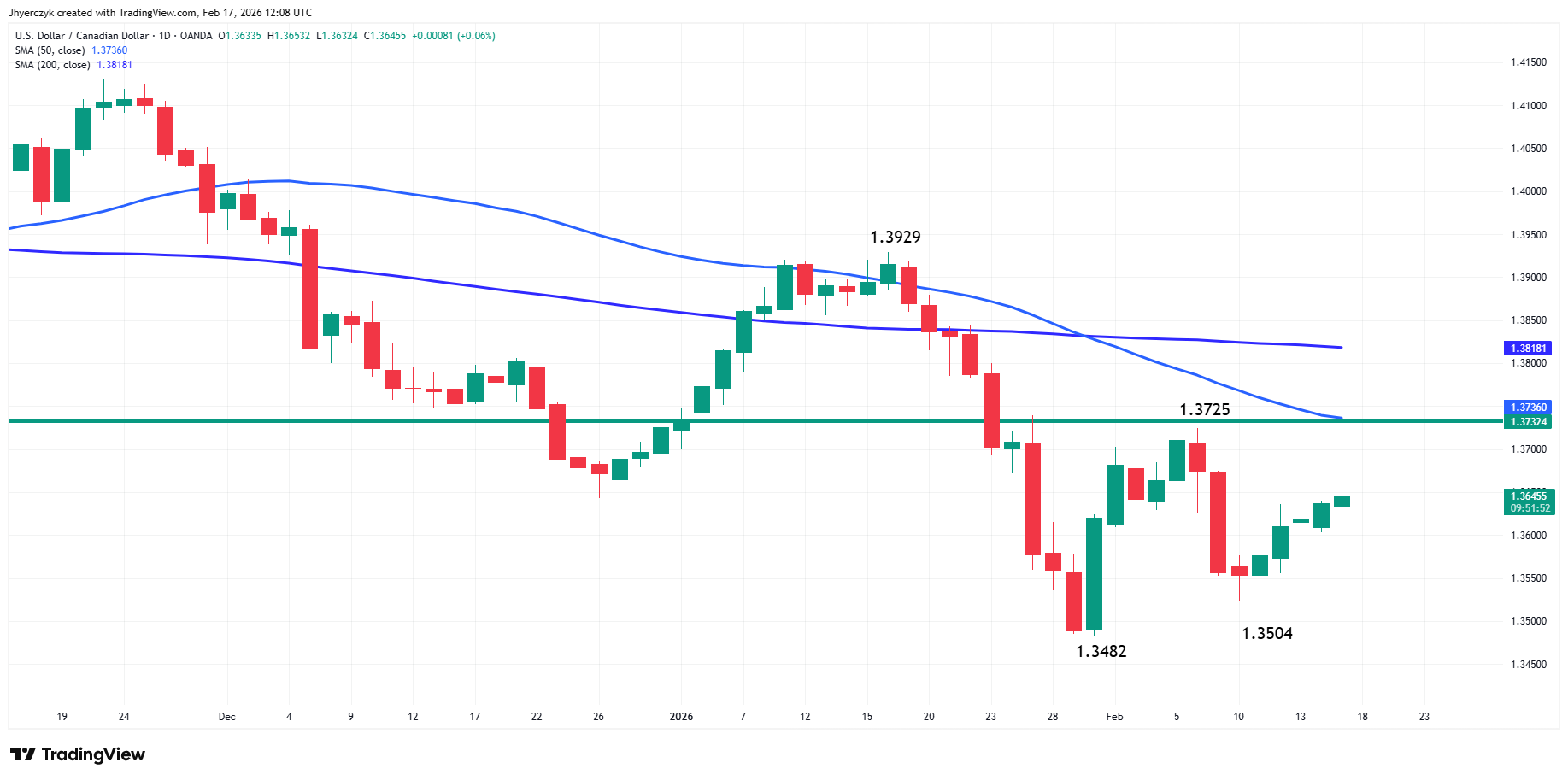
US Dollar/Canadian Dollar daily candlestick chart. Source: TradingView.
It would take (10%-15% probability) a significant pickup in inflationary pressures in the United States to drive the forecast of the potential for bull extension in the USD to be driven above 1.42 or possibly higher. To extend inflationary pressures sufficiently would require significantly escalated trade tensions both internally in the United States and across global trade groups.
Currently, however, the forecast is fairly straight forward in that USD/CAD has shown consistency in positively correlated increases to the USD against the CAD on rising upside surprises in the United States with declines commensurate to increased Fed easing expectations into the future.
The bond markets as they reflect the realities of inflationary pressures will ultimately drive the trajectory of the USD/CAD exchange rate; until that time, it is logical to respect the current range of the USD/CAD exchange rate and follow the headline market – both of which would provide valuable trading signals.


