
XRP extends its losing streak to three sessions as US economic data cools Fed rate cut bets further.
US economic indicators pointed to a resilient labor market, aligning with last week’s US jobs report, tempering expectations of a June Fed rate cut. Waning bets on a June Fed rate cut have weighed on demand for crypto-spot ETFs and XRP.
Nevertheless, expectations that the US Senate will eventually pass the Market Structure Bill, increased XRP utility, and resilient demand for US-XRP-spot ETFs continue to support a bullish medium-term (4-8 weeks) outlook for XRP, with a price target of $2.5.
Below, I will explore the key drivers behind recent price trends, the medium-term outlook, and the technical levels traders should watch.

US Jobless Claims Temper Fed Rate Cut Bets
On February 19, US labor market data dented hopes for a June Fed rate cut, weighing on risk assets. Initial jobless claims fell from 229k (week ending February 7) to 206k (week ending February 14), signaling tighter labor market conditions.
Typically, a tighter labor market boosts wage growth and consumer spending. An upswing in consumer spending would fuel demand-driven inflation, supporting a more hawkish Fed rate path. The jobless claims figures aligned with January’s jobs report. Unemployment fell from 4.4% in December to 4.3% in January, while average hourly earnings rose 3.7% year-on-year, mirroring December’s trend.
According to the CME FedWatch Tool, the probability of a June Fed rate cut has fallen from 62.3% on February 12 to 58.5% on February 20. Strong US labor market data and hawkish Fed Minutes overshadowed a softer CPI report. Later on Friday, February 20, US economic data will influence buying interest in XRP. Q4 GDP data, the Services PMI, and the Personal Income and Outlays report will be key for XRP and the broader crypto market.
XRP reacted to the Minutes and the jobless claims data, falling from $1.4452 to a February 20 session low of $1.3820.
Bitcoin Price Forecast
Every new Bitcoin analysis as it publishes, today's technical signal and key levels, live price — on one page.
See all Bitcoin forecasts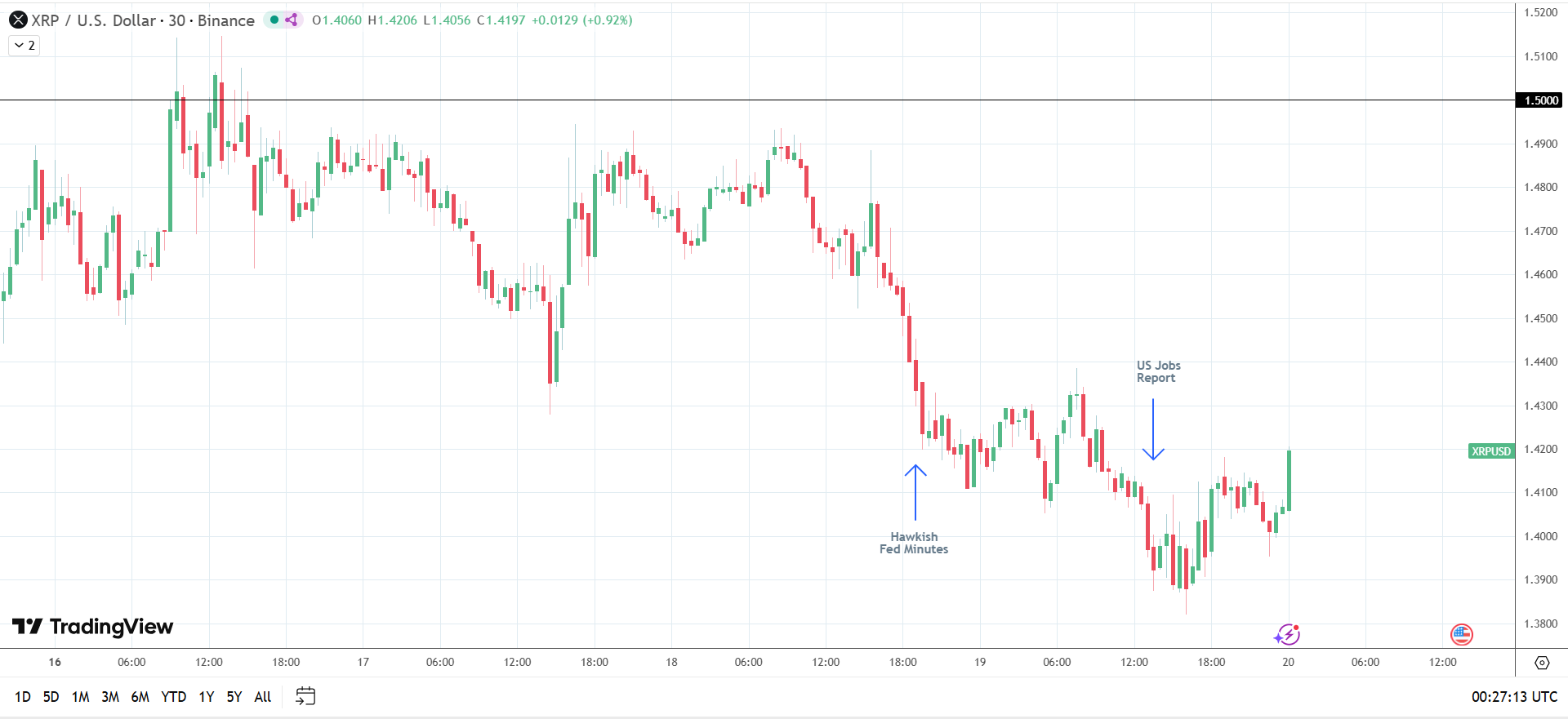
XRP-Spot ETF Outflows Add to the Negative Sentiment
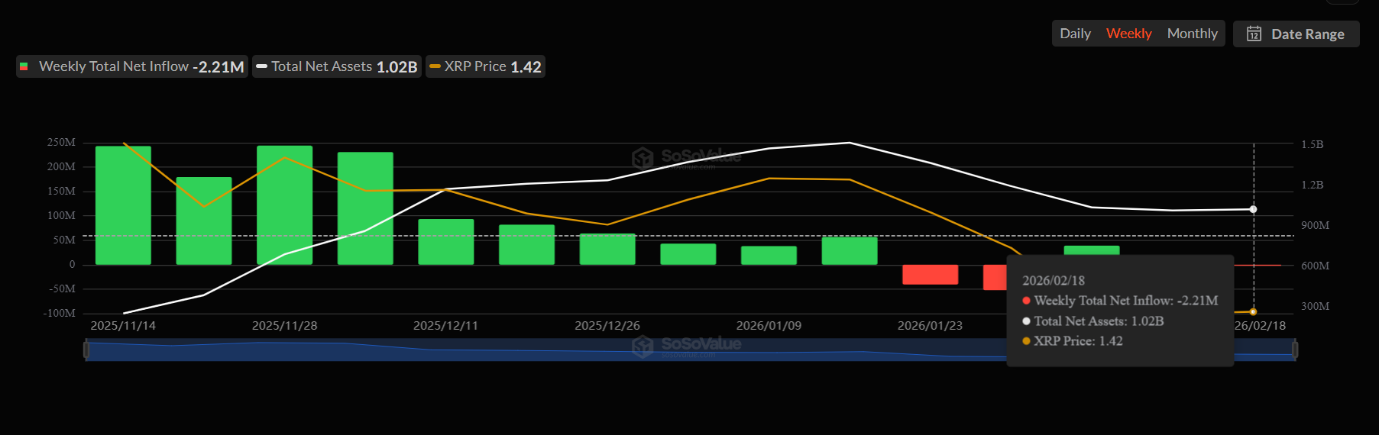
Cooling bets on a June Fed rate cut also weighed on institutional demand for crypto-spot ETFs, another headwind for XRP. This week, the US BTC-spot ETF market saw $238.2 million in net outflows, leaving year-to-date outflows at $2.52 billion. Meanwhile, the US XRP-spot ETF market reported $2.21 million in net outflows this week, adding to the negative sentiment. However, year-to-date, the XRP-spot ETF market saw net inflows of $60.08 million. Flow data for Thursday, February 19, will be available later today.
Spot ETF flow trends are crucial for supply-demand balances. BTC-spot ETF outflows contributed to Bitcoin and XRP’s year-to-date losses. BTC has tumbled 23.19% YTD, while XRP has fallen 22.95%.
XRP Price Forecast: Short-, Medium-, and Long-Term Targets
XRP has plunged 13.7% in February, supporting a cautiously bearish short-term outlook (1-4 weeks), with a target price of $1.0.
Nevertheless, resilient since-launch demand for XRP-spot ETFs, expectations that the US Senate will pass the Market Structure Bill, and increased XRP utility affirm the bullish medium- to long-term price projections:
- Medium-term (4-8 weeks): $2.5.
- Longer-term (8-12 weeks): $3.0.
Key Downside Risks to the Bullish Medium-Term Outlook
Several factors could derail the constructive medium-term bias. These include:
- A US-Iran conflict.
- Strong US economic data dampens bets on an H1 2026 Fed rate cut.
- Delays and/or partisan opposition to the Market Structure Bill.
- Extended periods of XRP-spot ETF net outflows.
Traders should also consider Bank of Japan chatter, given the impact of the mid-2024 yen carry trade unwind on XRP.
A hawkish Bank of Japan, with a higher neutral interest rate (potentially 1.5%-2.5%), would indicate multiple BoJ rate hikes. Multiple hikes would narrow US-Japan rate differentials in favor of the yen. Narrowing rate differentials could trigger a yen carry trade unwind, drying up market liquidity. For context, the BoJ previously announced a wider neutral rate band of 1%-2.5% but stated it would announce a narrower range at a later date.
These factors would weigh on XRP, push the token toward $1.0, and reinforce the cautiously bearish short-term outlook.
Technical Analysis: Levels to Watch
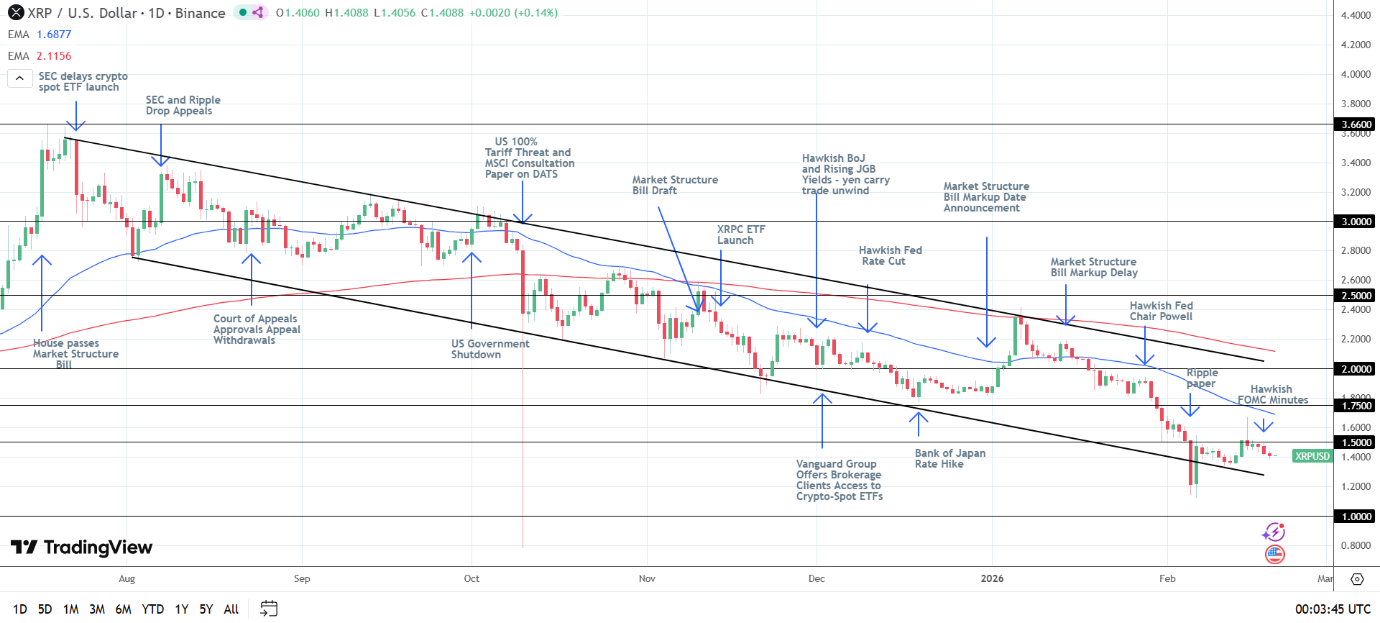
XRP fell 1.08% on February 19, following the previous day’s 3.47% loss, closing at $1.4068. The token bucked the broader market trend, where the crypto market cap climbed 0.42%.
Thursday’s pullback left XRP trading well below its 50-day and 200-day EMAs. The EMA positions signaled a bearish bias. Notably, the 50-day EMA steepened, pulling further back from the 200-day EMA, indicating further near-term selling pressure. Nevertheless, several positive fundamentals continue to counter bearish technicals, supporting the bullish medium-term outlook. Despite these positive fundamentals, short-term technicals remain bearish.
Key technical levels to watch include:
- Support levels: $1.0, and then $0.7773.
- 50-day EMA resistance: $1.6877.
- 200-day EMA resistance: $2.1156.
- Resistance levels: $1.5, $2.0, $2.5, and $3.0.
On the daily chart, a break above $1.50 would pave the way toward the 50-day EMA. A sustained move through the 50-day EMA would signal a near-term bullish trend reversal. A bullish trend reversal would bring the 200-day EMA into play.
A sustained break above the EMAs would affirm a bullish trend reversal and reinforce the medium- to longer-term price targets.
Fundamental Events Driving Near-Term Price Action
Near-term price drivers include:
- XRP-spot ETF flows.
- US economic data and the Fed’s policy stance. US GDP, Services PMI, and inflation numbers are likely to be key price catalysts.
- Crypto-related legislative developments.
- The Bank of Japan’s neutral rate and rate path.
- Increased geopolitical tensions in the Middle East.
Bearish Structure Intact: $1.0 Remains Crucial Support
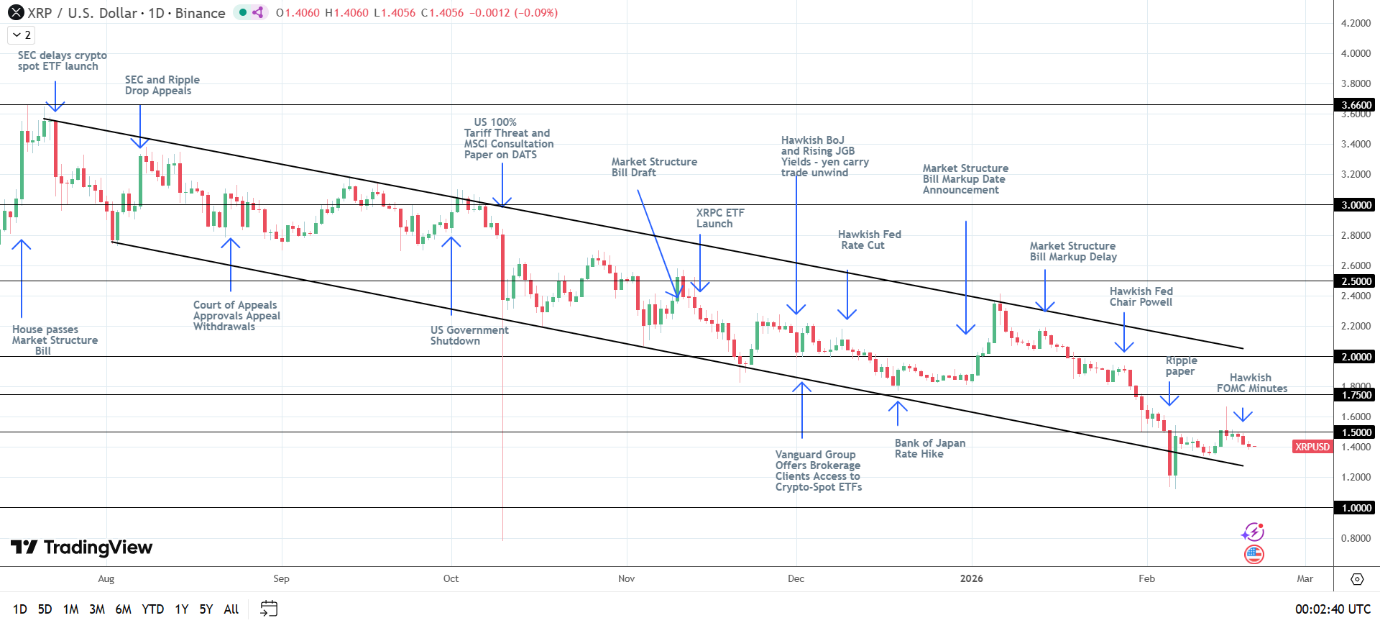
XRP’s Thursday loss affirmed the existing bearish trend. A drop below the lower trendline would expose the February 6 low of $1.1227. If breached, $1.0 would be the next key support level. A sustained fall through $1.0 would reaffirm the cautiously bearish short-term outlook and further validate the bearish structure.
However, a break above $1.5 would enable the bulls to target $2.0 and the upper trendline. A sustained move through the upper trendline would invalidate the bearish structure and signal a bullish trend reversal, reaffirming the constructive medium-term bias.
- Short-term (1-4 weeks): $1.0.
- Medium-term (4-8 weeks): $2.5.
- Longer-term (8-12 weeks): target of $3.0.
XRP Outlook: Geopolitics, Crypto Legislation, ETF Flows, and the Fed in Focus
Looking ahead, several key price catalysts expose XRP to increased volatility. Rising tensions in the Middle East and a US-Iran conflict would likely overshadow crypto-related legislative developments.
Nevertheless, an end to the TradFi-DeFi stalemate on stablecoin yields would boost hopes that the Senate will pass the Market Structure Bill, lifting XRP demand.
However, central bank chatter, US economic indicators, and XRP-spot ETF flows will also influence XRP’s price projection.
A more dovish Fed and a lower BoJ neutral rate (potentially 1%-1.25%) would lift sentiment. Strong demand for US XRP-spot ETFs and crypto-friendly legislative developments would reaffirm the bullish medium- to longer-term outlook.
In summary, these events would support a medium-term (4–8 weeks) move to $2.5. The US Senate passing the Market Structure Bill would reaffirm the longer-term (8-12 weeks) price target of $3.0.
Beyond 12 weeks, these factors may send XRP to its all-time high of $3.66 (Binance). A breakout above $3.66 would reinforce a 6- to 12-month price target of $5.