
US stock futures steadied on Tuesday, December 30, 2025, as market focus shifted from the Bank of Japan to the US Federal Reserve.
Changing market sentiment toward the BoJ’s monetary policy outlook clashed with hopes for a March Fed rate cut, signaling a narrowing US-Japan rate differential. The BoJ’s Summary of Opinions sent hawkish signals, pushing 10-year Japanese Government Bond (JGB) yields higher. 10-year JGB yields neared last week’s 2.1% in morning trading on Tuesday, tempering demand for risk assets.
Despite rising bets on multiple BoJ rate hikes, lower US borrowing rates would boost corporate earnings, supporting a bullish medium-term price outlook.
Below, I’ll outline the key market drivers, the medium-term outlook, and the key technical levels traders should watch.

Japanese Government Bond Yields Edge Toward 2.1%
10-year JGB yields climbed to 2.07% in morning trading, edging closer to last week’s 2.1%. The BoJ’s Summary of Opinions from the December Monetary Policy Meeting resonated, weighing on sentiment. Notably, the Nikkei 225 fell 0.28%, extending its losses from the previous day, despite USD/JPY reclaiming 156.
Yen carry trades have remained profitable under current US-Japan rate differentials. However, a higher-than-expected BoJ neutral interest rate and a dovish Fed rate path would likely reverse yen carry trades, drying up short-term liquidity and triggering a sharp sell-off of risk assets.
The BoJ continues to signal a broad neutral interest rate range of between 1% and 2.5%. BoJ Governor Kazuo Ueda recently told parliament that he would announce a neutral interest rate once the range narrowed, leaving uncertainty about the number of rate hikes needed to achieve monetary policy normalization.
Dow Jones Price Forecast
Every new Dow Jones analysis as it publishes, today's technical signal and key levels, live price — on one page.
See all Dow Jones forecastsFed Rate Path Key for Medium-Term Bullish Outlook
The risk of yen carry trade unwind is likely to continue influencing risk appetite. However, the US economic outlook and the Fed’s rate path remain key for US equity futures. Lower US borrowing costs would improve corporate profits and equity valuations. Furthermore, lower rates loosen credit conditions, another key bullish ingredient for US stock futures.
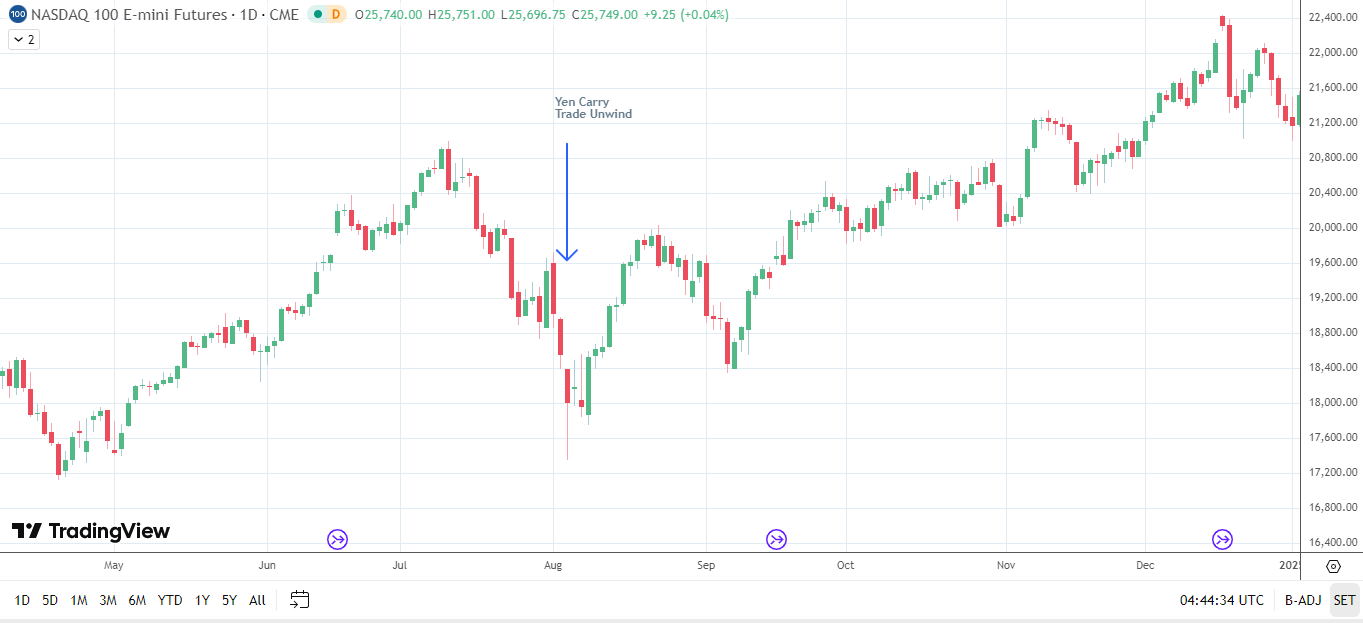
For context, the Nasdaq 100 E-mini slid 11.7% from July 31 to August 5 in response to the BoJ’s rate hike and cut to JGB purchases on July 31, 2024. However, the recovery was swift, boosted by expectations of multiple Fed rate cuts in H2 2024. Fast forward to December 2025, and markets are expecting the next Fed Chair to support lower interest rates, a boon for US risk assets.
US Data in Focus as the FOMC Meeting Minutes Loom
US futures edged lower during the Asian morning session on Tuesday, December 30. The Dow Jones E-mini and the Nasdaq 100 E-mini dropped 1 point and 5 points, respectively, while the S&P 500 E-mini slipped by half a point.
Later on Tuesday, the Chicago PMI and FOMC members’ speeches will influence risk sentiment. Economists expect the Chicago PMI to rise from 36.3 in November to 39.5 in December. A higher print would ease concerns about a sharp economic slowdown, lifting sentiment.
However, Fed speakers will likely have a greater influence on US equity futures. Growing support for a March Fed rate cut would likely drive demand for risk assets, supporting a bullish short- to medium-term price outlook.
According to the CME FedWatch Tool, the chances of a March Fed rate cut fell from 53.3% on December 26 to 52.3% on December 30. A March cut and a new Fed Chair in H2 2026, favoring lower rates, would reinforce the constructive short- to medium-term bias.
Key Technical Levels for Dow Jones, Nasdaq 100, and S&P 500
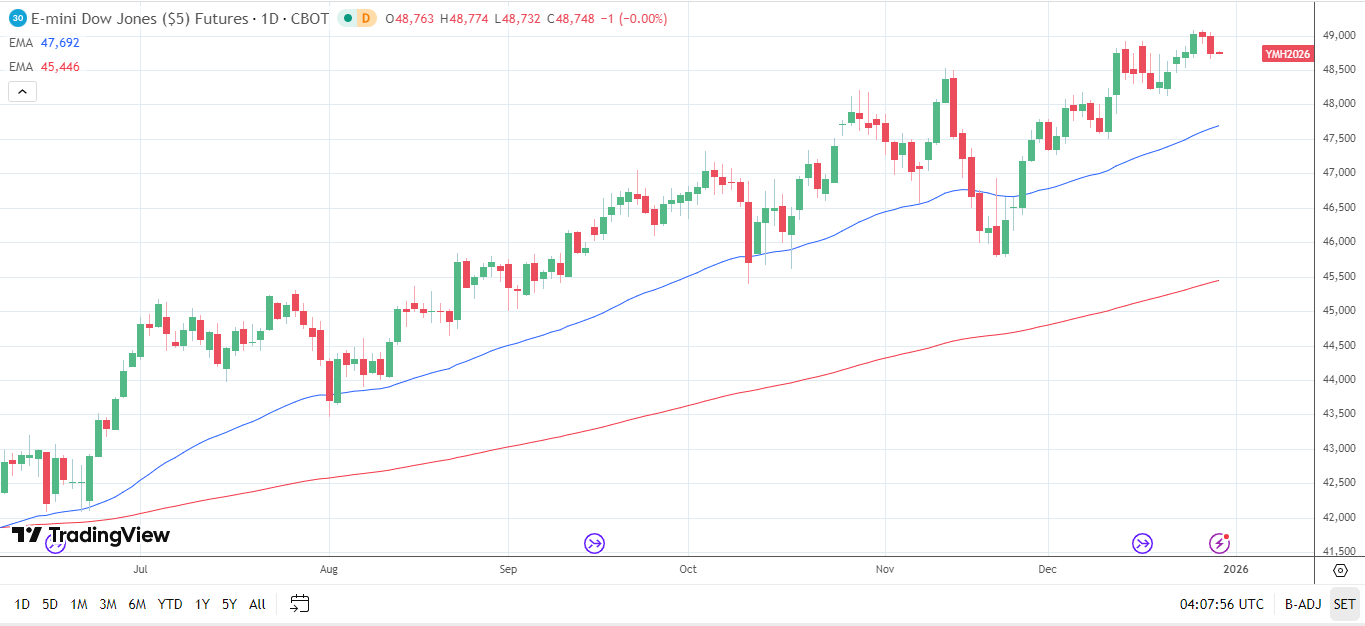
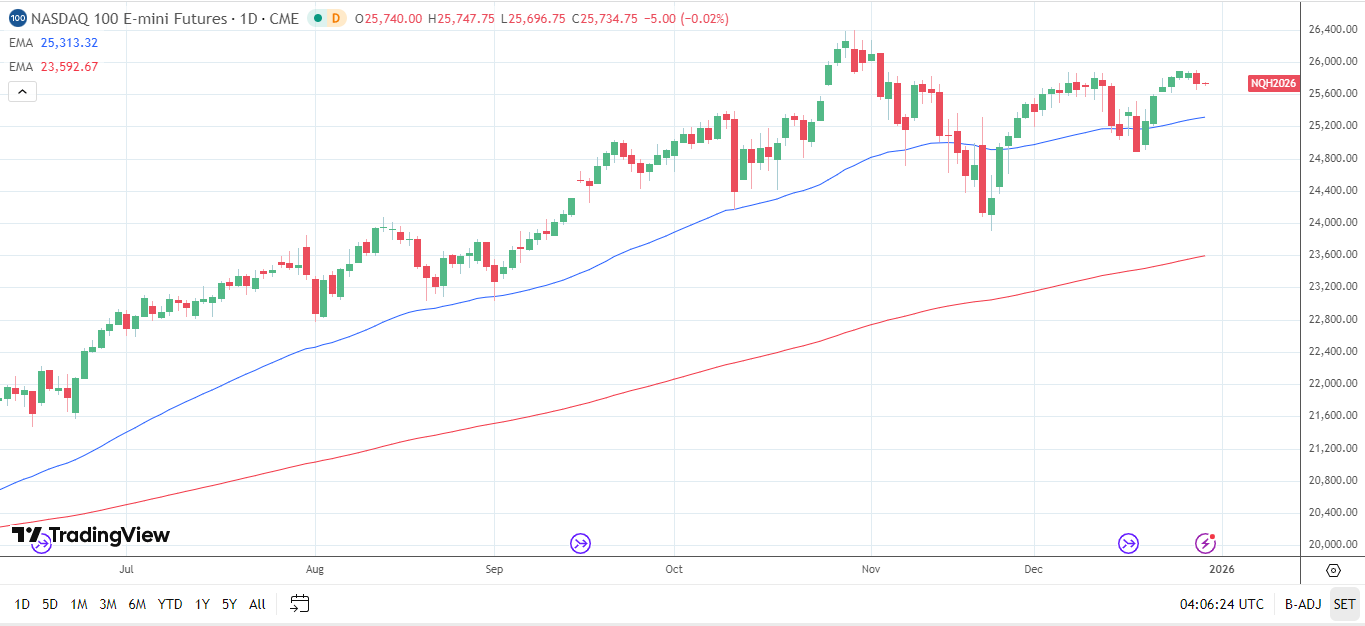
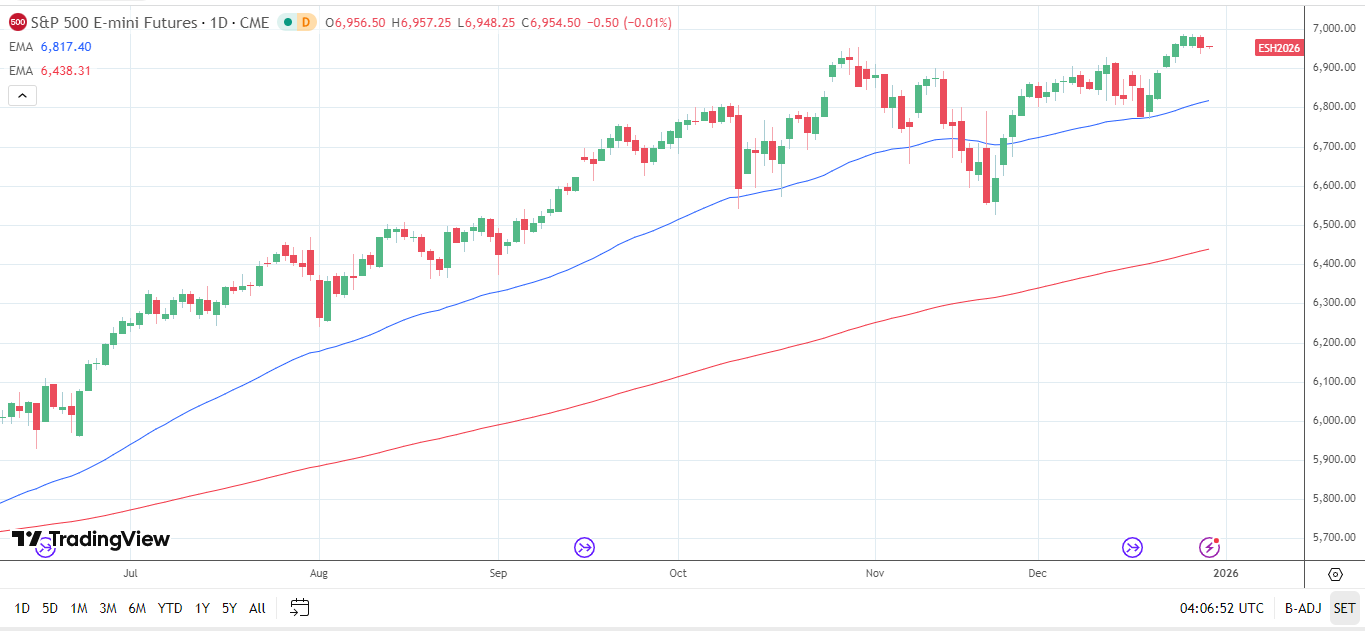
Despite Tuesday’s sell-off, the Dow Jones E-mini, the Nasdaq 100 E-mini, and the S&P 500 E-mini traded above their 50-day and 200-day EMAs. The EMAs signaled a bullish short- to medium-term bias, affirming the positive outlook.
Near-term trends will hinge on US data, the FOMC Meeting Minutes, and BoJ rhetoric. Key levels to monitor include:
Dow Jones
- Resistance: The December 26 record high of 49,086, and then 49,500.
- Support: 48,500 and then the 50-day EMA (47,692).
Nasdaq 100
- Resistance: 26,000 and then the October 30 record high of 26,399.
- Support: the 50-day EMA (25,313) and then 24,500.
S&P 500
- Resistance: the December 26 record high of 6,988, and then 7,000.
- Support: the 50-day EMA (6,817) and then 6,500.
Bullish Medium-Term Outlook: Central Bank Guidance Key
In my opinion, the short-term price outlook is cautiously bullish, considering the BoJ and Fed signals, alongside technicals. Furthermore, expectations of an incoming Fed Chair supporting low interest rates reinforce the positive medium-term outlook.
However, several scenarios would likely derail the constructive medium-term bias, including:
- The Bank of Japan declares a neutral interest rate of between 1.5 and 2.5% and hints at multiple rate hikes.
- Strong US data and hawkish Fed chatter dampen expectations of a Fed rate cut.
Conclusion: Outlook Bullish
In summary, a strong US economy, steady bets on further Fed rate cuts, the US-China AI race, and a cautious BoJ policy stance support a bullish short- to medium-term outlook for US stock futures.
However, traders should closely track USD/JPY, 10-year JGB yield, and Nikkei 225 trends, given the hawkish BoJ Summary of Opinions.
Yen intervention warnings and hawkish BoJ chatter would likely send JGB yields higher and USD/JPY lower, potentially challenging the bullish outlook.
Key levels to watch include a USD/JPY drop below 150 and 10-year JGB yields advancing to the December 22 high of 2.1%. These levels would likely send the Nikkei 225 lower, weighing on demand for US risk assets.
Despite the prospects of further BoJ hikes, US stock futures have the potential to reach new highs given expectations of a more dovish Fed rate path.
Follow our live coverage and consult the economic calendar for real-time market updates.