
Oil and Gas Prices Soaring As Middle East Tensions Cast a Shadow Over Supplies
Oil and natural gas prices are showing a clear willingness to take a risk as a flare-up of tensions in the Middle East has people worried that supply might be cut off. You can find WTI trading in the $96 to $98 a barrel range – that’s after it spent some time recently swinging wildly from $95.75 up to $99.17 ,while Brent is still hovering nicely above $112. That has effectively stretched out the gap between US and UK prices.
The markets are guessing that there could be problems with Gulf oil production and natural gas pipelines, which is only making the tight squeeze getting global supplies tighter.
Analysts say that if the current shutdowns just keep going then prices could easily hit $150 or even higher – and that’s all down to how low the spare capacity is and just how skimpy the storage levels are.
At this point policy moves to ease the strain on US oil distribution have caught a bit of a breather, but so far the anxiety levels are still running pretty high as traders try to reassess the risks that come with buying energy supplies.
Natural Gas Forecast: NG Holds $3.15 as Descending Trendline Caps $3.26
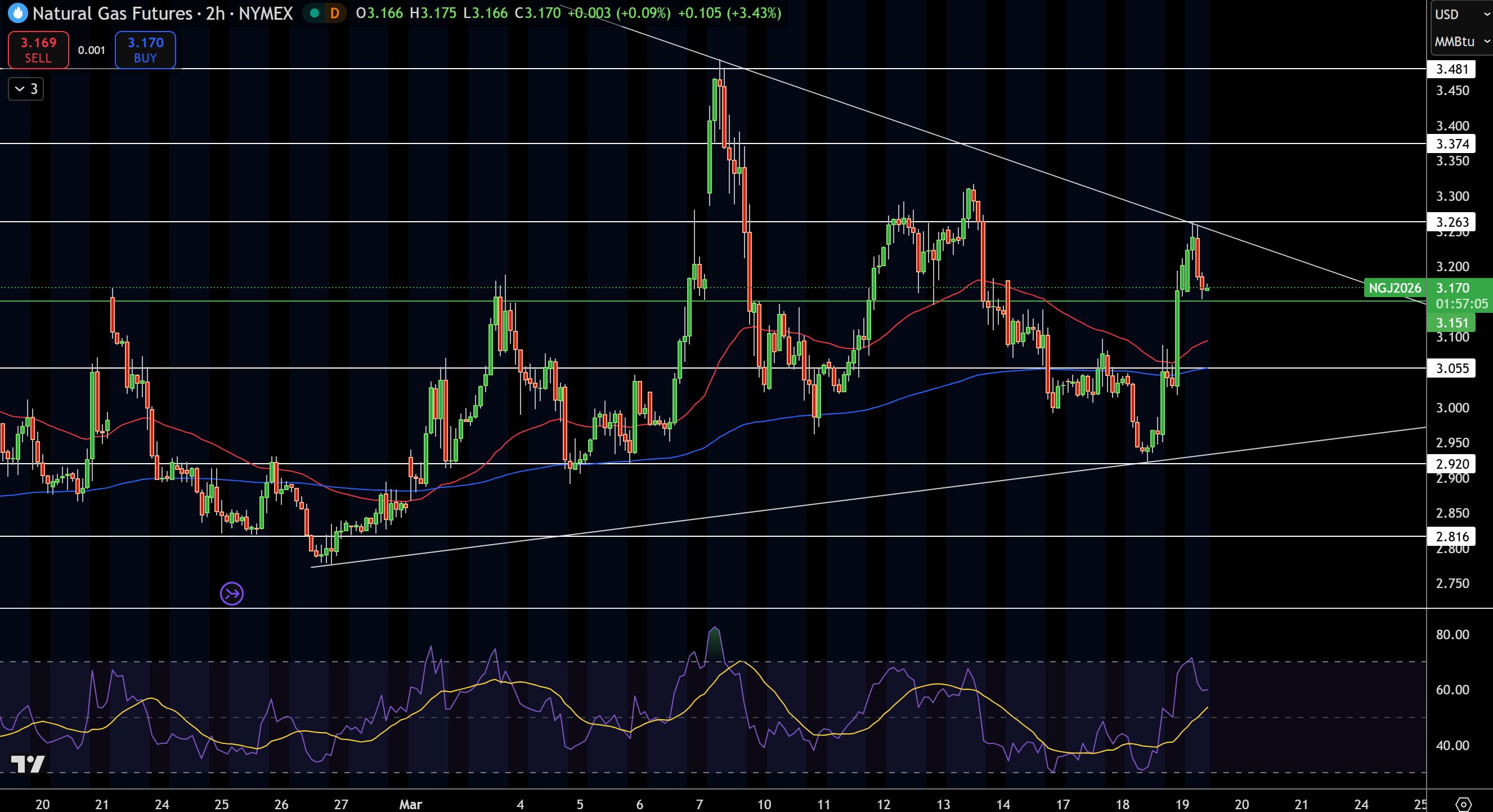
Natural Gas futures (2-hour chart) are currently hovering around $3.17, after a pretty sharp recovery from the $2.92 support zone, this time actually stabilizing above the $3.15 pivot level that had been looming large.
Price has also managed to bounce back above both the 50-period and 200-period moving averages, which is a pretty good sign that short-term momentum is improving – things are looking up. But don’t get too excited just yet – that dominant downward trendline from the high at $3.48 is still firmly in place and acting as a bit of a cap on the upside , capping things off just shy of $3.26
Looking at the charts, we can see that higher lows are forming , still clinging to a rising support line – and the squeeze is on between $3.15 and $3.26 with the price basically stuck in neutral. If we do manage to break above $3.26 we might just see a run up to $3.37 and then potentially beyond $3.48.
On the other hand, if $3.15 can’t hold, we might be looking at a pullback to $3.05 and then on to $2.92 support.
Natural Gas Price Forecast
Every new Natural Gas analysis as it publishes, today's technical signal and key levels, live price — on one page.
See all Natural Gas forecastsWTI Crude Oil Forecast: $98 Caps Upside as $92.98 Holds Support
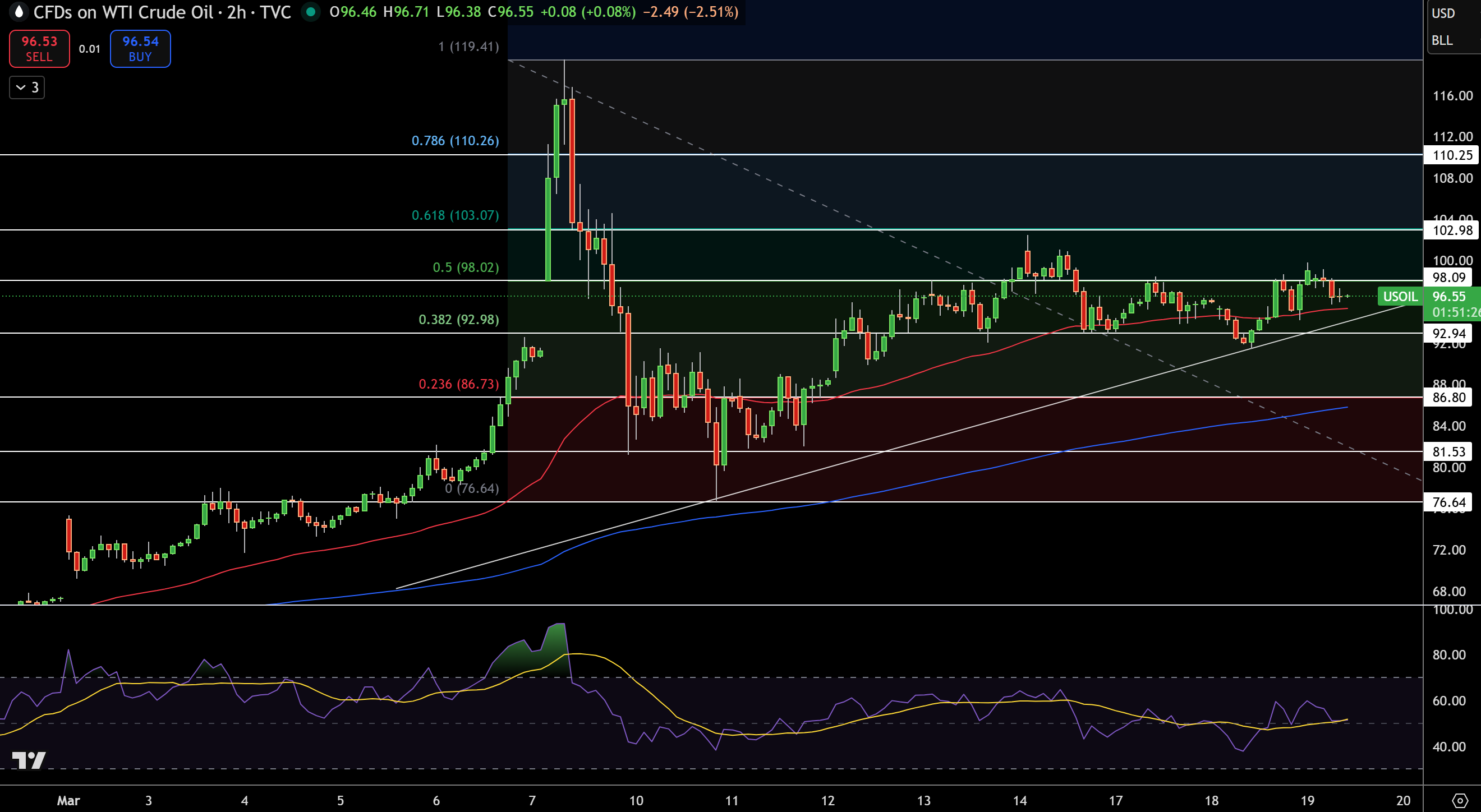
Crude oil and natural gas are seeing some serious price action at the moment, with plenty of risk priced in due to renewed troubles brewing in the Middle East. It’s got people worried about how stable global supplies might be.
Right now, you’re seeing WTI floating between 96 and 98 bucks a barrel after some wild swings from 95.75 to 99.17 in recent days, and Brent is sitting pretty above 112, in the process widening the gap between the transatlantic markets. Traders are effectively saying that thing could go real bad if we see disruptions coming to Gulf production & LNG infrastructure and that’s squeezing already pretty tight global supplies even tighter.
Analysts are bleating on about how if we do indeed see sustained outages, oil prices might just go flying up to $150 or even higher, especially given we’re not exactly swimming in spare capacity or inventory here. Any domestic policy aimed at addressing bottlenecks has offered some minor respite, but the truth is that volatility is still pretty high as markets go back and forth about what energy security really looks like.
Brent Crude Oil Forecast: UKOIL Pushes Toward $113 as Bulls Target $119.44
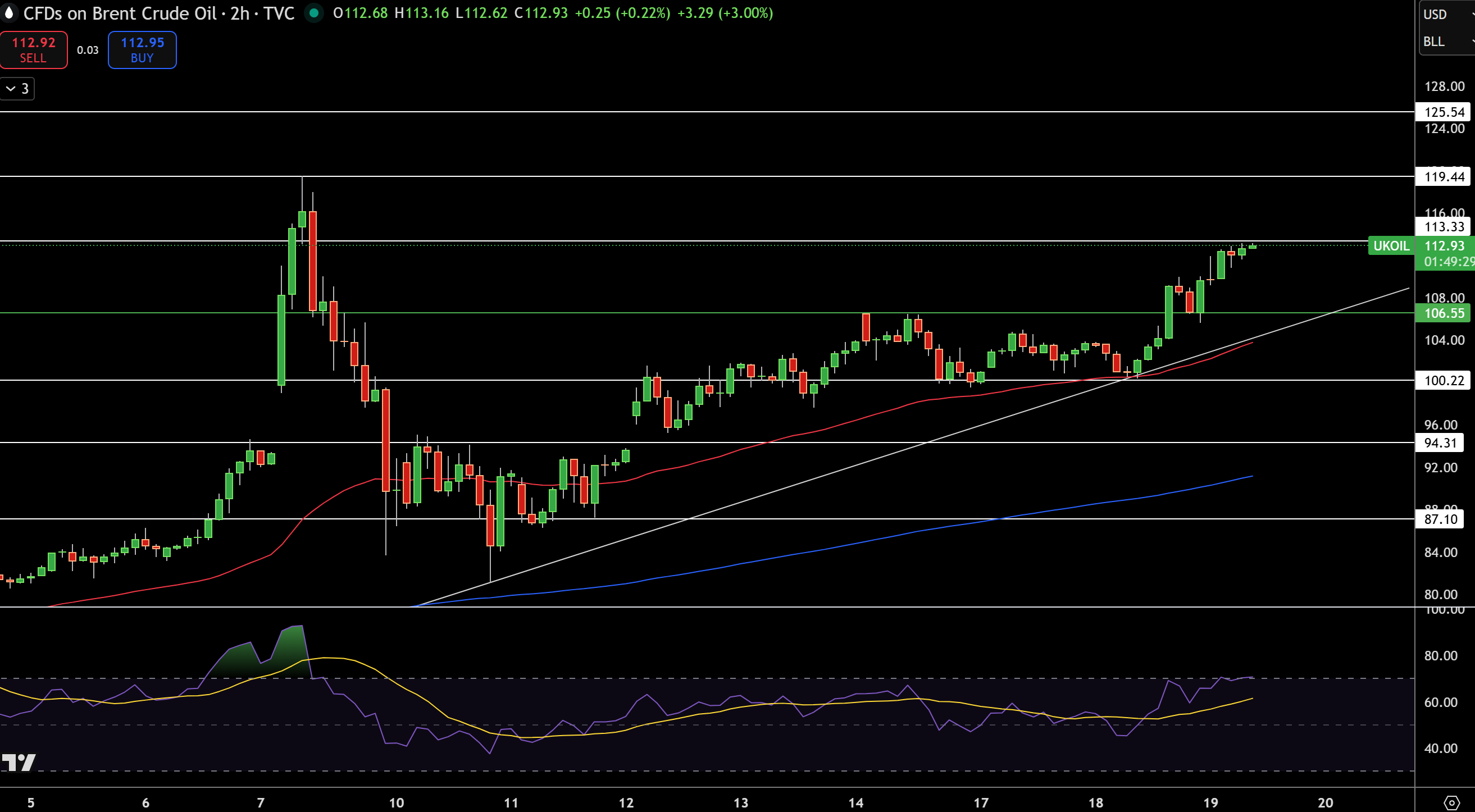
Brent Crude on the 2 hour chart is dancing around $112.93, and it’s looking like it’s going to keep on going up. Price has clearly broken through that $106.55 resistance and is still holding above its rising trendline – that’s a pretty strong sign of good upside momentum. The 50-period moving average is pointing upwards and doing a great job of keeping price supported near $104, while the 200-period MA is languishing below, which is another good sign that this uptrend is the real deal.
Right now the first thing to watch is that $113.33 level – if we can break above that then the path is open to $119.44. RSI is heading towards overbought territory at 70 – that’s a sign of strong momentum but also of some risk of a pullback. A dip below $108 would start to weaken the bullish picture, but if we can get sustained strength above $113 then the upside targets stay very much in play.