


Natural Gas Futures Struggle as Winter Demand Fades
U.S. natural gas futures eked out a small gain on Friday as the relatively muted week came to a close. Other than the gap lower opening on Monday and another big drawdown Thursday, the week was very quiet as traders began transitioning from the winter heating season to the spring shoulder season without much fanfare. In fact, if we strip out the two weeks in late January when the market went ballistic to the upside, the trade has been pretty quiet since early December.
Traders Tread Carefully After Polar Vortex Burn
Even though it looks like winter is over, traders are being extremely cautious as we head into the second half of February. I don’t see any evidence of excessive shorting although I see that gains are being capped. There doesn’t seem to be any pressure to sell weakness either. Perhaps this is because during late January the market was nearly 100% short according to government statistics and those traders were forced to cover aggressively en masse when the Polar Vortex warning came out around January 20.
With some traders still licking their wounds from that debacle, the trade looks a little more cautious now with nobody ready to pile on yet. It could happen, however, as we approach the rollover in about two weeks.
Midweek Rally Fizzles as Holiday Weekend Looms
Prices looked like they had reached a bottom after Wednesday’s minor reversal to the upside. A slight follow-through confirmed it on Thursday, but that was it for the move and the weakness prevailed early Friday. Traders looked like they had no incentive to be long over the long holiday weekend with mild weather ahead and demand from the East Coast returning to normal levels.
Weather Outlook Turns Bearish Through Mid-February
The weather outlook remains bearish with investors calling for more “sell the rally” trading. According to NatGasWeather, it’s going to be chilly across the Great Lakes and the Northeast through the weekend then warming next week. The rest of the U.S. is expected to be mild. Overall, demand during the February 12 to February 18 period is expected to be low.
Natural Gas Price Forecast
Every new Natural Gas analysis as it publishes, today's technical signal and key levels, live price — on one page.
See all Natural Gas forecastsTechnical Picture Shows Downtrend Intact
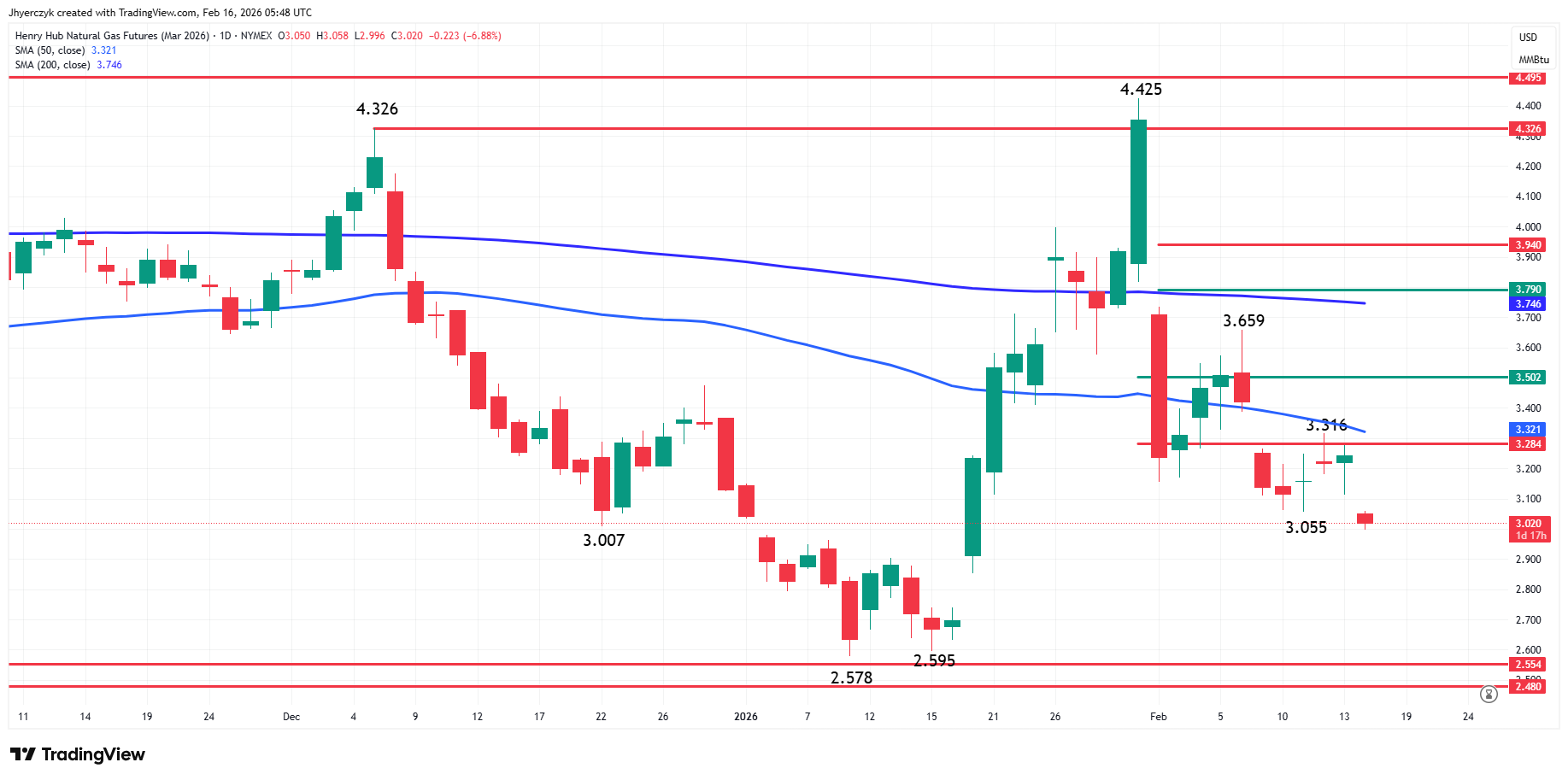
Technically, the trend is down using two metrics, the main swing chart and the moving averages. The nearest main top is $4.425. The minor tops are $3.316 and $3.659. I don’t expect to see a change in the main trend until a solid base is formed. The minor trend will change to up on a trade through $3.316, but that will only shift momentum. However, even that will be meaningless unless buyers can overcome the 50-day moving average at $3.321.
Additional barriers are the retracement zones at $3.284 to $3.502 and $3.790 to $3.940. The main barriers are the 200-day moving average at $3.746 and the main swing top at $4.425.
More Information in our Economic Calendar.


