
XRP soars to a Sunday, February 15, high of $1.6703 before dropping below $1.5 on profit-taking.
Optimism over US lawmakers reaching an agreement on stablecoin yields has lifted market sentiment, triggering XRP’s rebound from February’s low of $1.1227.
Meanwhile, Ripple CEO Brad Garlinghouse’s appointment to the CFTC advisory committee and robust demand for XRP-spot ETFs contributed to the recovery.
The rebound from February’s low supports the medium-term outlook. The projection hinges on crypto-related legislative developments, the Fed rate path, XRP utility, and XRP-spot ETF flows.
Below, I will explore the key drivers behind recent price trends, the medium-term (4-8 weeks) outlook, and the technical levels traders should watch.

Garlinghouse Joins CFTC Innovation Advisory Committee
On Thursday, February 12, the CFTC announced the members of its Innovation Advisory Committee (IAC). Ripple CEO Brad Garlinghouse was among the 35 members of the Committee, which included Coinbase (COIN) CEO Brian Armstrong and Chair & CEO of Nasdaq Adena Friedman.
The establishment of the IAC underscored a marked shift in the US crypto regulatory landscape, favoring digital assets. CFTC Chairman Michael Selig stated:
“The IAC’s work will help ensure the CFTC’s decisions reflect market realities so the agency can future-proof its markets and develop clear rules of the road for the Golden Age of American Financial Markets.”
While the CFTC and the SEC support a more crypto-friendly regulatory landscape, the passing of crypto legislation remains key to longer-term adoption. Crucially, President Trump’s pro-crypto agenda paved the way for the shift in the regulatory landscape. A change in government could materially alter the agencies’ positions regarding oversight in the absence of crypto legislation.
Market Structure Bill in the Spotlight
Importantly, crypto-friendly legislation would establish a clear statutory framework, regulatory certainty, and a more compelling prospect for crypto adoption. The absence of crypto legislation allowed the SEC, under Gary Gensler, to choose a regulatory stance on digital assets.
Growing optimism that the US Senate will pass the Market Structure Bill has boosted demand for XRP. Reports of a TradFi and DeFi standoff coming to an end have been key to XRP’s recent breakout above $1.5.
Coinbase CEO Brian Armstrong, a member of the IAC, expressed optimism over US banks and the DeFi space reaching an agreement, stating:
“Coinbase attended both recent White House meetings, and the crypto industry is aligned. We’re making good progress towards reaching a win-win-win between the White House, banks, and crypto, and we’ll keep advocating for what’s best for crypto users, especially core consumer benefits like rewards.”
XRP Exposed to Crypto-Related Legislative Headlines
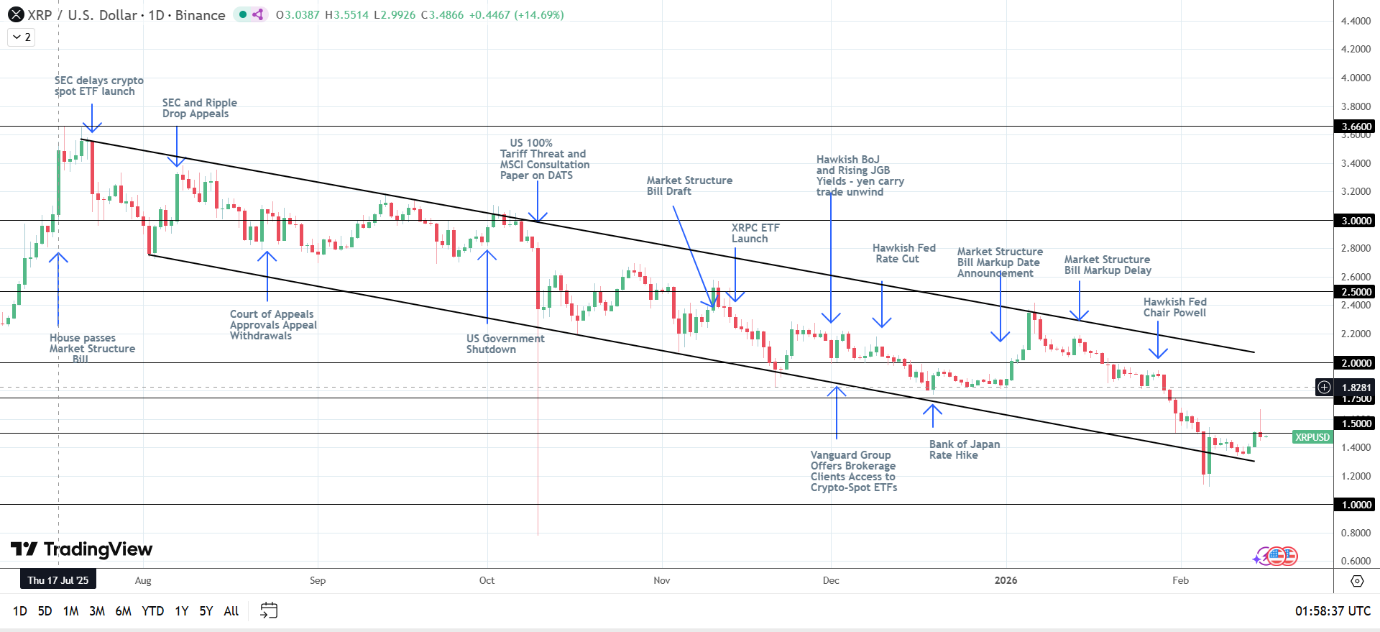
XRP remains highly sensitive to crypto-related regulatory developments. In January, the token rallied from a December 31 low of $1.8103 to a January 6 high of $2.4151 after the US Senate Banking Committee announced its markup vote on its draft text for the Market Structure Bill.
However, delays to the Agriculture Committee’s markup vote and the Banking Committee’s postponement of its markup vote triggered a sell-off, sending XRP to a 2026 low of $1.1227.
For context, Coinbase withdrew its support for the US Senate Banking Committee’s draft text for the Market Structure Bill, leading to the Banking Committee postponing its markup vote. Brian Armstrong warned that the draft amendments would kill rewards on stablecoins, allowing banks to ban their competition.
Since then, crypto and banking representatives have attended two sessions at the White House, looking to find common ground on stablecoin rewards.
Crucially, the US Senate passing the Market Structure Bill could kickstart an XRP rally. On July 17, 2025, XRP surged 14.69% after the US House of Representatives passed the Market Structure Bill to the Senate. These price trends highlight the potential upside for XRP should the Market Structure Bill receive bipartisan support.
XRP Price Forecast: Short-, Medium-, and Long-Term Targets
Despite rebounding from February’s low of $1.1227, year-to-date losses support a cautiously bearish short-term outlook (1-4 weeks), with a target price of $1.0.
However, robust demand for XRP-spot ETFs, increased XRP utility, and hopes that the US Senate will pass the Market Structure Bill reinforce the bullish medium- to long-term price projections:
- Medium-term (4-8 weeks): $2.5.
- Longer-term (8-12 weeks): $3.0.
Key Downside Risks to the Bullish Medium-Term Outlook
Several scenarios could unravel the constructive medium-term bias. These include:
- A hawkish Bank of Japan, with a higher neutral interest rate (potentially 1.5%-2.5%). Multiple BoJ rate hikes could narrow US-Japan rate differentials in favor of the yen. Narrowing rate differentials may trigger a yen carry trade unwind, leading to a liquidity crunch, as seen in mid-2024. A yen carry trade unwind would affirm XRP’s short-term bearish structure. For context, the BoJ previously declared a wider neutral rate range of 1%-2.5% but stated it would announce a narrower range at a later date.
- Fading bets on an H1 2026 Fed rate cut.
- Delays and/or partisan opposition to the Market Structure Bill.
- Extended periods of XRP-spot ETF net outflows.
These events would weigh on XRP, push the token toward $1.0, and reaffirm the cautiously bearish short-term outlook.
Technical Analysis: Levels to Watch
XRP fell 2.25% on February 14, partially reversing the previous day’s 7.23% rally to close at $1.4750. The token tracked the broader crypto market cap, which declined by 1.98%.
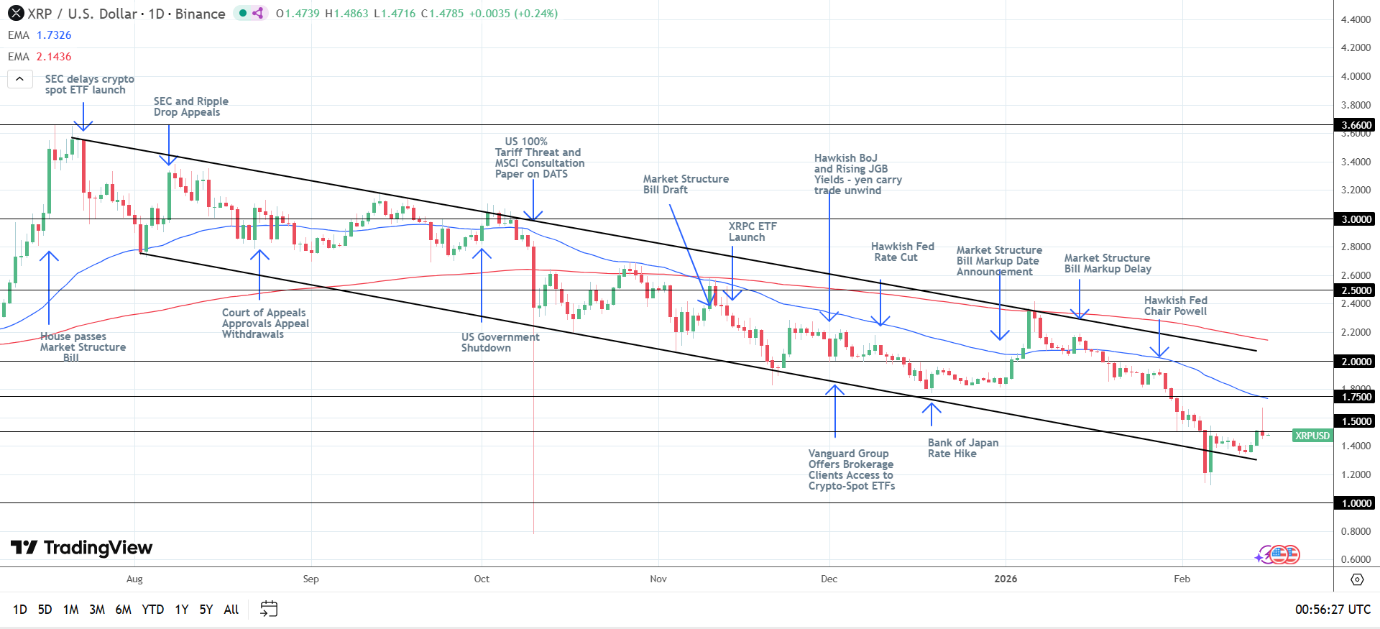
While XRP snapped a five-week losing streak in the week ending February 15, the token remained well below its 50-day and 200-day EMAs. The EMA positions signaled a bearish bias. However, the 50-day EMA has flattened, suggesting a potential shift in technicals. Additionally, several positive fundamentals continue to counter bearish technicals, supporting the bullish medium-term outlook.
Nevertheless, short-term technicals remain bearish despite improving fundamentals.
Key technical levels to watch include:
- Support levels: $1.0, and then $0.7773.
- 50-day EMA resistance: $1.7326.
- 200-day EMA resistance: $2.1436.
- Resistance levels: $1.5, $2.0, $2.5, and $3.0.
On the daily chart, a breakout above $1.50 would bring the 50-day EMA into play. A sustained move through the 50-day EMA would signal a near-term bullish trend reversal. A bullish trend reversal would open the door to testing the 200-day EMA.
A sustained break above the EMAs would affirm a bullish trend reversal and support the medium- to longer-term price targets.
Fundamental Events Driving Near-Term Price Action
Near-term price drivers include:
- XRP-spot ETF flows.
- US economic data and the Fed’s rate path. This week, the FOMC meeting minutes, FOMC member speeches, US GDP, and US inflation numbers will be key price catalysts.
- Crypto-related legislative developments.
- The Bank of Japan’s neutral rate and policy stance.
- Increased geopolitical tensions in the Middle East.
Bearish Structure Intact: $1.0 Remains Critical Support
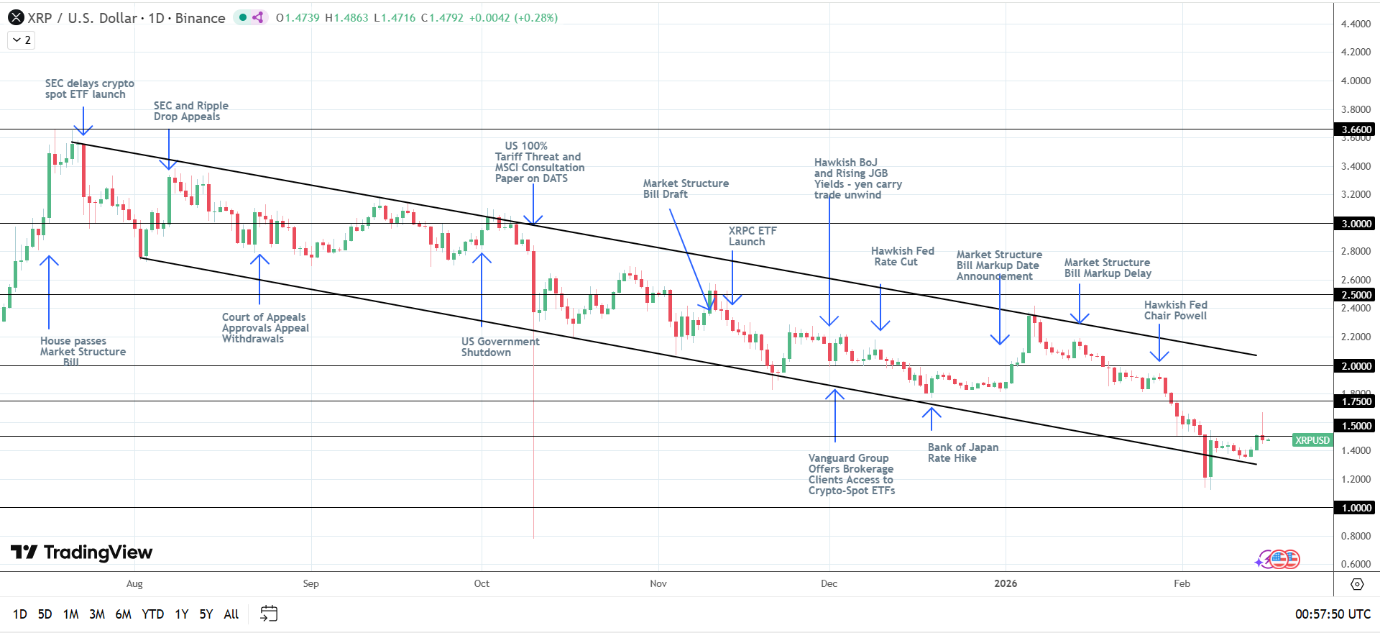
XRP’s pullback on February 15 affirmed the existing bearish trend. A drop below the lower trendline would expose the February 6 low of $1.1227. If breached, $1.0 would be the next key support level. A sustained fall below $1.0 would reinforce the bearish short-term outlook and further validate the bearish structure.
However, a break above $1.5 would enable the bulls to target $2.0 and the upper trendline. A sustained move through the upper trendline would invalidate the bearish structure and signal a bullish trend reversal, reinforcing the constructive medium-term bias.
- Short-term (1-4 weeks): $1.0.
- Medium-term (4-8 weeks): $2.5.
- Longer-term (8-12 weeks): target of $3.0.
XRP Outlook: Crypto Regulations, ETF Flows, and the Fed Remain Key Drivers
Looking ahead, regulatory developments on Capitol Hill remain pivotal to XRP’s price trajectory. Progress toward an agreement on stablecoin yields would boost hopes that the Senate will pass the Market Structure Bill, fueling XRP demand.
Meanwhile, central bank rhetoric and XRP-spot ETF flows will also dictate XRP’s price trends.
A more dovish Fed rate path and a lower BoJ neutral rate (potentially 1%-1.25%) would lift sentiment. Strong demand for US XRP-spot ETFs and crypto-friendly legislative developments would reaffirm the positive medium-term outlook.
In summary, these scenarios support a medium-term (4–8 weeks) move to $2.5. The US Senate passing the Market Structure Bill would reinforce the longer-term (8-12 weeks) price target of $3.0.
Beyond 12 weeks, these factors are likely to send XRP to its all-time high of $3.66 (Binance). A break above $3.66 would affirm a 6- to 12-month price target of $5.