
Bitcoin (BTC) rebounds from $65,000, looking to snap a three-week losing streak. BTC reclaimed $70,000 for the first time in four trading sessions. Softer US inflation raised bets on a Fed rate cut, lifting sentiment.
Speculation that the Market Structure Bill would pass the Senate added to the positive sentiment.
While the US BTC-spot ETF market extended its outflow streak to four weeks, net inflows on February 13 signaled a potential shift in institutional demand.
Notably, a dovish Fed rate path and the progress toward crypto-friendly legislation continue to support a cautiously bullish medium-term price outlook.
Below, I consider the key drivers behind recent price trends, the short-term outlook, the medium-term trajectory, and the key technical levels traders should watch.

US CPI Report Fuels Fed Rate Cut Bets
The US annual inflation rate fell from 2.7% in December to 2.4% in January, below a consensus of 2.5%. Meanwhile, core inflation eased from 2.6% in December to 2.5% in January. Cooling inflationary pressures increased expectations of a June Fed rate cut, boosting demand for BTC and the broader crypto market.
According to the CME FedWatch Tool, the chances of a June Fed rate cut increased from 64.6% on February 12 to 68.6% on February 13, following the release of the data.
Crucially, lower borrowing rates would increase liquidity, potentially fueling leveraged positioning in BTC and speculative trades.
Bitcoin Price Forecast
Every new Bitcoin analysis as it publishes, today's technical signal and key levels, live price — on one page.
See all Bitcoin forecasts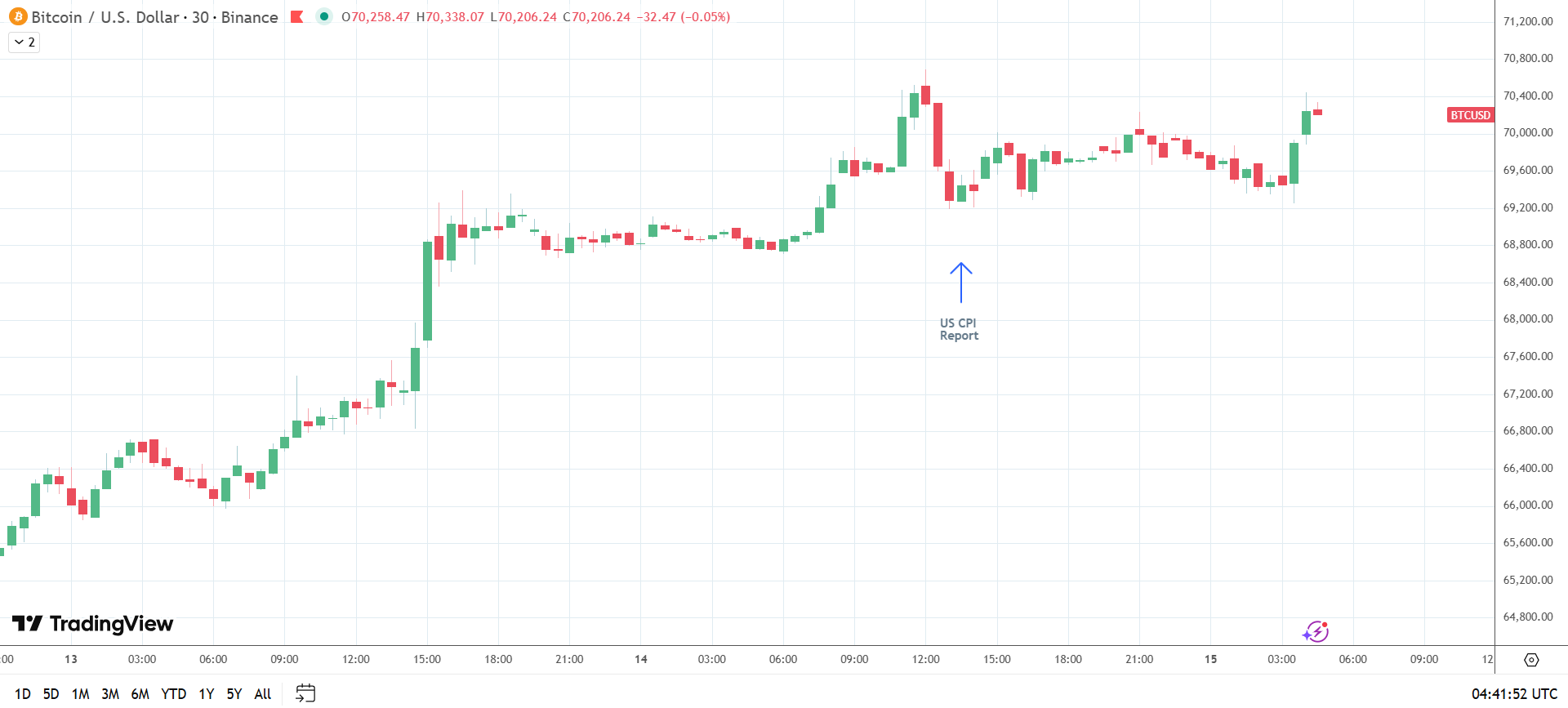
US Spot-ETF Market Snaps Two-Day Outflow Streak
Rising bets on a June Fed rate cut bolstered demand for US BTC-spot ETFs, which saw $15.1 million in net inflows on February 13. While inflows were modest, ending a two-day losing streak lifted sentiment. Despite snapping a two-day daily outflow streak, the broader weekly outflow trend extended to four weeks in the reporting week ending February 13, limiting BTC’s gains.
According to Farside Investors, key flows for the reporting week ending February 13 included:
- iShares Bitcoin Trust (IBIT) saw net outflows of $234.8 million.
- Fidelity Wise Origin Bitcoin Fund (FBTC) had net outflows of $124.7 million.
- Grayscale Bitcoin Trust (GBTC) reported net outflows of $77.0 million.
- In total, six ETF issuers reported weekly net outflows, compared to five ETFs with weekly net inflows.
Despite reclaiming $70,000, the four-week outflow streak has weighed heavily on BTC, which has tumbled 19.74% year-to-date. Importantly, the spot ETF flow trends support a bearish short-term outlook.
Bitcoin and the US Economic Calendar: GDP, Inflation, PMI Data, and the Fed in Focus
Looking at the week ahead, US economic data will influence risk sentiment following the market response to the US CPI report.
On Wednesday, February 18, the FOMC Minutes will give further insight into the Fed’s policy outlook. Fed Chair Powell downplayed the likelihood of a near-term rate cut, citing a resilient labor market and elevated inflation. However, a willingness to cut rates if inflation eases would boost risk appetite, given January’s inflation figures.
However, Friday, February 20, is likely to be pivotal for BTC’s near-term price trends. The US Personal Income and Outlays report, Services PMI data, and Q4 GDP numbers will influence market sentiment toward the Fed rate path.
A larger-than-expected core PCE price index reading for December and a pickup in service sector activity in January would temper bets on a June Fed rate cut, weighing on demand for BTC. However, a lower GDP print could overshadow the Personal Income and Outlays report, potentially giving the Services PMI a greater weighting.
Beyond January’s headline Services PMI, traders should consider price trends. Softer input and output prices would align with January’s CPI report, supporting a more dovish Fed policy stance.
US economic data in line with forecasts would reinforce the bearish short-term outlook. Nevertheless, optimism that the US Senate will eventually pass the Market Structure Bill affirms the bullish medium-term outlook for BTC.
Bitcoin Fear & Greed Index Signals Bearish Sentiment
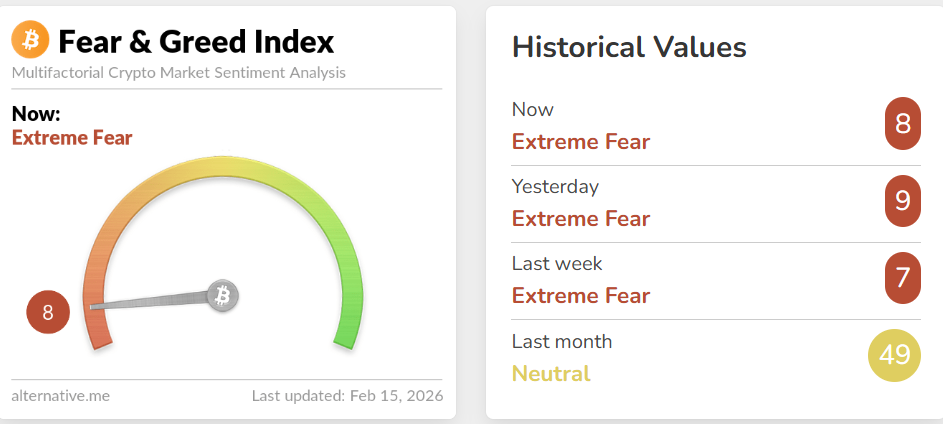
Despite reclaiming $70,000, the Bitcoin Fear & Greed Index remains within the Extreme Fear zone. The Fear & Greed Index fell from 9 to 8 on Sunday, February 15. Despite rising from 7 on Sunday, February 8, the Index continued to reflect extreme bearish sentiment. Typically, these conditions signal a price recovery, reinforcing the bullish medium-term outlook.
Downside Risks to Medium-Term Outlook: Central Banks, US Data, and ETF Flows
While fundamentals continue to support a constructive medium-term bias, downside risks include:
- The BoJ signals a higher neutral interest rate (potentially 1.5%-2%), indicating multiple rate hikes. BoJ rate hikes and Fed rate cuts would narrow US-Japan rate differentials in favor of the yen. A markedly narrower rate differential could trigger a yen carry trade unwind as seen in mid-2024.
- US economic data cools Fed rate cut bets.
- BTC-spot ETFs report extended periods of outflows.
These events would likely send BTC toward $60,000, exposing the August 2024 low of $49,351 (the yen carry trade unwind low).
In summary, the short-term outlook remains bearish as fundamentals align with technicals. However, the medium- to longer-term outlook is cautiously constructive, subject to positive fundamentals developing. These fundamentals include the progress of the Market Structure Bill and expectations of Fed rate cuts.
Technical Analysis
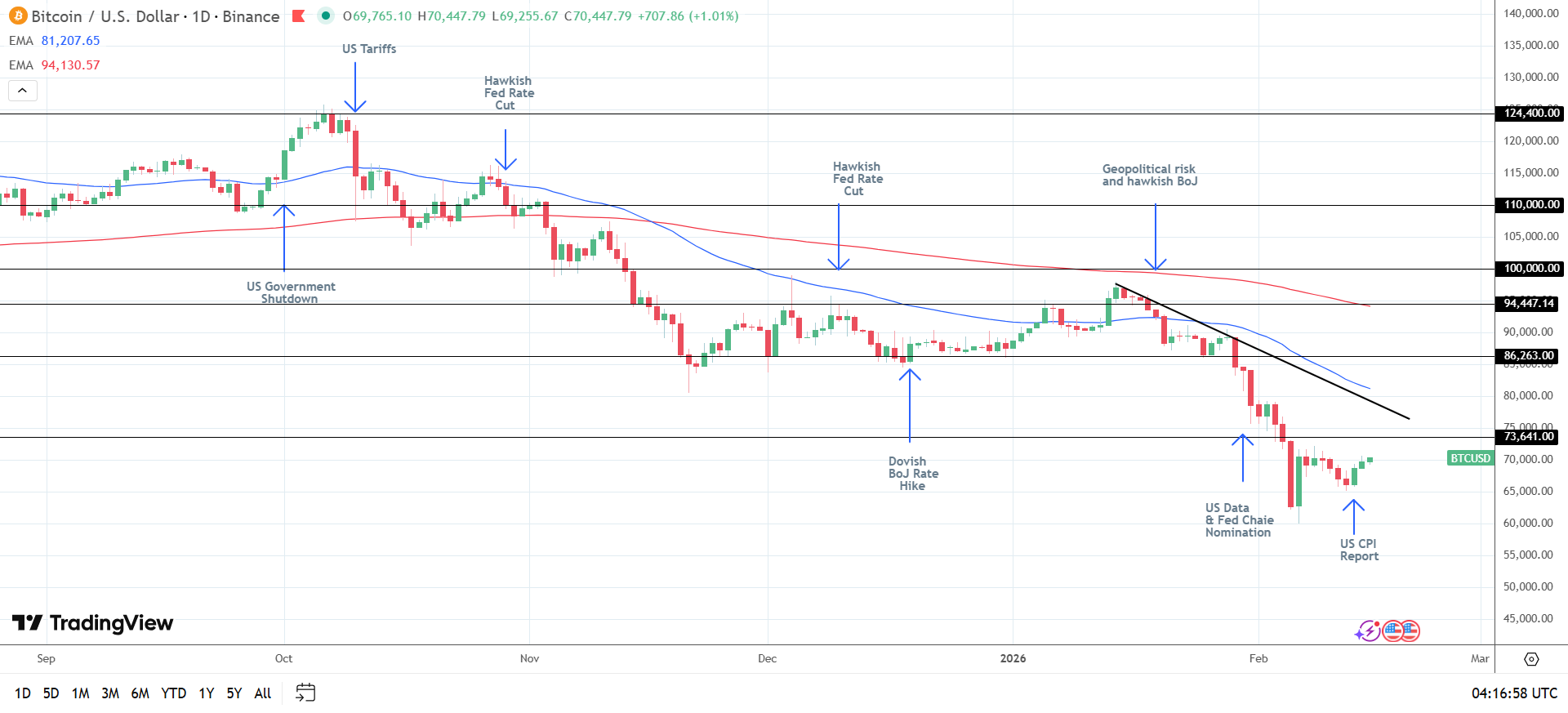
Despite recovering from $65,000, BTC trades well below its 50-day and 200-day Exponential Moving Averages (EMAs), indicating a bearish bias. However, oversold conditions and evolving fundamentals suggest a rebound from the current levels, countering the negative technicals.
A break above $75,000 would enable the bulls to target $80,000 and the 50-day EMA. A sustained move through the 50-day EMA would signal a near-term bullish trend reversal, bringing the 200-day EMA into play. A sustained move above the 200-day EMA would affirm a bullish trend reversal, paving the way toward the $100,000 psychological level.
Bearish Structure in Focus: What Happens if BTC Reclaims $80,000?
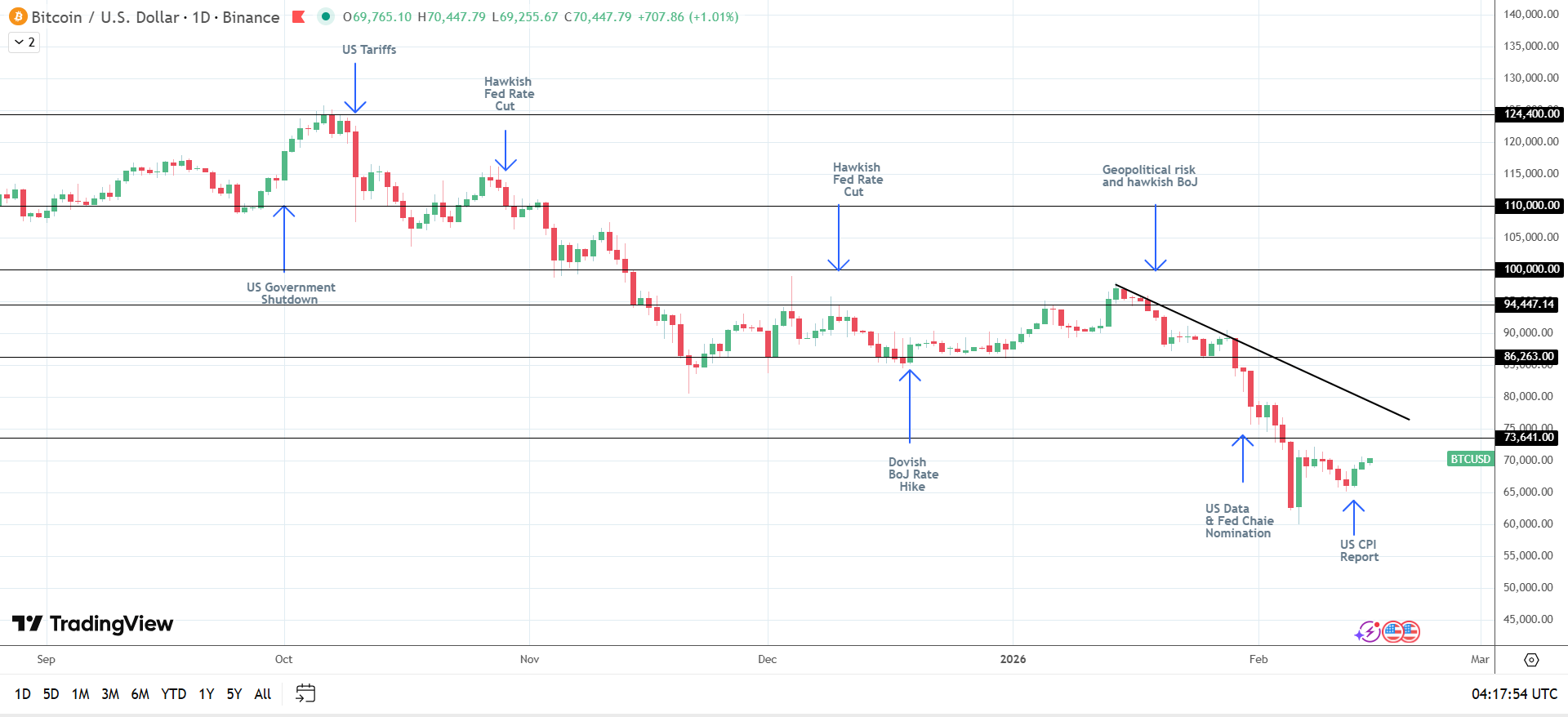
Reclaiming $70,000 brings the upper trendline into play. A sustained move through the upper trend line would invalidate the bearish structure, reinforcing the bullish medium-term (4-8 weeks) price target of $100,000.
However, a sustained fall below the February 6 low of $60,000 would expose the August 24 low of $49,351 and validate the bearish structure.
Track BTC market trends with our real-time data and insights here.
Outlook: Reclaiming $80,000 Key to Medium-Term Bullish Outlook
US economic data, Fed commentary, the BoJ policy stance, crypto-related legislative developments, and US BTC-spot ETF flows will influence demand for BTC.
Considering the recent price action, the medium- and long-term outlook remains constructive, with a 6-12 month price target of $123,731 (ATH). The US Senate’s passing the Market Structure Bill and rising bets on Fed rate cuts would support the bullish outlook.
Stay informed on BTC trends by monitoring macroeconomic developments, ETF flows, and technical indicators here.