
USD/JPY plunged 2.9% to close the week ending February 13 at 152.629. Intervention warnings, optimism about Prime Minister Sanae Takaichi’s adoption of prudent fiscal policies, a more hawkish BoJ, and softer US inflation sent the pair sharply lower.
This week’s reversal was the largest since November 2024, and since the yen carry trade unwind in mid-2024, supporting the bearish short- to medium-term outlook.
Below, I examine the upcoming economic calendar, the medium-term catalysts (4-8 weeks), and the technical levels traders should watch.

Bank of Japan and Prime Minister Takaichi Clash on Rate Hike Timing
This month, Prime Minister Sanae Takaichi won a landslide election, giving the Liberal Democratic Party (LDP) and Japan Innovation Party (JIP) a supermajority in the Lower House.
The coalition’s supermajority removed the need for smaller parties to form a government, delivering political stability. Furthermore, Prime Minister Takaichi no longer needs to make concessions to lesser parties to pursue her fiscal policy goals. This has eased jitters that excessive fiscal spending would balloon Japan’s debt-to-GDP ratio.
Notably, 10-year Japanese Government Bond (JGB) yields have pulled back from January’s multi-decade high of 2.382%, as risk premiums for holding JGBs eased. Improved sentiment fueled demand for the yen.
Ahead of the election, we suggested a potential shift in sentiment toward Prime Minister Takaichi’s fiscal policies in the event of a landslide victory, supporting a bearish outlook for USD/JPY.
USD/JPY Price Forecast
Every new USD/JPY analysis as it publishes, today's technical signal and key levels, live price — on one page.
See all USD/JPY forecasts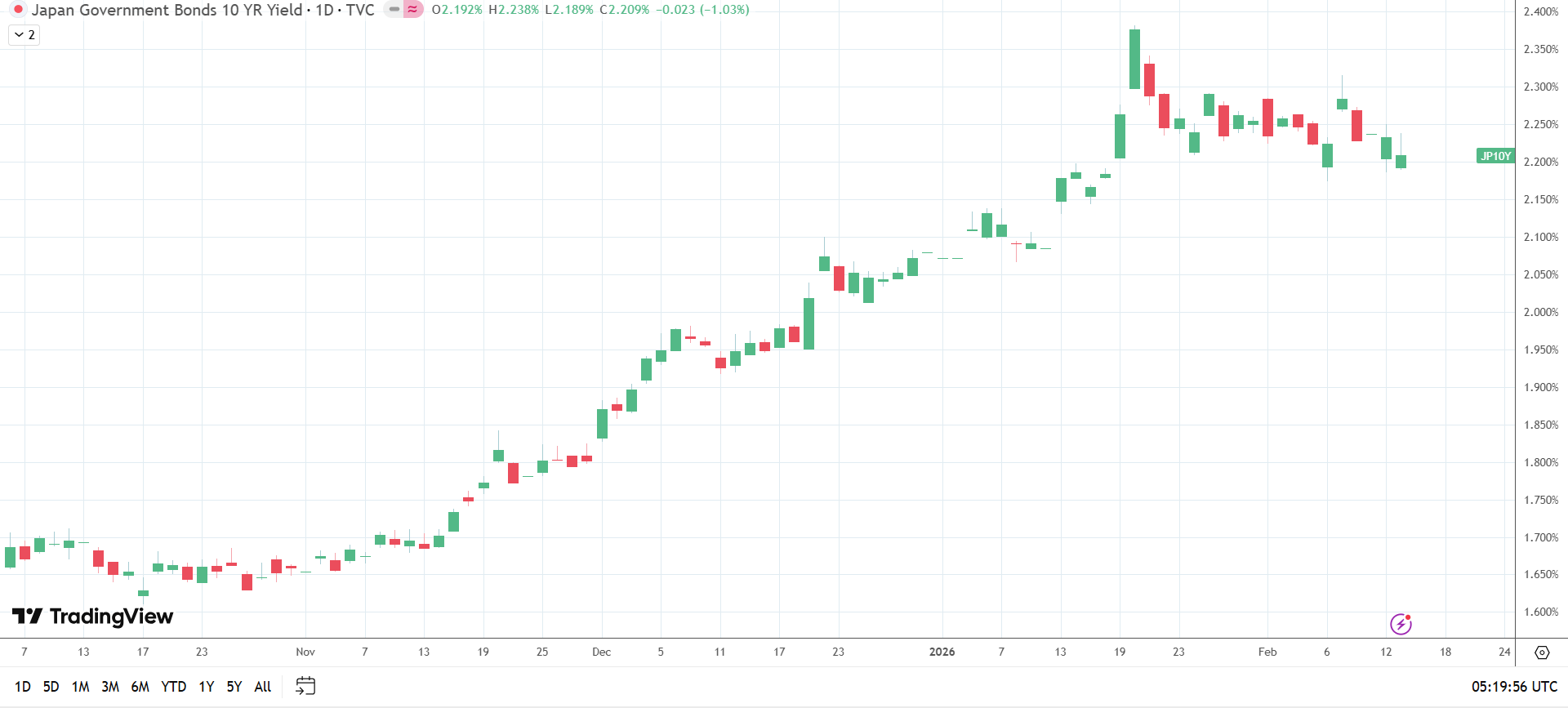
Key Japanese Economic Indicators to Look Out For
As the dust settles from the election, the market focus turns to crucial Japanese economic indicators and the BoJ’s policy stance.
On Monday, February 16, preliminary Q4 GDP numbers will influence sentiment toward a spring BoJ rate hike and yen demand. Economists forecast the Japanese economy will expand by 0.4% quarter-on-quarter in Q4 after contracting by 0.6% in Q3.
An economic recovery would raise bets on an April BoJ rate hike, fueling buying interest in the yen. A stronger yen would send USD/JPY lower.

However, traders should also consider trends in private consumption and external demand. The BoJ continues to monitor the effect of US tariffs on external demand, while private consumption fuels demand-driven inflation. Stronger-than-expected external demand and private consumption would further boost spring rate hike bets.
Importantly, forecasts align with the BoJ’s hawkish quarterly projections, which contributed to the USD/JPY pair’s drop below 153.
Meanwhile, Japanese trade data will require consideration on Wednesday, February 18. Economists expect exports to surge 12% year-on-year in January, up sharply from 5.1% in December. Strong external demand would signal a pickup in economic momentum and potentially boost corporate profits. Rising profits may enable firms to raise wages, fueling consumer spending and demand-driven inflation.
On Friday, February 20, national inflation figures will wrap up a busy week. Economists forecast headline inflation to drop from 2.1% in December to 1.9% in January, below the BoJ’s 2% target. However, the so-called core-core inflation rate is expected to ease from 2.9% to 2.8% in January, holding well above the target. A modest drop in core-core inflation would continue supporting the hawkish BoJ policy stance, strengthening the yen.
In summary, upbeat data would affirm the bearish short- to medium-term outlook for USD/JPY.
US Economic Calendar: Inflation and the Fed in Focus
While the Japanese data will influence buying interest in the yen, US economic indicators and Fed chatter will dictate demand for the US dollar.
On Wednesday, February 18, the FOMC Minutes will come under market scrutiny. Fed Chair Powell cautioned that a resilient labor market and elevated inflation are likely to delay rate cuts. The minutes are likely to reveal whether the Fed is more focused on the labor market or inflation. A greater focus on inflation could boost expectations of a June cut, given that headline inflation eased to 2.4% in January.
While the Minutes will be key, Friday’s economic data will be crucial for the Fed and sentiment toward monetary policy. The Personal Income and Outlays Report, Q4 GDP data, and the Services PMI will fuel speculation about a June Fed rate cut.
Economists expect the Core PCE Price Index to rise 0.4% month-on-month in December after increasing 0.2% in November. Meanwhile, economists forecast the Services PMI will rise from 52.7 in December to 53.1 in January. A pickup in inflationary pressures and an uptick in service sector activity would temper expectations of a June Fed rate cut. A more hawkish Fed rate path would boost demand for the US dollar, sending USD/JPY higher.
However, softer GDP growth would likely limit the impact of the numbers on US dollar demand. Economists expect the US economy to expand by 3% quarter-on-quarter in Q4, down from 4.4% in Q3.
FOMC Members’ Reaction to US Data Key for the US Dollar
Beyond the data, traders should closely track Fed commentary for views on the timing of a rate cut.
According to the CME FedWatch Tool, the chances of a March 2026 Fed rate cut fell from 18.4% on February 6 to 9.2% on February 13. Additionally, the probability of a June cut declined from 71.9% to 68.6%. Changes in the chances of March and June cuts will be key for US dollar trends.
Market View: Medium-Term Yen Strength
In my opinion, USD/JPY would likely continue falling toward 150 on expectations of multiple Fed rate cuts and a hawkish BoJ rate path. Narrowing US-Japan rate differentials, favoring the yen, would affirm the bearish medium-term (4-8 weeks) outlook. A break below 150 would reinforce the longer-term (8-16 weeks) 145-140 range.
Counter-Trend Risks: What Could Send USD/JPY Toward 160?
Upside risks include:
- Prime Minister Takaichi announces aggressive fiscal spending plans.
- Strong US economic data and Fed chatter dampen bets on an H1 2026 rate cut.
- Weaker Japanese economic data temper BoJ rate hike expectations.
Despite the upside risks, yen intervention threats are likely to cap upside around 160, based on past events. Given the upside risks, a breakout above 158 would pave the way toward January’s high of 159.453. A move toward 159.453 would invalidate the medium-term bearish structure.
Financial Analysis
Technical Outlook: Bearish Momentum Building
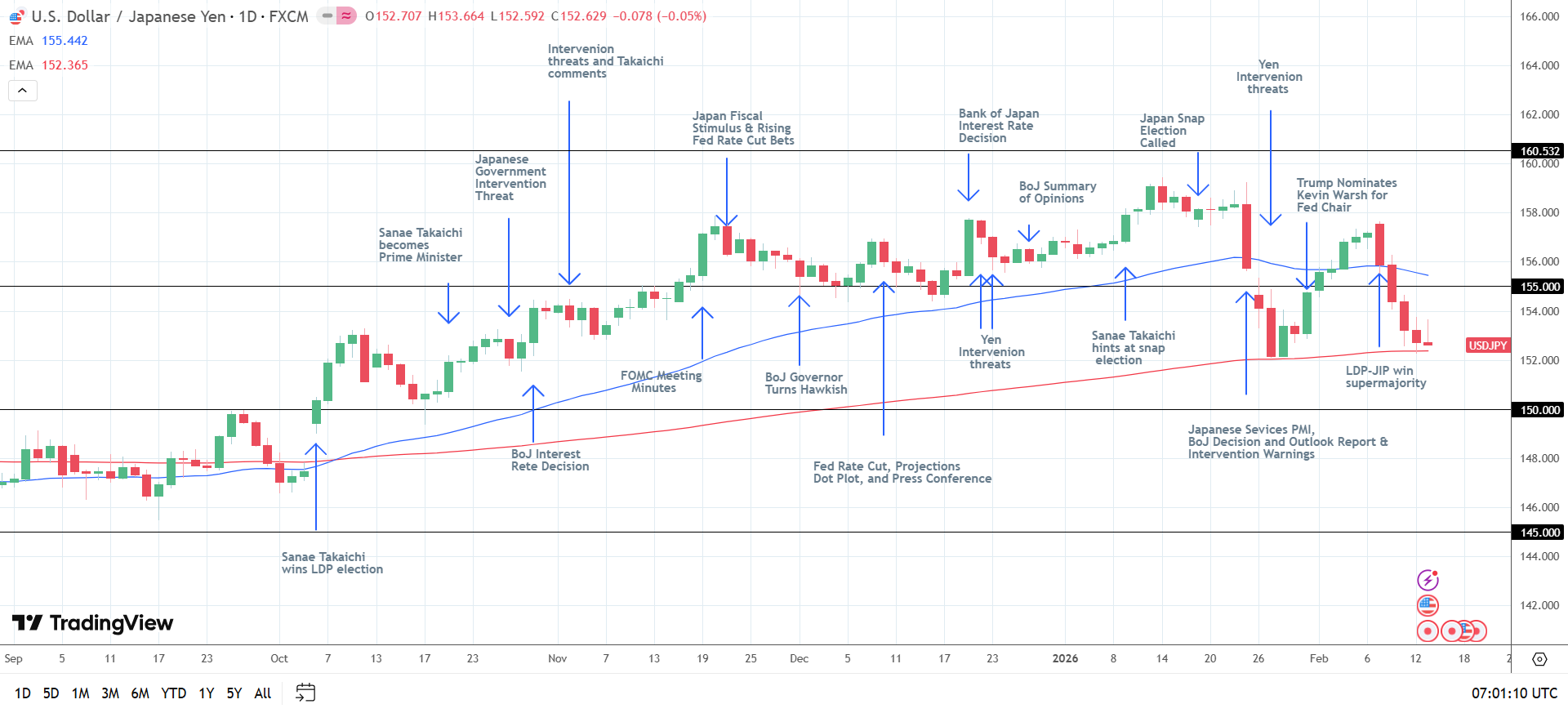
On the daily chart, USD/JPY traded below its 50-day Exponential Moving Average (EMA), but held above its 200-day EMA. The EMA positions indicated a bearish near-term, but a bullish longer-term bias. However, positive yen fundamentals continue to offset longer-term technicals, supporting the negative outlook for USD/JPY.
A break below the 200-day EMA would affirm last week’s bearish trend reversal and expose 150. If breached, the October low of 146.585 would be the next key support level.
Key Takeaways
The USD/JPY pair has advanced 1.37% in February, reversing the previous month’s 1.34% loss. However, hawkish BoJ rhetoric would signal a narrower rate differential, reaffirming the bearish medium- to long-term outlook for USD/JPY.
Key levels will include 150 and 140 on the downside, and 158 and 160 on the upside.
Consult our economic calendar for historical and upcoming data.