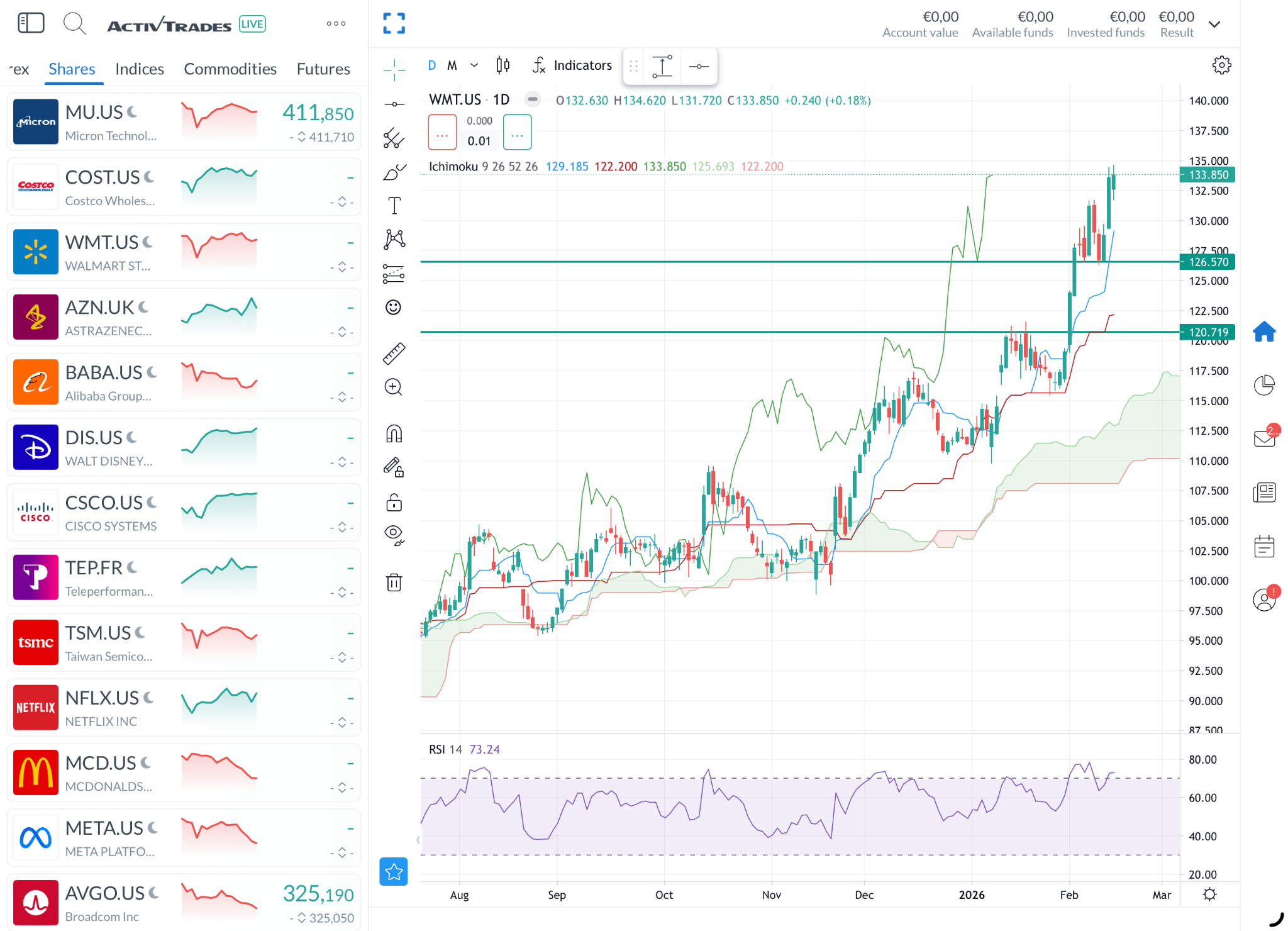
After being up around 20% in 2026 and reaching a historic $1 trillion market capitalization in early February—becoming the first traditional retailer to achieve that milestone—the company now faces the challenge of justifying that valuation with continued growth, particularly in e-commerce and technology-driven operations.
With Walmart’s stock price hovering near record levels, the big question for investors is: can the company continue delivering results strong enough to support further upside in its share price, or has much of its transformation already been priced in?
From Retail Giant to Tech Powerhouse: Walmart’s Trillion-Dollar Milestone
Walmart’s entry into the trillion-dollar club marks more than a symbolic achievement. It reflects a fundamental shift in how investors perceive the company. Historically categorized as a defensive, low-margin retailer, Walmart is increasingly being seen through a different lens—one that emphasizes technology, data, logistics sophistication, and platform economics.
By crossing the $1 trillion market cap threshold, Walmart joined a select group largely composed of technology leaders such as Apple, Amazon, Microsoft, Nvidia, Meta, Tesla and Broadcom. It now sits alongside conglomerates like Berkshire Hathaway and energy heavyweight Saudi Aramco. For a company long associated with physical stores and grocery aisles, that shift in peer group is significant.
Another key milestone reinforcing this repositioning was Walmart’s decision in December 2025 to transfer its stock listing from the New York Stock Exchange to the NASDAQ, after more than five decades on the NYSE. While technically a listing change, the move carried symbolic weight. NASDAQ is traditionally associated with high-growth, innovation-driven companies. By choosing that exchange, Walmart signaled that it no longer wants to be viewed primarily as a brick-and-mortar retailer, but rather as a technology-enabled logistics and commerce platform.
This strategic evolution is visible in the company’s operating model. Walmart’s supply chain is increasingly managed by AI-driven forecasting systems, its warehouses rely heavily on automation and robotics, its e-commerce platform continues to scale rapidly, and its digital advertising business is expanding as a higher-margin revenue stream. In other words, technology is no longer a support function—it is embedded in the core of the business.
The recent rally in Walmart’s stock has been supported by multiple catalysts. However, Wall Street analysts have shown particular enthusiasm for the company’s online sales growth and margin expansion, both of which are closely linked to its investments in artificial intelligence and automation. Efficiency gains in logistics, improved inventory management, and data-driven merchandising decisions have helped strengthen profitability, reinforcing the argument that some believe Walmart deserves a valuation closer to that of a technology-enabled platform rather than a traditional retailer.
How Walmart Uses AI to Improve Its Overall Business
Artificial intelligence is becoming a structural part of how Walmart operates. It is not limited to one team or one tool. Instead, AI is integrated across forecasting, inventory management, logistics, warehouse operations and internal decision-making. These examples illustrate some of the most visible uses of AI today, although the company is developing many other tools and techniques behind the scenes.
One of the most important applications of AI at Walmart is perhaps demand forecasting.
Retail is fundamentally about predicting what customers will buy, in which location, and at what moment. AI systems analyze massive volumes of historical sales data together with external variables such as seasonality, local weather forecasts, regional events and economic conditions.
For example, if unusually high temperatures are expected in a specific state, AI can anticipate increased demand for bottled water, fans, or air conditioning units in stores located in that region. Instead of reacting after shelves are empty, Walmart can move inventory in advance. This reduces stockouts while also limiting excess inventory that would otherwise sit in warehouses and tie up capital. The same logic applies to international shipments, where AI helps determine optimal shipping timing and monitors quality trends, improving reliability across global supply chains.
AI also gives Walmart real-time visibility over inventory across its vast network of stores, fulfillment centers and distribution hubs.
Because the company operates at an enormous scale, even small inefficiencies can become very costly. AI-powered systems continuously update inventory levels and detect disruptions automatically. If a logistics lane is blocked due to severe weather or if a distribution center faces operational issues, the system can reroute products through alternative facilities. This makes the supply chain more flexible and resilient.
In addition, computer vision technology is used to inspect inbound goods. Cameras combined with AI models can detect damaged packaging or quality issues before products reach store shelves, reducing returns and protecting brand reputation.
Inside warehouses, AI works alongside robotics and automation systems to increase productivity and improve safety.
Many repetitive manual tasks, such as sorting, scanning, and moving goods, are partially automated. Smart cameras monitor operations in real time and identify irregularities, such as misplaced pallets or workflow bottlenecks. When an issue occurs, AI systems can alert the appropriate employee or recommend corrective action.
Generative AI tools also help managers interpret operational data more quickly, turning raw metrics into understandable summaries and insights. This reduces downtime, improves throughput, and lowers the risk of workplace injuries, while helping Walmart operate its distribution network more efficiently.
Another sector seeing a major AI-driven boost is logistics and transportation.
For a retailer of Walmart’s size, optimizing truck routes and load efficiency directly affects profitability. AI algorithms evaluate delivery schedules, route alternatives, and consolidation opportunities to balance speed and cost.
For example, instead of dispatching several partially filled trucks, the system may combine shipments to improve truck fill rates while still meeting delivery deadlines. This improves margins, reduces fuel consumption, and enhances service reliability. Faster and more predictable deliveries ultimately translate into better customer satisfaction.
A more internal but strategically important innovation (mentioned in Q4 2025 earnings call) is “Wally,” a generative AI assistant developed for Walmart’s merchant teams.
Merchants are responsible for selecting products, setting prices, and monitoring performance across thousands of SKUs (Stock Keeping Units). Traditionally, this work required extensive manual data analysis. Wally accelerates this process by analyzing complex datasets instantly, identifying anomalies in product performance, and helping diagnose root causes when sales deviate from expectations.
For example, if a product underperforms in certain stores, the system can analyze pricing differences, supply chain delays, or local demand patterns to suggest possible explanations. Wally automates time-consuming admin tasks, allowing business owners to spend their energy on strategic growth.
Taken together, these examples show how AI helps Walmart improve forecasting accuracy, reduce operational costs, increase resilience, and enhance customer experience. However, these applications represent only part of a broader transformation. The company continues to develop additional AI capabilities in areas such as personalization, fraud detection, dynamic pricing, and customer service automation, among others. At Walmart’s scale, even marginal improvements in efficiency can generate a significant financial impact.
In Part Two, we will focus on other aspects traders and investors should focus on in the upcoming earnings releases.
Sources: Walmart Global Tech, Walmart, Investopedia, Wall Street Journal, SupplyChainDive