Preliminary British GDP for the fourth quarter was overall worse than expected and came against the backdrop of recent greater political intrigue in Britain. However, the pound didn’t show a clear ongoing direction against most major currencies in the aftermath. This article summarises the latest GDP data from Britain, then looks briefly at the charts of EURGBP and GBPJPY.
After quarterly growth of 0.1% in the fourth quarter of 2025, it’d be fair to say that the British economy’s recent performance has been lacklustre:
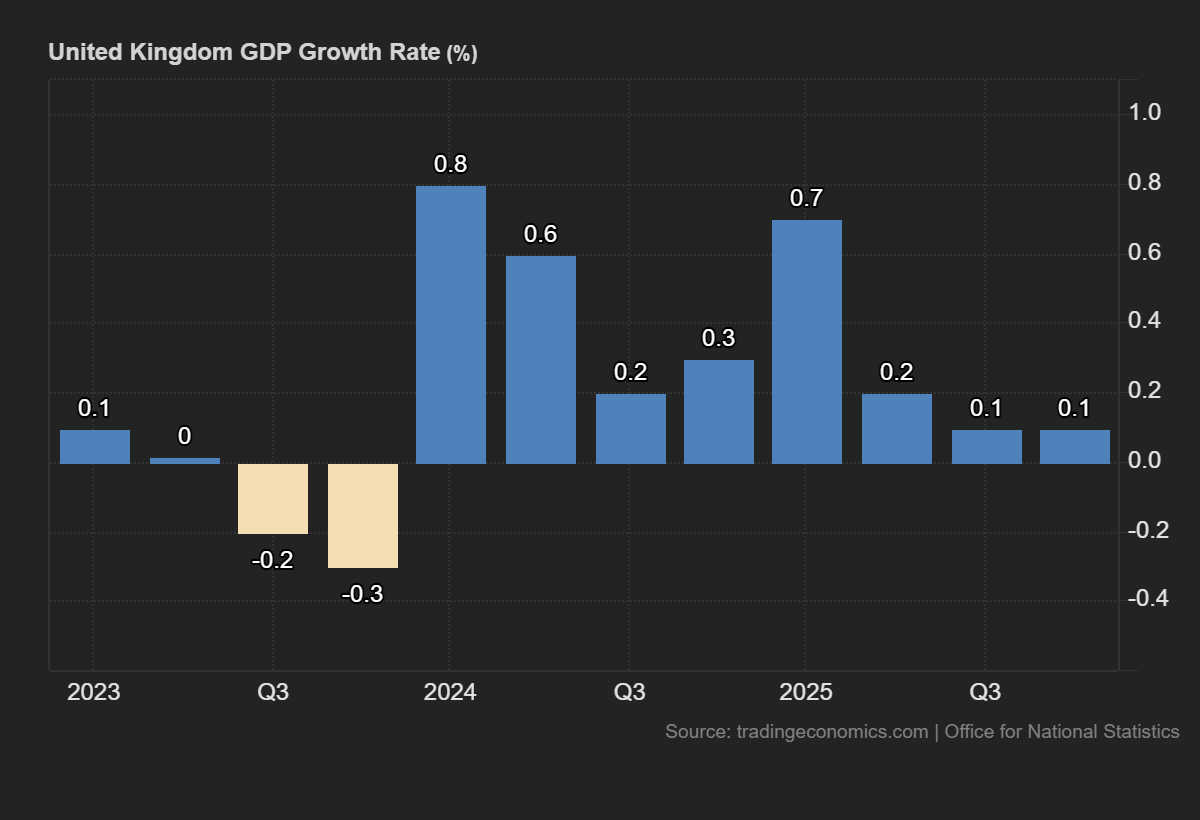
The dominant sector, services, was stagnant, with last quarter’s growth coming from production instead. Meanwhile, construction declined by around 2.1%. Annual growth last year was 1.3% in total, an improvement on 2024’s 1.1% but lower than earlier estimates of around 1.5%.
Despite the government generally prioritising economic growth and a total of six cuts from the Bank of England (‘the BoE’) so far this cycle, businesses’ and consumers’ sentiment remains fairly weak. The UK was the fastest-growing European member of the G7 last year, but it’s questionable how long the current bank rate of 3.75% can be maintained, given that British unemployment and inflation both remain significantly higher than in some other major economies, such as the USA and Japan.
The BoE is widely expected to call for a single cut to 3.5% on 19 March, given that it was a very close vote of the Monetary Policy Committee last time, with the decision to hold winning by a single vote. Another four cuts this year seems extremely unlikely, but the possibility of three now seems a lot less remote. With the pound close to long-term highs in various pairs except against the euro, confirmation of looser monetary policy in 2026 might have a significant and ongoing negative effect on sterling; however, the British job report on Tuesday, 17 February, is a key release in the immediate future.

Euro-pound Mostly Unmoved by Weaker British GDP
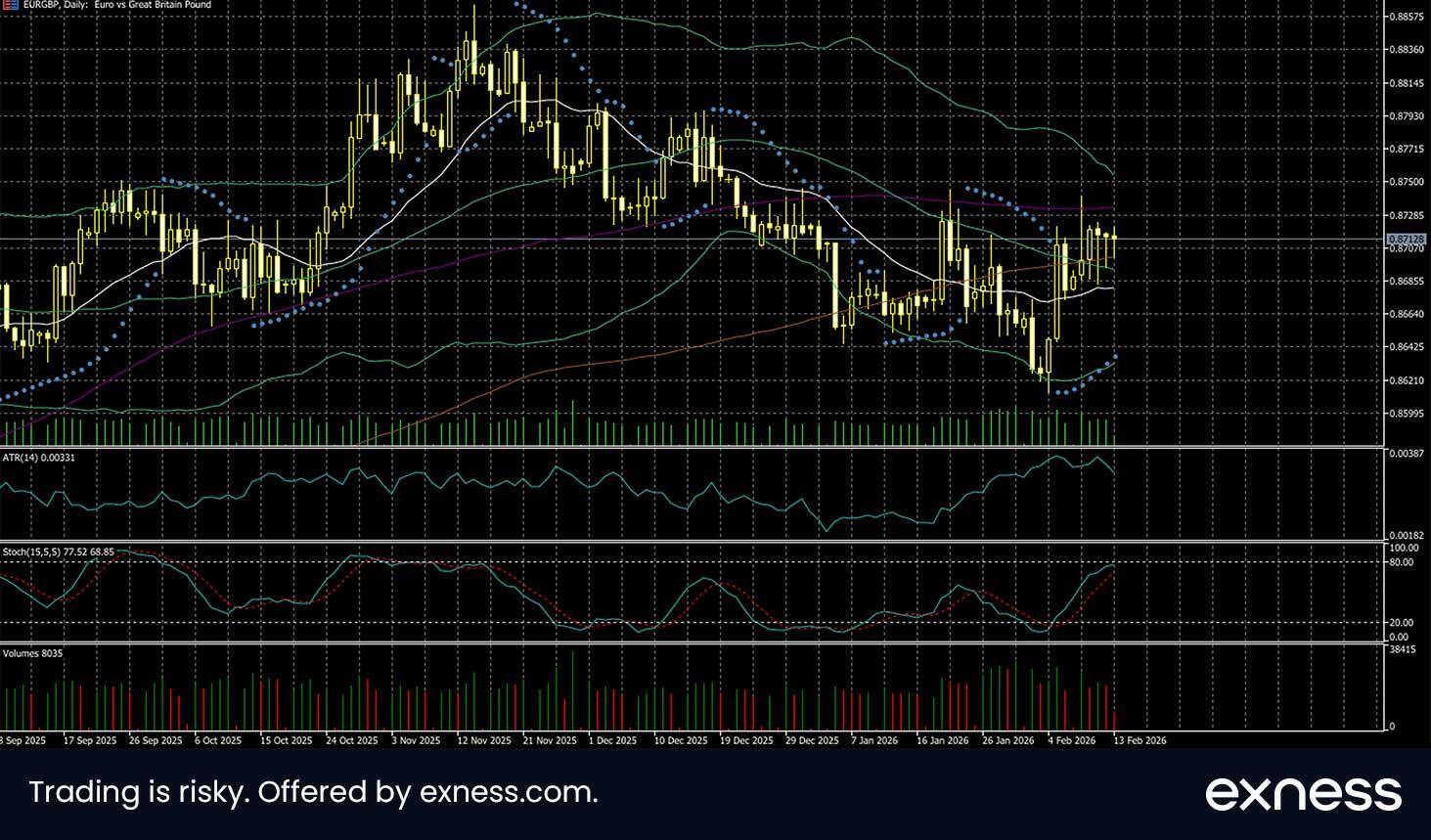
Most of the major news driving the euro-pound recently has affected the pound in general, with there being generally little significant intrigue in politics or monetary policy in the eurozone. The ECB recently dismissed concerns about the euro’s appreciation while also noting that inflation is in a good place, so participants continue to assume that changes to European base rates are unlikely in the near future.
Although the euro has indeed moved up recently against the pound as elsewhere, there’s no clear evidence yet that the medium-term downtrend is over. The death cross of the 50 SMA from Bands below the 200 can probably be discounted in the circumstances, given how much this signal lags. Meanwhile, the 100 SMA around 87.3p looks like a potentially strong dynamic resistance, having been tested unsuccessfully twice in 2026 so far. It’s unclear for now what the catalyst might be to push the price higher.
The obvious target in the relatively short term for sellers would be early February’s lows around 86.2p, but it might be difficult for the price to push below the cluster of three moving averages. There’s no clear signal from the slow stochastic or ATR, but the former is very close to the overbought zone. Traders are looking ahead eagerly to 17 February’s job report from Britain.
Pound-yen Retraces After Clear Results from the Election
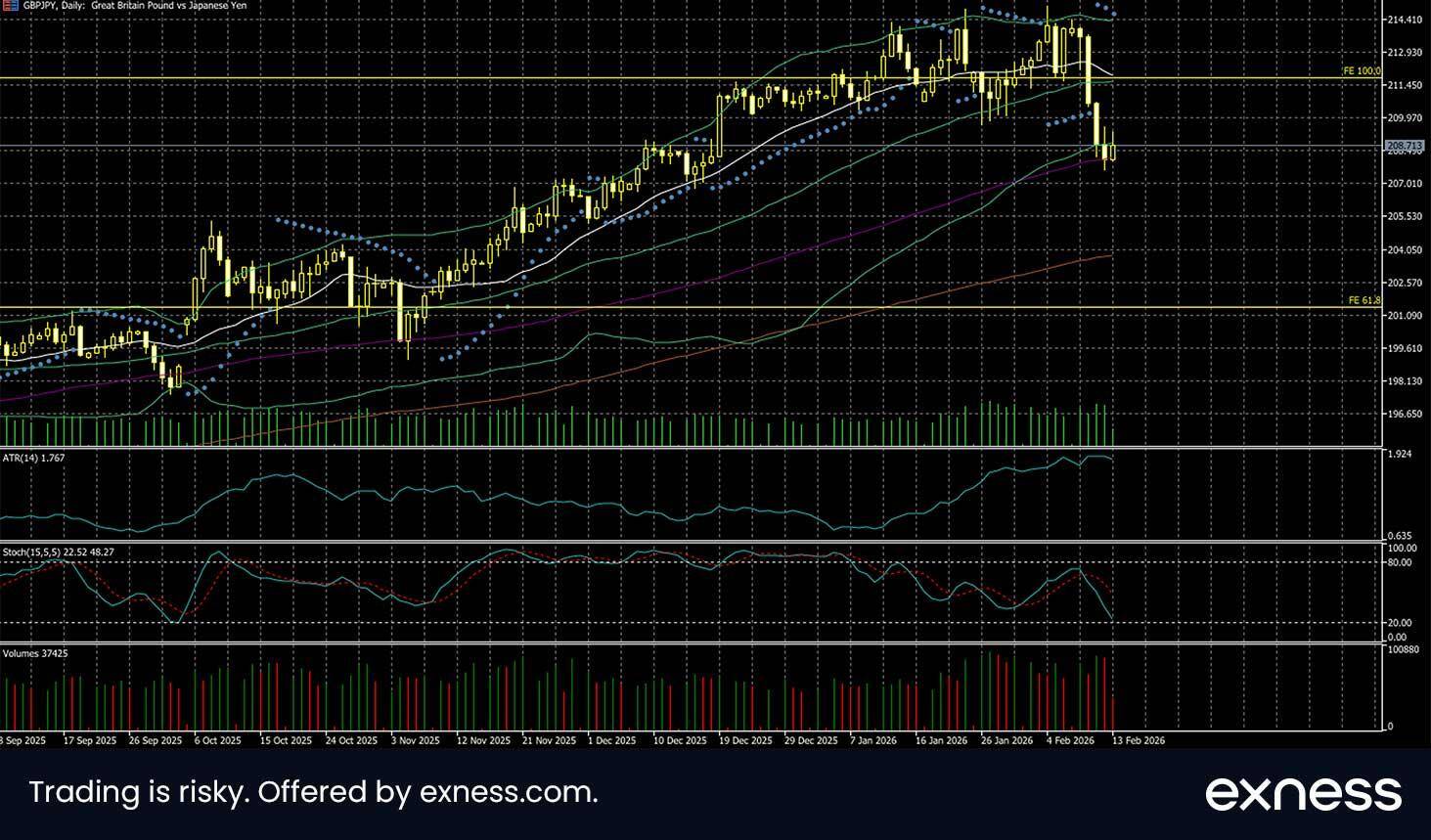
The yen gained across the board from 9 February as traders woke up to news of a landslide victory by Japan’s coalition government, with the main partner, the Liberal Democratic Party, showing its best ever results since its foundation in the 1950s. The government’s very large majority in Japan’s lower house removes the possibility of political instability there for the time being, while many participants are increasingly convinced that the government’s fiscal plans will aid growth without pressuring public finances excessively.
Against this backdrop, some continuation downward sooner or later would normally be likely, with the confluence of the 38.2% weekly Fibonacci retracement and the 200 SMA being an obvious though quite aggressive target. However, the price is currently testing the 100 SMA and 23.6% weekly Fibo, so it’d be possible to see consolidation around here for some time or possibly a bounce.
Lukewarm GDP from Britain on 12 February means that traders are concentrating more intently on the upcoming job report on 17 February. A higher claimant count change for January or higher unemployment for December might hit the pound here and elsewhere to drive the price lower.
This article was submitted by Michael Stark, an analyst at Exness.
For the latest analysis, ideas for trading and more, follow Michael on X: @MStarkExness.
The opinions in this article are personal to the writer; they do not represent those of Exness. This is not a recommendation to trade.