
Storage and El Niño Handed Bears Everything
August NYMEX natural gas futures settled at $3.01, down $0.20 or -6.23% on Thursday, the biggest single-session drop in weeks and the lowest close in about six weeks. The EIA storage report gave sellers the opening and the Super El Niño forecast made sure nobody stepped in to buy the dip.

Daily August Natural Gas Futures Technical Analysis
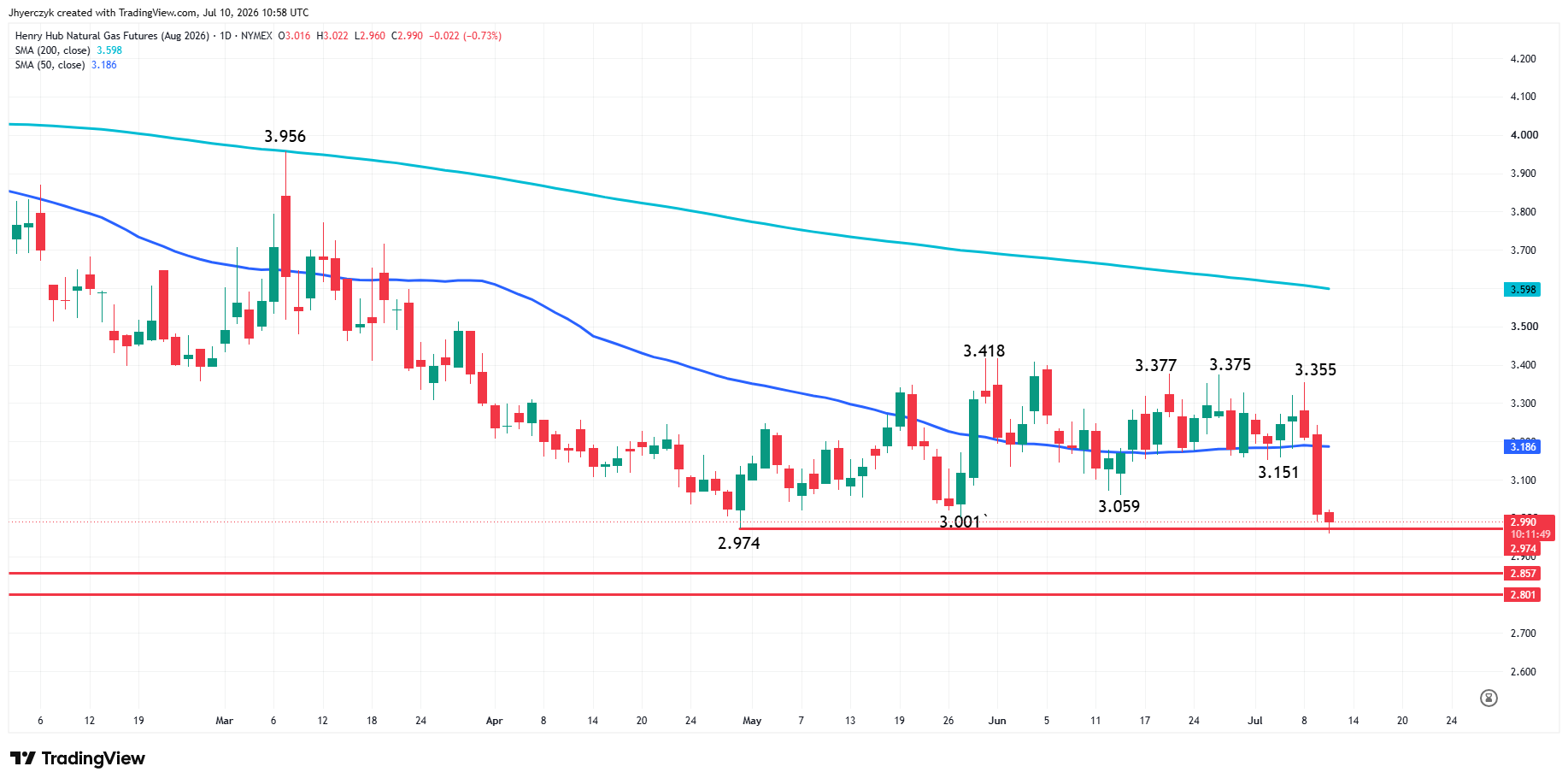
August natural gas futures are slightly lower early Friday after plunging more than 6% the previous session. It was a bloodbath on Thursday after the bearish EIA storage report, but the sell-off was smooth. Bearish traders first sliced through the 50-day moving average support before systematically taking out three swing bottoms at $3.151, $3.059 and $3.001. Needless to say, the downtrend was reaffirmed according to the swing chart. Moving average traders likely reached the same conclusion with the 50-day moving average at $3.186 becoming new resistance.
After Thursday’s steep plunge and with another three weeks to go before the rollover into the September futures contract, small speculators are likely scratching their heads. With risk for short-sellers defined as $3.186 and $3.355 and higher, it’s difficult for speculators to initiate new short-positions at current price levels.
It’s only July 10 so there is still time for a bullish weather market. Be patient, but at current price levels, the risk may be low for a counter-trend buy. We just have to wait for the proper set up. The move could be fast and furious because summer rallies do that.
Daily February Natural Gas Futures Technical Analysis
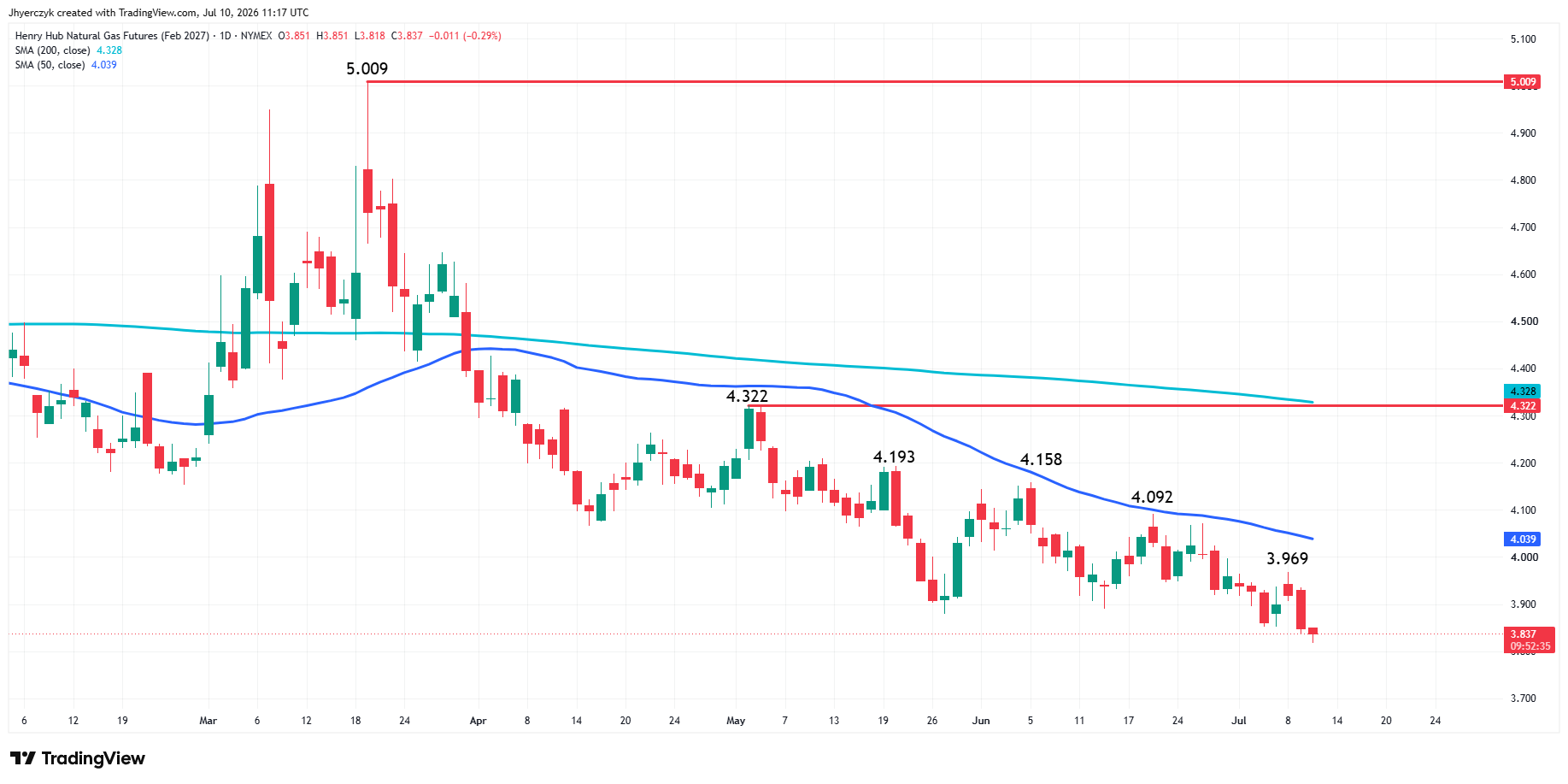
February Natural Gas futures also plunged on Thursday, but the move wasn’t as severe as the nearby August contract. The trend is down on the swing chart. The first sign of strength will be a move through the nearest swing top at $3.969. But to be safe, crossing to the strong side of the 50-day moving average at $4.039 will be needed to tighten up the trend.
Natural Gas Price Forecast
Every new Natural Gas analysis as it publishes, today's technical signal and key levels, live price — on one page.
See all Natural Gas forecastsThis is the winter contract. Ample supply in July has been exerting pressure on it. However, now we have the Super El Nino story creating a “sell the rally” narrative. We’ll likely see that type of trading until we get the true winter forecasts later in the year. Additionally, a hot spell in July, August or September that increases demand and depletes storage will also have a positive impact on prices.
One thing to note is that short-sellers could begin building a big bearish position ahead of winter, which means they will be vulnerable to a major cold spell just like we saw in January/February 2026. That’s a long way off. However, it should serve as a reminder to keep your eyes on the Commitment of Traders reports because this futures contract can get oversold pretty fast.
Injections Keep Outrunning the Five-Year Average
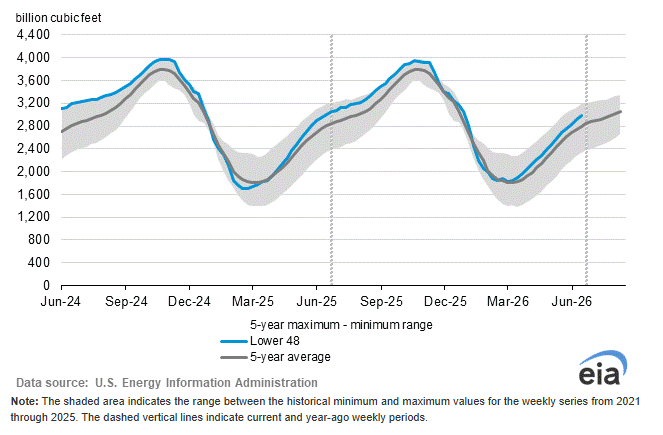
The 61 Bcf build matched expectations but it beat the five-year average injection of 51 Bcf and that is the number doing the damage.
Total working gas inventories sit at 2,983 Bcf, only 15 Bcf below last year but 185 Bcf or 6.6% above the five-year average. The build came despite persistent summer heat across most of the country.
Stronger wind generation during the reporting week picked up enough of the electricity load to let more gas flow into storage instead of getting burned at the plant.
That is not the pattern bulls want to see in the middle of July.
El Niño Is Already Pricing Out Winter Demand
Thursday’s storage number was the trigger. The El Niño story is the one that follows traders home. NOAA’s experimental forecasts and several leading climate models now point to one of the strongest El Niño events since reliable records began. Ocean temperatures across the equatorial Pacific keep warming and forecasters assign a high probability that the event peaks during winter.
Natural Gas Intelligence meteorologists expect the pattern to keep the coldest Arctic air locked over northern Canada while the Pacific jet stream strengthens underneath. That gives the northern United States a warmer-than-normal winter with fewer of the major cold shots that drain storage and spike prices. The models are getting more confident, not less. Short sellers are not waiting for winter to confirm it. They are building positions around that scenario and the December contract is already showing it.
113.5 Bcf/Day Output Is Not Helping Bulls
Lower 48 dry gas production hit 113.5 Bcf per day on Thursday according to BloombergNEF, up 6.8% from a year ago. Domestic demand averaged 78.1 Bcf per day. LNG feed gas deliveries slipped to 19.0 Bcf per day. The EIA recently raised its 2026 production forecast to 111.2 Bcf per day and output is already running above that number. Baker Hughes reported the rig count added one to 126 active rigs. Drilling has come off the 134-rig peak from earlier this year but not fast enough to matter.
Summer Heat Is the Only Floor Left
The southern two-thirds of the country is running 90s and triple digits through mid-July and that keeps power-sector gas burn alive. Edison Electric Institute reported electricity generation for the week ending July 4 jumped 7.7% year-over-year. The 52-week trend is up 2.3%.
Ras Laffan is the other floor. Qatar’s LNG export complex took extensive damage from military strikes earlier this year and repairs could stretch for years. That facility handles roughly one-fifth of global LNG export capacity. Reduced Qatari supply eventually pulls more demand toward U.S. LNG cargoes. That story is further out but it is real.
What to Watch
Storage is rebuilding above the five-year pace with production setting records and the Super El Niño forecast is getting stronger, not weaker. Summer heat is propping up power demand but that is a seasonal floor with an expiration date. The counter-trade is a hot spell that depletes storage faster than expected, but it has to show up in the weekly injection numbers before anyone trusts it.
The 50-day moving average on August futures is now resistance. Staying below it keeps sellers in control. The February contract is telling the same story with the El Niño narrative adding a ceiling over every winter bounce until the real winter forecasts arrive later this year.
More Information in our Economic Calendar.