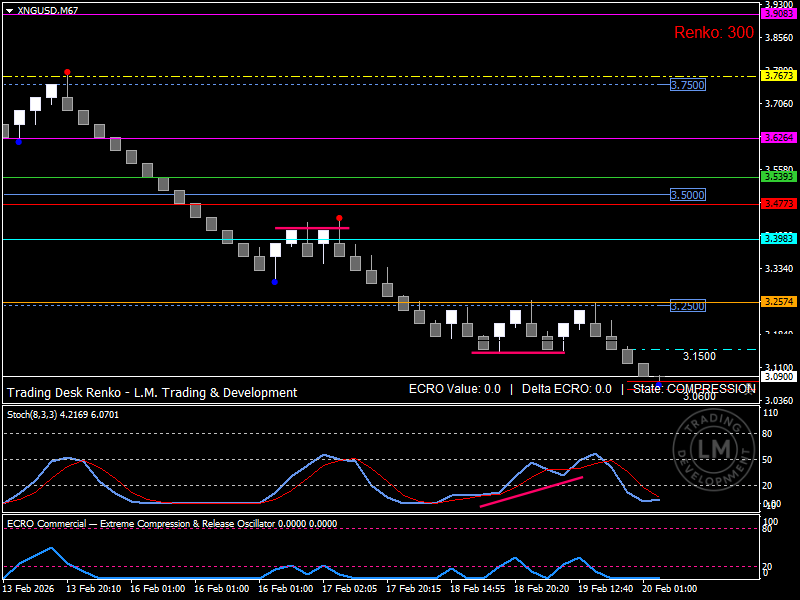
In my view, the current compression phase suggests the market is approaching an inflection point, with the 3.10 area acting as a key short-term support. Below, I outline the latest market drivers, positioning dynamics, and the technical levels that matter most.

News
Recent trading in Henry Hub natural gas has reflected a market caught between steady production and uneven demand signals. Prices have drifted lower over the past sessions, with the market repeatedly testing the lower end of its recent range.
The latest data from the US Energy Information Administration continues to highlight robust output levels, reinforcing the perception that supply remains adequate even as late winter weather periodically lifts consumption.
Consequently, natural gas has struggled to build sustained upside momentum, with rallies quickly meeting selling pressure.
Context
Stepping back, the broader structure of the natural gas market still reflects a well supplied environment. While seasonal volatility has not disappeared, the extreme tightness seen in previous years has largely disappeared.
Natural Gas Price Forecast
Every new Natural Gas analysis as it publishes, today's technical signal and key levels, live price — on one page.
See all Natural Gas forecastsUS production remains close to record levels, and storage dynamics have not yet signaled a structural deficit. This backdrop helps explain why price advances have repeatedly faded near resistance zones.
At the same time, the market is no longer in free fall. Price action is increasingly showing signs of stabilization near the 3.10 area, suggesting that bearish momentum may be losing strength.
From a cycle perspective, the market appears to be transitioning from directional decline toward a potential basing phase. The key question now is whether demand catalysts will be strong enough to trigger a sustained recovery.
From a broader cyclical perspective, natural gas continues to trade within a structurally heavy regime despite episodic weather-driven spikes. Over the past several quarters, the market has repeatedly struggled to sustain upside momentum as strong U.S. production and comfortable storage levels have acted as a persistent counterweight to short-term demand shocks. This pattern suggests that rallies are still being sold into strength rather than accumulated for a sustained trend reversal.
At the same time, the recent compression phase visible on the Renko structure indicates that downside momentum may be entering a mature stage. When price compression coincides with historically elevated supply expectations, the market often transitions into a period of range-bound volatility before establishing the next directional leg. This keeps the near term outlook balanced, but with a clear need for a catalyst to shift the broader narrative.
Financial Analysis
Production Strength Continues to Anchor the Market
Fundamentally, the dominant theme remains the resilience of US natural gas supply. Recent EIA updates confirm that output levels are still elevated, limiting the urgency of buying pressure.
This steady production profile has created a push and pull dynamic. Weather driven demand spikes provide temporary support, but the underlying supply cushion continues to cap rallies.
In my view, natural gas will likely struggle to sustain sharp upside moves without a clear demand shock as long as production remains near current levels.
Technical Structure Shows Compression Near Support
From a technical standpoint, the Renko structure highlights a market in compression. Price action is clustering near the 3.10 zone, which has repeatedly acted as short term support.
Momentum indicators also reflect this loss of downside acceleration. Oscillators are stabilizing from previously weak readings, suggesting that selling pressure is no longer intensifying.
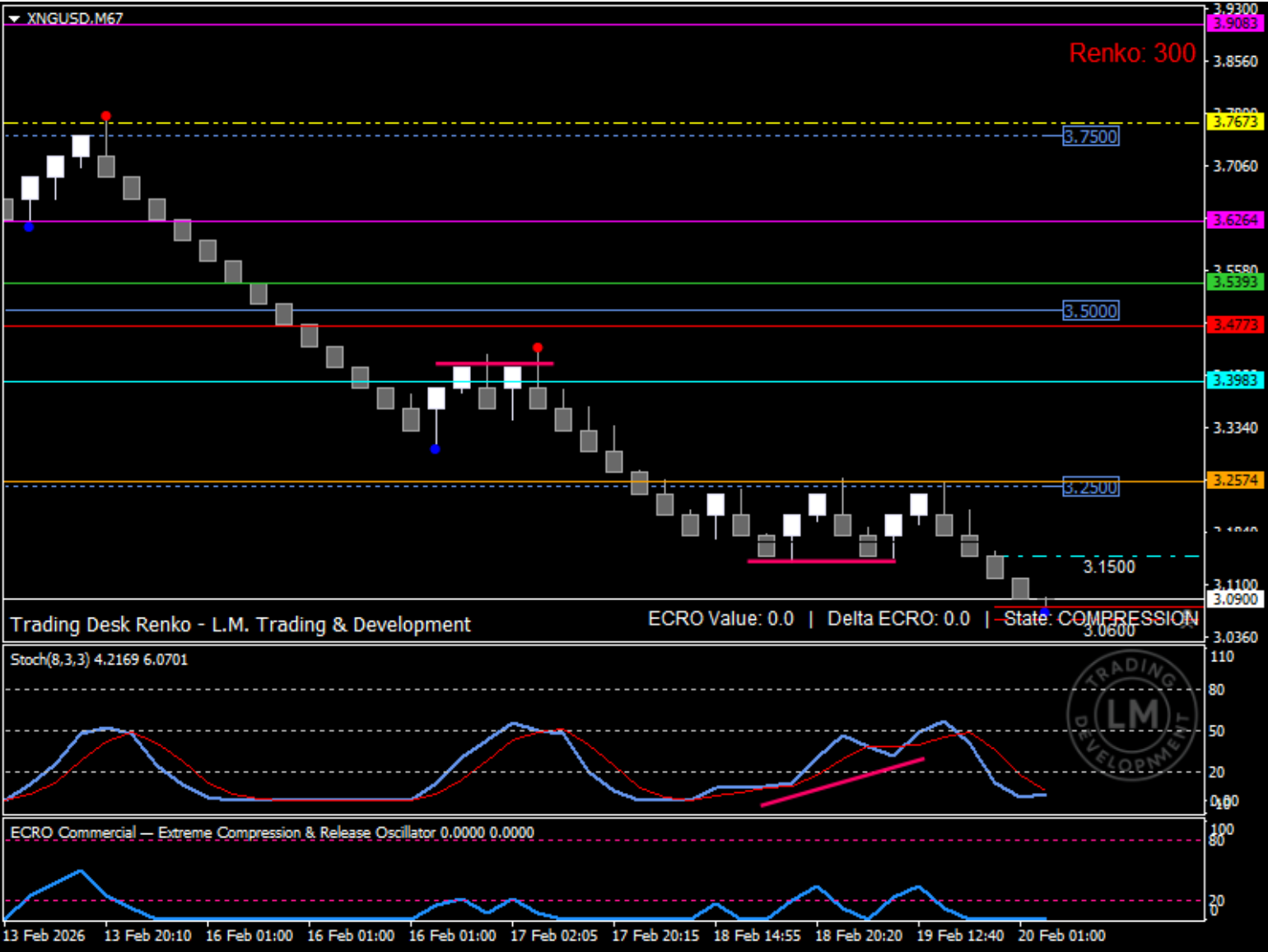
Key levels to monitor include:
• Immediate support near 3.10
• Secondary support around 3.00
• Initial resistance near 3.25
• Major resistance in the 3.50 area
A decisive move above 3.25 would be the first signal that buyers are regaining control.
From a positioning standpoint, the current structure does not yet reflect the kind of capitulation typically associated with durable bottoms. Futures positioning and broader risk sentiment remain cautious rather than outright bearish, which suggests the market may still require further consolidation before attracting stronger directional conviction. Historically, natural gas tends to form more reliable medium-term lows only after volatility increases alongside a clear shift in storage expectations or demand driven by weather.
In this context, the technical support zone currently under pressure should be monitored closely. Stabilisation above this area could encourage short-covering flows and trigger a corrective rebound. Conversely, a decisive break below this level would likely confirm that the market is still repricing the supply overhang.
Position and Risk
In my view, the natural gas market is entering a transitional phase rather than continuing in a clean bearish trend. The base case is for continued range behavior in the short term, with prices oscillating between 3.00 and 3.25 as the market digests the current supply backdrop.
If support near 3.10 holds, a gradual recovery toward 3.25 and potentially 3.50 becomes increasingly plausible over the coming weeks.
However, risks remain clearly skewed to the downside if production stays elevated and weather demand underperforms expectations. A sustained break below 3.00 would signal that bearish pressure is re-accelerating and could expose the market to a deeper retracement.
Volatility in natural gas remains structurally high, so positioning should account for sharp short term swings.
Conclusion
Natural gas prices remain under pressure, but the recent price behavior suggests the market may be moving from directional weakness into a compression and potential basing phase.
The 3.10 level is emerging as a critical short term pivot. Holding above this zone keeps the door open for a recovery toward 3.25 and possibly 3.50 in the weeks ahead. A break below 3.00, however, would invalidate the stabilization thesis and point to renewed downside risk.
Looking further ahead, the broader trajectory of natural gas will depend heavily on whether strong US supply continues to outweigh incremental demand improvements.