Key Insights
- Natural gas prices moved lower on Friday.
- The weather is expected to be colder than usual.
- The rotary rig count by two in the latest week.
On Friday, natural gas prices moved lower, dropping 3.7% and falling 8.5% for the week. LNG demand remains strong, and natural gas arrivals at LNG terminals continue to climb. The weather is expected to be colder than normal on the East Coast and mid-West for the next 2-weeks.
According to the EIA, the total U.S. consumption of natural gas rose by 3.0% compared with the previous report week. According to NOAA, the residential and commercial sectors had the largest gain from the last week’s report, increasing by 7.6% as lower-than-normal temperatures affected most of the continental United States. Natural gas consumed for power generation climbed by 1.4% week over week, and industrial sector consumption increased by 0.8%.

Technical Analysis
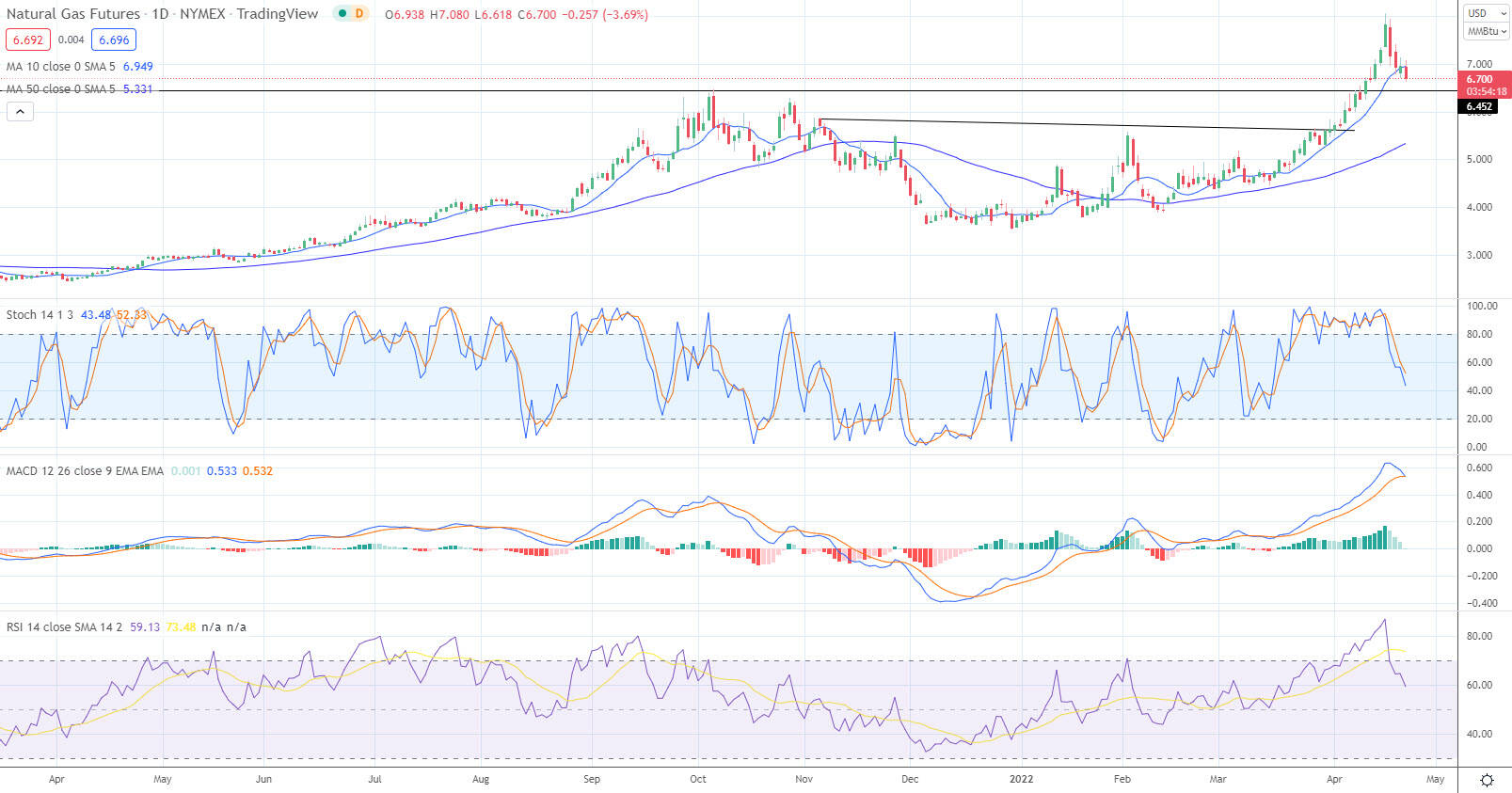
Natural gas prices fell on Friday. Prices fell through short-term support, which is now resistance seen near the 10-day moving average at 6.95. Additional support is at the top of the most recent range at the February highs at 5.57. Target resistance is seen near the April highs at 8.06.
Short-term momentum has reversed and turned negative as the fast stochastic generated a crossover sell signal.
Medium-term momentum has negative. The MACD (moving average convergence divergence) generated a crossover sell signal. This scenario occurs when the MACD line (the 12-day moving average minus the 26-day moving average crosses below the MACD signal line (the 9-day moving average of the MACD line.
The MACD histogram is printing in negative territory with a declining trajectory which points to lower prices.