WTI Crude Surges Past $102 as War Risk Drives the Rally
Nearby WTI crude oil futures began the week with strong upward momentum after last week’s sharp rally. Last week, the nearby contract settled at $99.64, up $5.16 or +5.46%. Early Sunday, the market is posting another strong jump, with prices reaching $102.83, up another $3.50. The follow-through rally signals that traders are reacting to ongoing geopolitical risks rather than short-term supply data. I didn’t see single event that suggested a new sense of urgency in the supply situation, but rather a military buildup by the U.S. and the threat of retaliation by Iran.
Technical Outlook
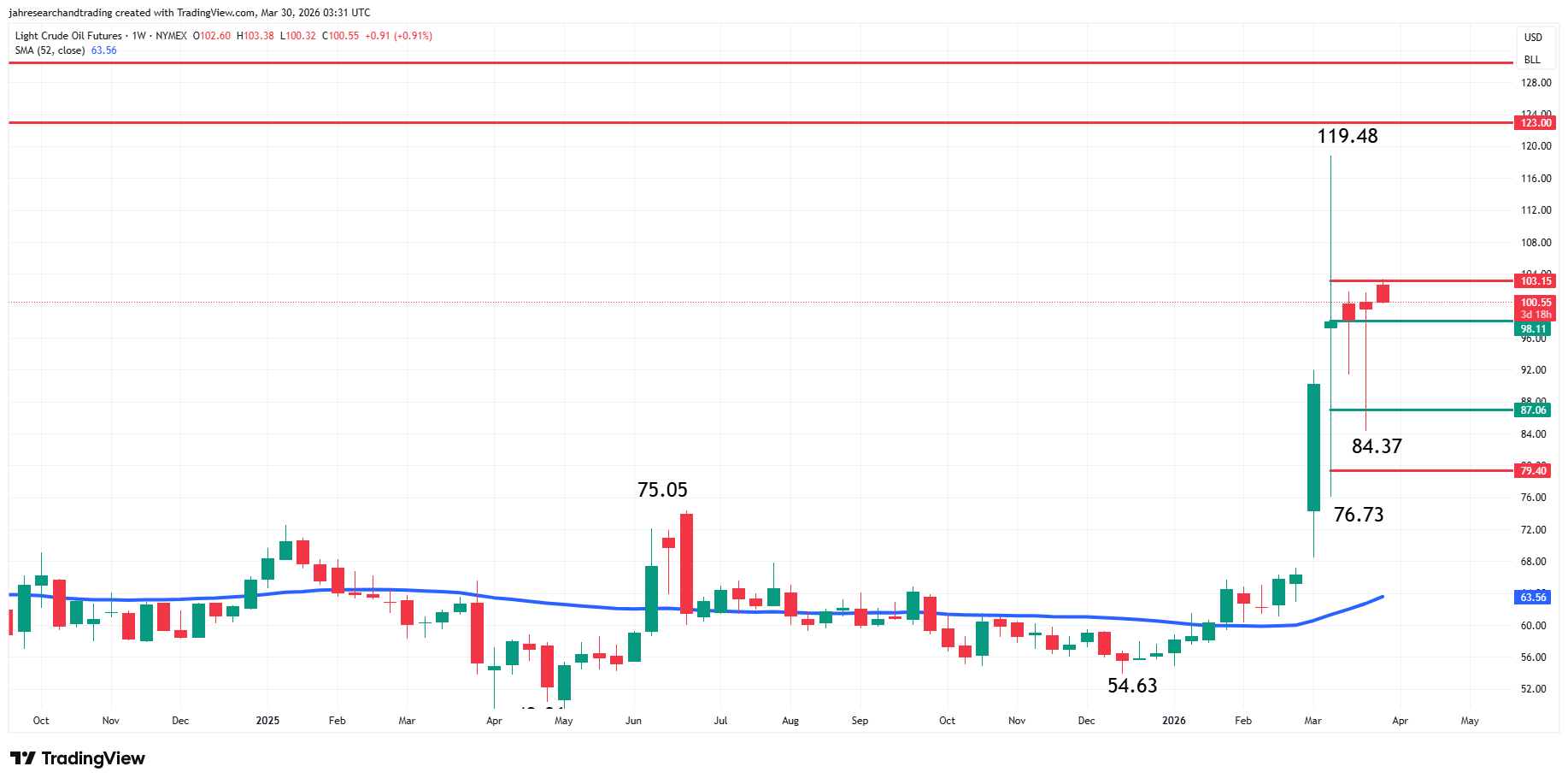
Technically, the main trend is up according to the weekly swing chart and the moving averages. This week’s early rise through $102.44 changed the low at $84.37 into a new swing bottom. The early rally also reaffirmed the uptrend, while a break of $84.37 shifts momentum to the downside.
Our weekly chart indicates there is no true resistance until $119.48, once $103.15 is taken out with conviction. Since this is an event driven breakout attempt, traders may be anticipating something major on the horizon to accelerate prices to the upside.
In addition to the swing bottom support at $84.37, traders had been showing a lot of respect to the 50% level at $98.11. For three weeks, this price has acted as short-term support. Now that the market has broken convincingly above this level, we’re looking for buyers to defend it and create a stronger support level.
Looking at the bigger picture, the intermediate and long-term trends are being controlled by the 52-week moving average at $63.56.
Brent Oil Price Forecast
Every new Brent Oil analysis as it publishes, today's technical signal and key levels, live price — on one page.
See all Brent Oil forecastsThe Strait of Hormuz Is Still Closed and the Market Is Pricing In the Worst
The main driver of this rally is the war. I think a lot of oil traders believe like me that securing the Strait should have been top priority on day one. Now we sit, nearly 30 days later, and it’s still closed to most commercial traffic. The Strait handles roughly 20% of global crude oil, refined products, and LNG flows. That’s not a small number and the market knows it.
What Traders Should Be Watching This Week
Watch the military headlines. More U.S. buildup, fresh strikes, or Iranian retaliation and prices go higher fast. Any hint of de-escalation or the Strait reopening and sellers will show up. It’s that simple right now. The price action is going to follow the war, not the supply data.
The Bias Stays Higher Until Something Changes
Iran is threatening to expand the war and hit neighboring oil producers. If that happens we stop talking about short-term supply disruptions and start talking about long-term production damage. That’s a much bigger problem. Until something changes, every dip is a buying opportunity and the bias stays higher.
More Information in our Economic Calendar.