



Oil Slips as Traders Weigh Iran Peace Deal
WTI crude oil futures are edging lower early Wednesday as traders digest the latest news regarding a possible peace deal between the United States and Iran. The story initially broke on Monday, fueling a break from $101.67 to $84.37. The past two sessions, the market has remained inside this range, suggesting investor indecision and impending volatility.

Technical Outlook
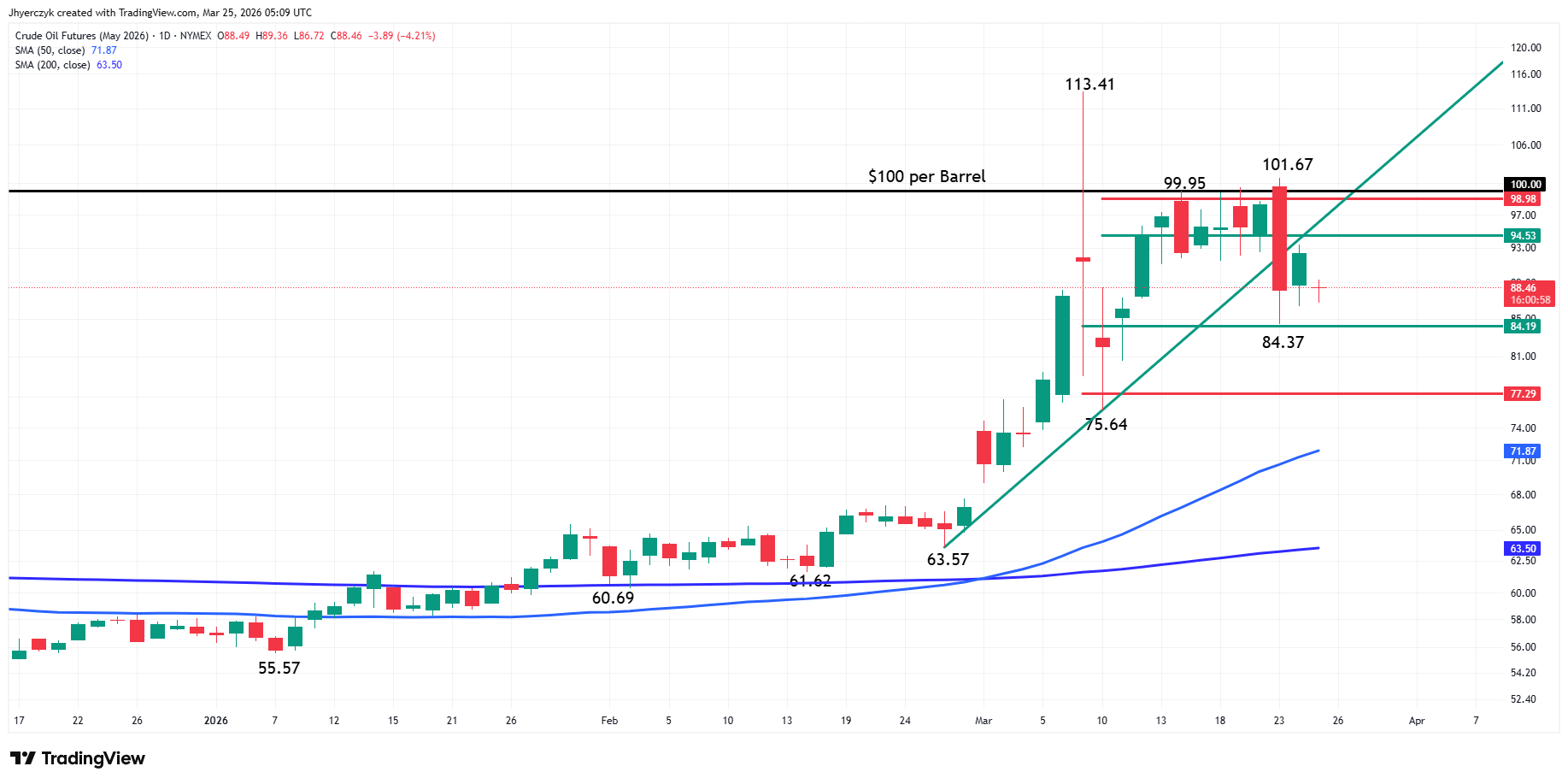
May WTI futures continue to find short-term resistance at the $94.53 to $98.98 retracement zone and the psychological $100 per barrel level. Although the main trend is up, momentum shifted to the downside on Monday when sellers took out a key trend line. Nonetheless, the market remains well supported by the intermediate retracement zone at $84.19 to $77.29.
The first major downside target is the 50-day moving average at $71.87, which is trading on the strong side of the 200-day moving average at $63.51. The short-term moving average crossed to the bullish side of the long-term moving average on March 2, perhaps launching the start of the rally to $113.41. The spread between the 50-day MA and the 200-day MA is currently at +8.36.
Although we could see some short-term weakness and volatility, it’s going to be a while before the 50-day MA crosses to the bearish side of the 200-day MA. This means the market will remain in “buy the dip” mode for weeks. The potentially bearish news making headlines now could bring prices down to value areas, but I don’t see it changing the long-term trend to down. This is because the region is likely to remain a hotbed for months. The Strait of Hormuz could reopen to normal oil tanker traffic, but it’s going to take years for the damaged infrastructure to be repaired. This should be enough to underpin the market for months.
Peace Talk Optimism Is Doing the Damage
Fundamentally, prices are easing early Wednesday because of a possible ceasefire between the U.S. and Israel. While this could lead to the easing of supply disruptions, traders are still waiting for confirmation that a deal is in place. Currently, traders are relying on news reports that say the U.S. has sent Iran a 15-point plan to end the war between them.
Brent Oil Price Forecast
Every new Brent Oil analysis as it publishes, today's technical signal and key levels, live price — on one page.
See all Brent Oil forecastsWhat I’m seeing is profit-taking and not any real outright shorting. New short sellers are likely to arrive if the outlook becomes clear. Currently, I think there is still too much uncertainty as to whether negotiations will be successful.
A 15-Point Plan With a Lot to Prove
According to reports, among the conditions being discussed is a month-long ceasefire to discuss the plan. The plan itself is expected to include the dismantling of Iran’s nuclear program, the ceasing of support for military groups like Hamas and Hezbollah and the reopening of the Strait of Hormuz.
That’s a lot on the table, which is why I’m a little skeptical. I can see weakness developing on long-liquidation and profit-taking but prices are likely to remain volatile and trading is expected to take place in a wide range with the possibility of sudden flips in either direction. I think the best approach will be to watch the reactions to the key retracement zones. A gift to long-term bullish traders will be a pullback to the moving averages. I expect new buyers to step in if the market ever returns to that area.
More Information in our Economic Calendar.


