
Iraq Deal Sends Oil Lower but Don’t Call It a Top Yet
Brent and West Texas Intermediate (WTI) crude oil futures are edging lower shortly before the NYMEX opening on Wednesday. The early weakness has the markets about $2 per barrel lower after a 3% gain the previous session.
Traders are saying the decline is supply related, driven by news that Iraq and Kurdish authorities reached an agreement to restart oil exports through Turkey’s Ceyhan port. In my opinion, sellers are hitting the market because this surprise development eased some immediate concerns about supply shortages as additional crude is expected to return to global markets.
At 07:27 GMT, Brent crude is down about 2.2% to just above $101.00, while May WTI is off over 3% to around $93.00. It’s a little too early to say that this represents a turning point in the market but it’s good news for traders betting on a top. It shows that other countries are willing to take chances at alleviating the current tightness in supply.

Fear Trade or Real Shortage?
Nonetheless, despite today’s pullback, prices remain elevated with Brent holding above $100.00 for several consecutive sessions. The price action this week suggests these high prices may be driven more by fear than actual shortages. The markets are lower this week despite Iran’s disruption to oil flows at the Strait of Hormuz. That said, Iraq’s southern oil production has reportedly dropped sharply due to regional instability, so this added supply has only slightly offset the bigger concerns.
The Strait of Hormuz Is Still Calling the Shots
While the early focus is on the additional supply, let’s not lose sight of the fact that the major factor supporting high oil prices is the continued disruption around the Strait of Hormuz. Iraq’s oil output in the South, near the Strait has dropped about 70%, according to Reuters, so it makes sense to try to get oil out of the country up north.
The war developments overnight didn’t do anything to suggest the end is near either. In fact, tensions may have escalated further after Iran confirmed the death of a top security official in an Israeli attack. Additionally, Iran once again rejected calls for de-escalation. Iran appears to be digging in for the long-haul, even as military activity from the U.S. included the targeting of Iranian positions near the Strait of Hormuz to protect shipping routes.
API Numbers Add to the Selling Pressure
Sticking with the supply side, the American Petroleum Institute (API), announced late Tuesday, a sharp increase of over 6 million barrels in stockpiles, well above expectations. The cause is either weaker demand or rising supply, but does it really matter now. Nonetheless, it did contribute a little to today’s weakness.
Brent Oil Price Forecast
Every new Brent Oil analysis as it publishes, today's technical signal and key levels, live price — on one page.
See all Brent Oil forecastsTraders Remain in Buy the Dip Mode
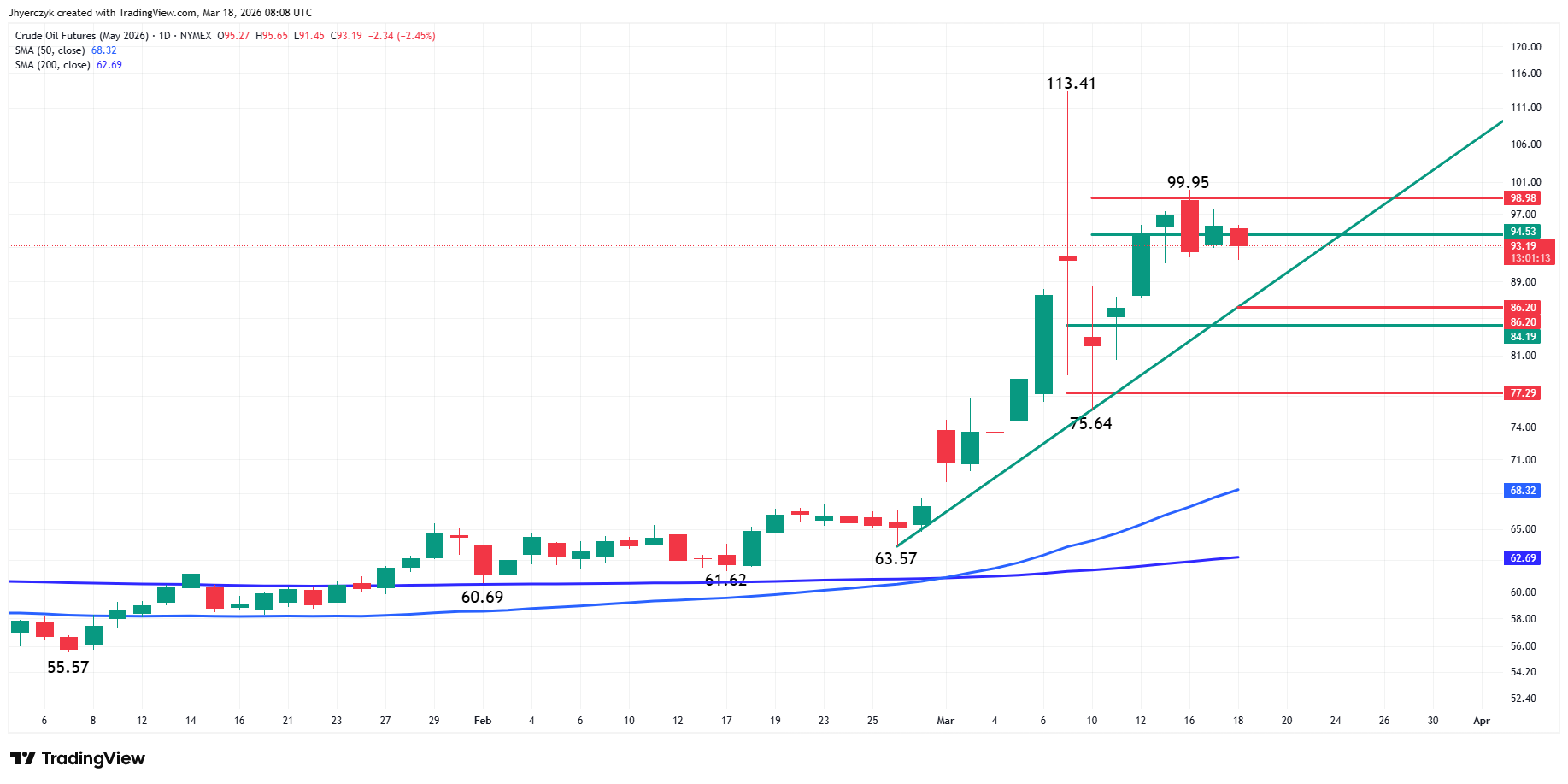
Technically, May WTI crude oil futures are still in an uptrend according to the swing chart and trend line. I expect prices to remain elevated and traders to remain in “buy the dip” mode as long as there are ongoing geopolitical risks.
Prices have straddled a key pivot at $94.53 the past five sessions so it’s safe to say that this indicator is controlling the near-term direction of the market. A sustained move over $94.53 could lead to a test of the 61.8% level at $98.98, which is likely the true trigger point for an acceleration to the upside. But to be safe, let’s call it Monday’s high at $99.95.
If sellers begin to pound the short-side through $94.53, then watch for a potential plunge into the trend line at $86.20. If the fundamentals haven’t changed then buyers may step in on a pullback into this trend indicator.
More Information in our Economic Calendar.