


Crude Oil Rises as U.S.-Iran Talks Stall, India Demand Lifts Outlook
West Texas Intermediate (WTI) crude oil futures are edging higher on Wednesday, underpinned by heightened risks in the Middle East as U.S.-Iran talks have failed to yield anything concrete after three days of intense negotiations. Meanwhile, traders are also reacting positively to signs of an easing surplus, fueled by increased demand from India, tied to its recent trade deal with the United States.
At 09:24 GMT, March WTI crude oil is trading $64.84, up $0.88 or +1.38%.
Strait of Hormuz Risk Premium Remains Intact
“Oil retains a bullish tail-risk bid as U.S.-Iran talks continue but remain fragile, keeping the Strait of Hormuz risk premium supported amid ongoing sanctions pressure, tariff threats tied to Iranian trade, and heightened U.S. regional military posture,” LSEG analysts wrote in a report.
The price action suggests traders are waiting for the framework of a deal between the U.S. and Iran, but so far it seems the two countries are still in the talking stage, and this is making traders nervous. Reuters reported that Iran’s foreign ministry spokesperson said on Tuesday that nuclear talks with the U.S. allowed Tehran to gauge Washington’s seriousness and showed enough consensus to continue on the diplomatic track.
I’m a little surprised by the statement because I would’ve thought that sending a naval armada off the coast of Iran would’ve been enough of a statement of the seriousness of the situation.
Mixed Signals Keep Uncertainty High
Signals from the region continued to be mixed, which doesn’t ease the uncertainty of the situation. While Oman’s foreign minister said discussions were productive, ANZ analysts said in a note that there were reports that the U.S. may send a second aircraft carrier to the Middle East, according to Reuters.
India Demand Offsets Rising U.S. Crude Inventories
In other news, the supply/demand picture looked a little mixed late Tuesday. The demand outlook was positive, with news that oil on water was returning to normal with purchases from India providing a lift. However, the supply situation remained cautious, with the American Petroleum API reporting a 13.4 million barrel hike in U.S. crude inventories. Later today at 15:30 GMT, the U.S. Energy Information Administration (EIA) is expected to report an 800,000 barrel increase in the week to February 6. However, this may be offset by a 1.3 million barrel draw in distillates and a 400,000 barrel draw in gasoline.
Brent Oil Price Forecast
Every new Brent Oil analysis as it publishes, today's technical signal and key levels, live price — on one page.
See all Brent Oil forecastsUptrend Intact: Watch $64.29 Trend Line Support
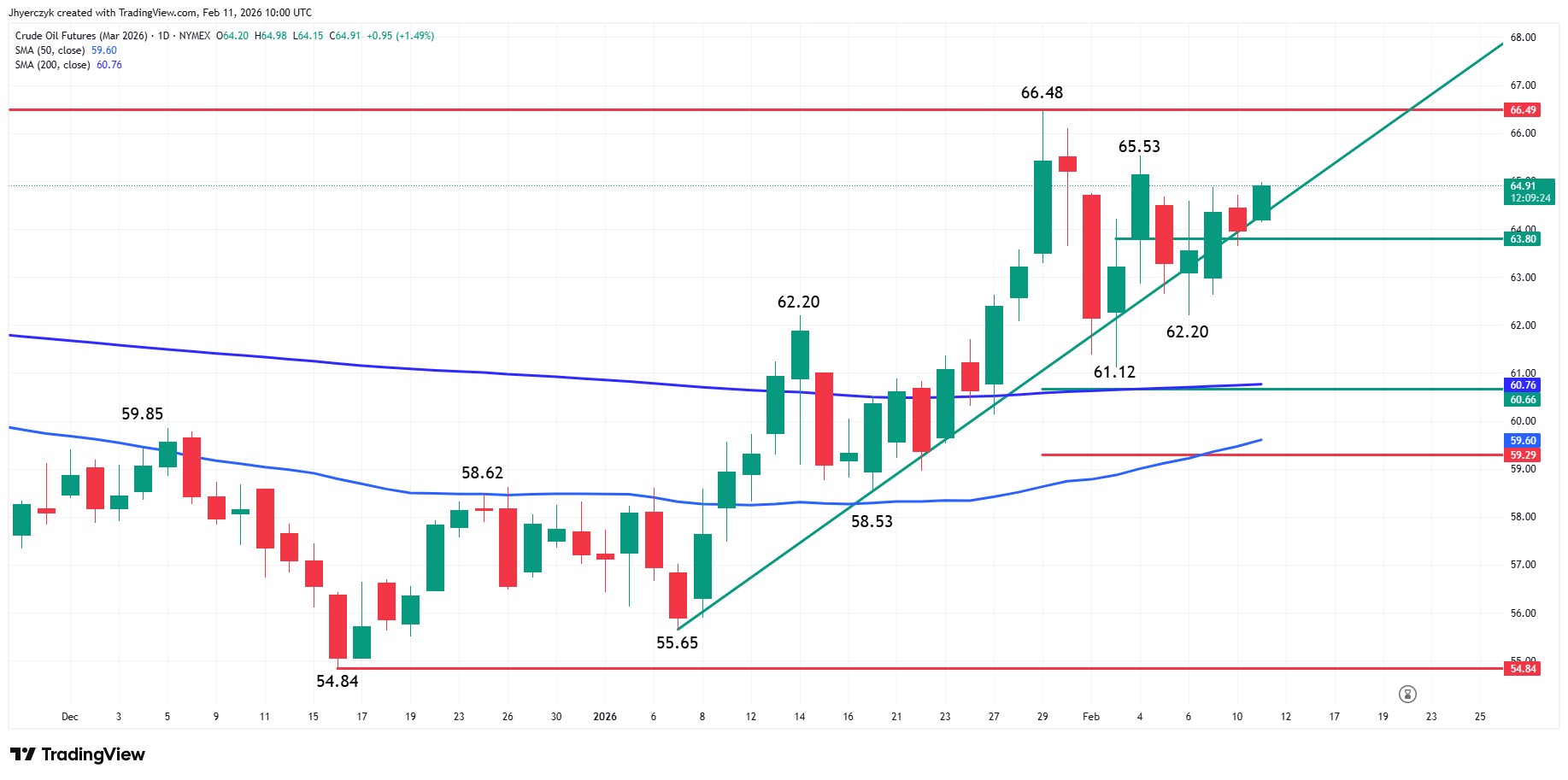
Technically, the main trend is up according to the swing chart, trendline, and moving averages.
A trade through $65.53 should lead to increased momentum, with the main top at $66.48 the next target. Taking out the longer-term top at $66.49 could trigger an acceleration to the upside.
Trend line support moves up to $64.29. The trend and the momentum should remain intact as long as this price holds as support today.
Longer-term and intermediate-term support is being provided by the 200-day moving average at $60.76 and the 50-day moving average at $59.60, respectively.
Breaking the trend line at $64.29 will be the first sign of weakness, with the selling possibly intensifying under a minor pivot at $63.80.
More Information in our Economic Calendar.